Thank you for visiting SNEWPapers!
Sign up free
Editorial
May 28, 1953
Gadsden County Times
Quincy, Gadsden County, Florida
What is this article about?
Editorial by Dr. Orin R. Yost argues that juvenile delinquency requires understanding child personality, family dynamics, and emotional needs rather than just punishment, advocating for mental hygiene research to address root causes and prevent adult crime.
Clipping
OCR Quality
95%
Excellent
Full Text
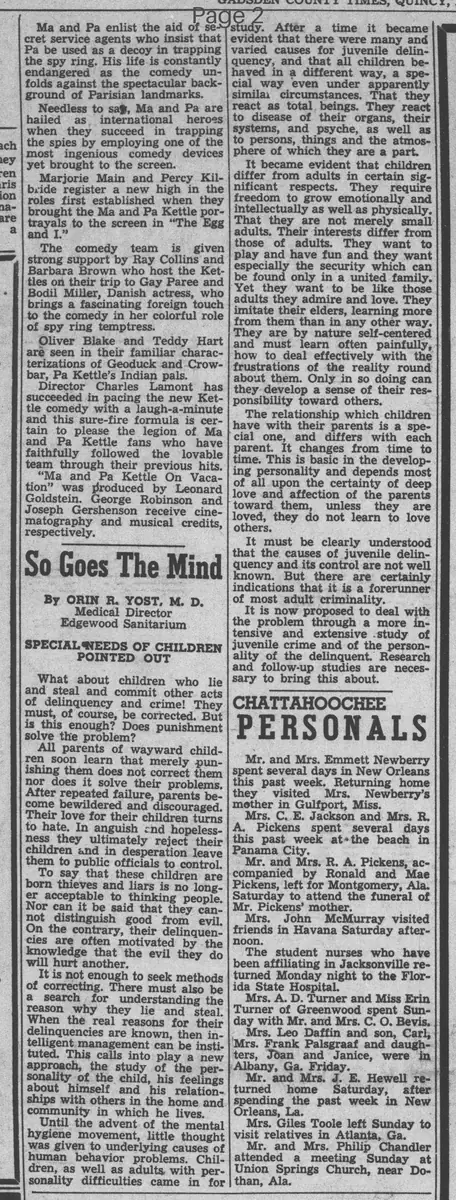
So Goes The Mind
By ORIN R. YOST, M. D.
Medical Director
Edgewood Sanitarium
SPECIAL NEEDS OF CHILDREN POINTED OUT
What about children who lie and steal and commit other acts of delinquency and crime! They must, of course, be corrected. But is this enough? Does punishment solve the problem?
All parents of wayward children soon learn that merely punishing them does not correct them nor does it solve their problems. After repeated failure, parents become bewildered and discouraged. Their love for their children turns to hate. In anguish and hopelessness they ultimately reject their children and in desperation leave them to public officials to control.
To say that these children are born thieves and liars is no longer acceptable to thinking people. Nor can it be said that they cannot distinguish good from evil. On the contrary, their delinquencies are often motivated by the knowledge that the evil they do will hurt another.
It is not enough to seek methods of correcting. There must also be a search for understanding the reason why they lie and steal. When the real reasons for their delinquencies are known, then intelligent management can be instituted. This calls into play a new approach, the study of the personality of the child, his feelings about himself and his relationships with others in the home and community in which he lives.
Until the advent of the mental hygiene movement, little thought was given to underlying causes of human behavior problems. Children, as well as adults with personality difficulties came in for
study. After a time it became evident that there were many and varied causes for juvenile delinquency, and that all children behaved in a different way, a special way even under apparently similar circumstances. That they react as total beings. They react to disease of their organs, their systems, and psyche, as well as to persons, things and the atmosphere of which they are a part.
It became evident that children differ from adults in certain significant respects. They require freedom to grow emotionally and intellectually as well as physically. That they are not merely small adults. Their interests differ from those of adults. They want to play and have fun and they want especially the security which can be found only in a united family.
Yet they want to be like those adults they admire and love. They imitate their elders, learning more from them than in any other way. They are by nature self-centered and must learn often painfully how to deal effectively with the frustrations of the reality round about them. Only in so doing can they develop a sense of their responsibility toward others.
The relationship which children have with their parents is a special one, and differs with each parent. It changes from time to time. This is basic in the developing personality and depends most of all upon the certainty of deep love and affection of the parents toward them, unless they are loved, they do not learn to love others.
It must be clearly understood that the causes of juvenile delinquency and its control are not well known. But there are certainly indications that it is a forerunner of most adult criminality.
It is now proposed to deal with the problem through a more intensive and extensive study of juvenile crime and of the personality of the delinquent. Research and follow-up studies are necessary to bring this about.
By ORIN R. YOST, M. D.
Medical Director
Edgewood Sanitarium
SPECIAL NEEDS OF CHILDREN POINTED OUT
What about children who lie and steal and commit other acts of delinquency and crime! They must, of course, be corrected. But is this enough? Does punishment solve the problem?
All parents of wayward children soon learn that merely punishing them does not correct them nor does it solve their problems. After repeated failure, parents become bewildered and discouraged. Their love for their children turns to hate. In anguish and hopelessness they ultimately reject their children and in desperation leave them to public officials to control.
To say that these children are born thieves and liars is no longer acceptable to thinking people. Nor can it be said that they cannot distinguish good from evil. On the contrary, their delinquencies are often motivated by the knowledge that the evil they do will hurt another.
It is not enough to seek methods of correcting. There must also be a search for understanding the reason why they lie and steal. When the real reasons for their delinquencies are known, then intelligent management can be instituted. This calls into play a new approach, the study of the personality of the child, his feelings about himself and his relationships with others in the home and community in which he lives.
Until the advent of the mental hygiene movement, little thought was given to underlying causes of human behavior problems. Children, as well as adults with personality difficulties came in for
study. After a time it became evident that there were many and varied causes for juvenile delinquency, and that all children behaved in a different way, a special way even under apparently similar circumstances. That they react as total beings. They react to disease of their organs, their systems, and psyche, as well as to persons, things and the atmosphere of which they are a part.
It became evident that children differ from adults in certain significant respects. They require freedom to grow emotionally and intellectually as well as physically. That they are not merely small adults. Their interests differ from those of adults. They want to play and have fun and they want especially the security which can be found only in a united family.
Yet they want to be like those adults they admire and love. They imitate their elders, learning more from them than in any other way. They are by nature self-centered and must learn often painfully how to deal effectively with the frustrations of the reality round about them. Only in so doing can they develop a sense of their responsibility toward others.
The relationship which children have with their parents is a special one, and differs with each parent. It changes from time to time. This is basic in the developing personality and depends most of all upon the certainty of deep love and affection of the parents toward them, unless they are loved, they do not learn to love others.
It must be clearly understood that the causes of juvenile delinquency and its control are not well known. But there are certainly indications that it is a forerunner of most adult criminality.
It is now proposed to deal with the problem through a more intensive and extensive study of juvenile crime and of the personality of the delinquent. Research and follow-up studies are necessary to bring this about.
What sub-type of article is it?
Crime Or Punishment
Social Reform
Moral Or Religious
What keywords are associated?
Juvenile Delinquency
Child Personality
Mental Hygiene
Family Relationships
Parental Love
Delinquent Correction
Personality Study
What entities or persons were involved?
Orin R. Yost
Edgewood Sanitarium
Parents
Children
Editorial Details
Primary Topic
Causes And Management Of Juvenile Delinquency
Stance / Tone
Advocacy For Understanding Child Personality And Family Dynamics Over Punishment
Key Figures
Orin R. Yost
Edgewood Sanitarium
Parents
Children
Key Arguments
Punishment Alone Does Not Correct Delinquent Children
Delinquencies Stem From Personality Issues And Relationships, Not Innate Traits
Mental Hygiene Movement Reveals Varied Causes Of Juvenile Delinquency
Children Need Emotional And Intellectual Freedom, Security In United Family
Children Imitate Admired Adults And Learn Responsibility Through Facing Frustrations
Parental Love Is Essential For Children To Develop Capacity To Love Others
Juvenile Delinquency Often Precedes Adult Criminality
Intensive Study And Research On Delinquent Personalities Are Needed