Thank you for visiting SNEWPapers!
Sign up free
Letter to Editor
July 1, 1796
Gazette Of The United States, & Philadelphia Daily Advertiser
Philadelphia, Philadelphia County, Pennsylvania
What is this article about?
Legal analysis arguing that Pennsylvania's Governor holds pardoning powers comparable to the English king, including remitting fines and releasing recognizances, except those taken on private complaints. Discusses constitutional provisions and legal precedents to clarify executive authority limits.
Clipping
OCR Quality
95%
Excellent
Full Text
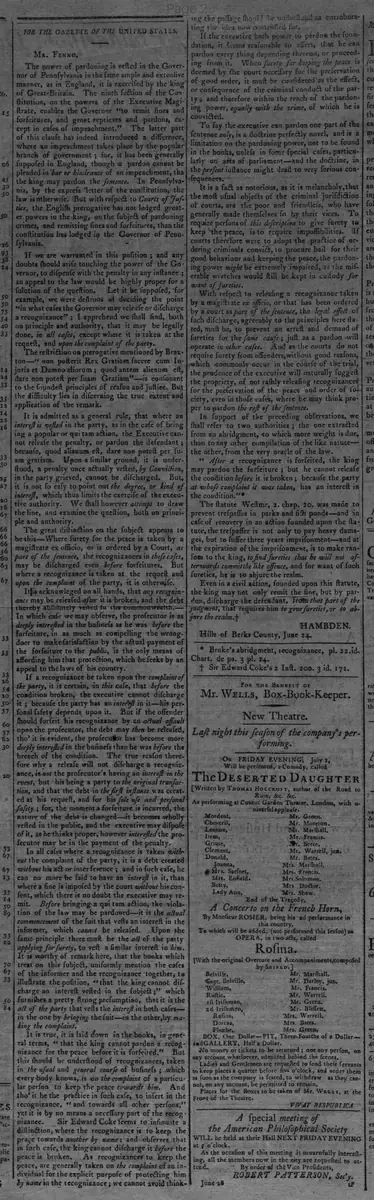
FOR THE GAZETTE OF THE UNITED STATES.
MR. Fenno,
The power of pardoning is vested in the Governor of Pennsylvania in the same ample and extensive manner, as in England, it is exercised by the king of Great-Britain. The ninth section of the Constitution, on the powers of the Executive Magistrate, enables the Governor "to remit fines and forfeitures, and grant reprieves and pardons, except in cases of impeachment." The latter part of this clause has indeed introduced a difference, where an impeachment takes place by the popular branch of government; for, it has been generally supposed in England, though a pardon cannot be pleaded in bar or hindrance of an impeachment, that the king may pardon the sentence. In Pennsylvania, by the express letter of the constitution, the law is otherwise. But with respect to Courts of Justice, the English prerogative has not lodged greater powers in the king, on the subject of pardoning crimes, and remitting fines and forfeitures, than the constitution has lodged in the Governor of Pennsylvania.
If we are warranted in this position; and any doubts should arise touching the power of the Governor, to dispense with the penalty in any instance; an appeal to the law would be highly proper for a solution of the question. Let it be supposed, for example, we were desirous of deciding the point "in what cases the Governor may release or discharge a recognizance"; I apprehend we shall find, both on principle and authority, that it may be legally done, in all cases, except where it is taken at the request, and upon the complaint of the party.
The restriction on prerogative mentioned by Bracton—"non poterit Rex Gratiam facere cum Injuria et Damno aliorum; quod autem alienum et. dare non potest per quam Gratiam"—is consonant to the soundest principles of reason and justice. But the difficulty lies in discerning the true extent and application of the remark.
It is admitted as a general rule, that where an interest is vested in the party, as in the case of bringing a popular or qui tam action, the Executive cannot release the penalty, or pardon the defendant; because, quod alienum et, dare non potest per u-
am gratiam. Upon a similar ground, it is understood, a penalty once actually vested, by Conviction, in the party grieved, cannot be discharged. But, it is not so easy to point out the degree, or kind of interest, which thus limits the exercise o the executive authority. We shall however attempt to draw the line, and examine the question, both on principle and authority.
The great distinction on the subject appears to be this—Where surety for the peace is taken by a magistrate ex officio, or is ordered by a Court, as part of the sentence, the recognizances in these cases, may be discharged even before forfeitures. But where a recognizance is taken at the request and upon the complaint of the party, it is otherwise.
It is acknowledged on all hands, that any recognizance may be released after it is broken, and the debt thereby absolutely vested in the comr
In which case we may observe, the prosecutor is as deeply interested in the business as he was before the forfeiture, in as much as compelling the wrong-
doer to make satisfaction by the actual payment of the forfeiture to the public, is the only means of affording him that protection, which he seeks by an appeal to the laws of his country.
If a recognizance be taken upon the complaint of the party, it is certain, in this case, that before the condition broken, the executive cannot discharge it; because the party has an interest in it his personal safety depends upon it. But if the offender should forfeit his recognizance by an actual assault upon the prosecutor, the debt may then be released. tho' it is evident, the prosecutor has become more deeply interested in the business than he was before the breach of the condition. The true reason therefore why a release will not discharge a recognizance, is not the prosecutor's having an interest in the event, but his being a party to the original transaction, and that the debt in the first instance was created at his request, and for his sole use and personal safety; for, the moment a forfeiture is incurred, the nature of the debt is changed—it becomes wholly vested in the public, and the executive may dispose of it, as he thinks proper, however interested the prosecutor may be in the payment of the penalty.
In all cases where a recognizance is taken without the complaint of the party, it is a debt created without his act or interference; and in such case, he can no more be said to have an interest in it, than where a fine is imposed by the court without his consent, which there is no doubt the executive may remit. Before bringing a qui tam action, the violation of the law may be pardoned—it is the actual commencement of the suit that vests an interest in the informer, which cannot be released. Upon the same principle there must be the act of the party applying for surety, to vest a similar interest in him.
It is worthy of remark here, that the books which treat on this subject, uniformly mention the cases of the informer and the recognizance together, to illustrate the position, "that the king cannot discharge an interest vested in the subject;" which furnishes a pretty strong presumption, that it is the act of the party that vests the interest in both cases— in the one by bringing the suit—in the other, by making the complaint.
It is true, it is laid down in the books, in general terms, " that the king cannot pardon a recognizance for the peace before it is forfeited." But this should be understood of recognizances, taken in the usual and general course of business; which every body knows, is on the complaint of a particular person to keep the peace towards him. And tho' it be the practice in such case, to insert in the recognizance, " and towards all other persons," yet it is by no means a necessary part of the recognizance. Sir Edward Coke seems to insinuate a distinction, where the recognizance is to keep the peace towards another by name: and observes that in such case, the king cannot discharge it before the peace is broken. As recognizances to keep the peace, are generally taken on the complaint of an individual for the explicit purpose of protecting him by name in the recognizance; we cannot avoid thinking the passage should be understood as corroborating the idea now contended for.
If the executive hath power to pardon the foundation, it seems reasonable to assert, that he can pardon every thing depending thereon, or proceeding from it. When surety for keeping the peace is deemed by the court necessary for the preservation of good order, it must be considered as the effect, or consequence of the criminal conduct of the party; and therefore within the reach of the pardoning power, equally with the crime, of which he is convicted.
To say the executive can pardon one part of the sentence only, is a doctrine perfectly novel, and is a limitation on the pardoning power, not to be found in the books, unless in some special cases, particularly on acts of parliament—and the doctrine, in the present instance might lead to very serious consequences.
It is a fact as notorious, as it is melancholy, that the most usual objects of the criminal jurisdiction of courts, are those poor and friendless, who have generally made themselves so by their vices. To require persons of this description to give surety to keep the peace, is to require impossibilities. If courts therefore were to adopt the practice of ordering criminals convict, to procure bail for their good behaviour and keeping the peace, the pardoning power might be extremely impaired, as the miserable wretches would still be kept in custody for want of sureties.
With respect to releasing a recognizance taken by a magistrate ex officio, or that has been ordered by a court as part of the sentence, the legal effect of such discharge, agreeably to the principles here stated, must be, to prevent an arrest and demand of suretys for the same cause; just as a pardon -will operate in other cases. And as the courts do not require surety from offenders, without good reasons, which commonly occur in the course of the trial, the prudence of the executive will naturally suggest the propriety, of not rashly releasing recognizances for the preservation of the peace and order of society, even in those cases, where he may think proper to pardon the rest of the sentence.
In support of the preceding observations, we shall refer to two authorities: the one extracted from an abridgment, to which more weight is due. than to any other compilation of the like nature- the other, from the very oracle of the law.
" After a recognizance is forfeited, the king may pardon the forfeiture; but he cannot release the condition before it is broken; because the party at whose complaint it was taken, has an interest in the condition."*
The statute Westm. 2. chap. 20. was made to prevent trespass in parks and fish ponds—and in case of recovery in an action founded upon the statute, the trespasser is not only to pay heavy damages, but to suffer three years imprisonment—and at the expiration of the imprisonment, is to make ransom to the king, to find sureties that he will not afterwards commit the like offence, and for want of such suretys, he is to abjure the realm.
Even in a civil action, founded upon this statute, the king may not only remit the fine, but by pardon, discharge the defendant, from that part of the judgment, that requires him to give sureties, or to abjure the realm.
HAMBDEN.
Hills of Berks County, June 24.
Brooke's abridgment, recognizance, pl. 22. id.
Chatt. de pa. 3 pl. 24.
Sir Edward Coke's 2 Inst. 200. 3 id. 171.
MR. Fenno,
The power of pardoning is vested in the Governor of Pennsylvania in the same ample and extensive manner, as in England, it is exercised by the king of Great-Britain. The ninth section of the Constitution, on the powers of the Executive Magistrate, enables the Governor "to remit fines and forfeitures, and grant reprieves and pardons, except in cases of impeachment." The latter part of this clause has indeed introduced a difference, where an impeachment takes place by the popular branch of government; for, it has been generally supposed in England, though a pardon cannot be pleaded in bar or hindrance of an impeachment, that the king may pardon the sentence. In Pennsylvania, by the express letter of the constitution, the law is otherwise. But with respect to Courts of Justice, the English prerogative has not lodged greater powers in the king, on the subject of pardoning crimes, and remitting fines and forfeitures, than the constitution has lodged in the Governor of Pennsylvania.
If we are warranted in this position; and any doubts should arise touching the power of the Governor, to dispense with the penalty in any instance; an appeal to the law would be highly proper for a solution of the question. Let it be supposed, for example, we were desirous of deciding the point "in what cases the Governor may release or discharge a recognizance"; I apprehend we shall find, both on principle and authority, that it may be legally done, in all cases, except where it is taken at the request, and upon the complaint of the party.
The restriction on prerogative mentioned by Bracton—"non poterit Rex Gratiam facere cum Injuria et Damno aliorum; quod autem alienum et. dare non potest per quam Gratiam"—is consonant to the soundest principles of reason and justice. But the difficulty lies in discerning the true extent and application of the remark.
It is admitted as a general rule, that where an interest is vested in the party, as in the case of bringing a popular or qui tam action, the Executive cannot release the penalty, or pardon the defendant; because, quod alienum et, dare non potest per u-
am gratiam. Upon a similar ground, it is understood, a penalty once actually vested, by Conviction, in the party grieved, cannot be discharged. But, it is not so easy to point out the degree, or kind of interest, which thus limits the exercise o the executive authority. We shall however attempt to draw the line, and examine the question, both on principle and authority.
The great distinction on the subject appears to be this—Where surety for the peace is taken by a magistrate ex officio, or is ordered by a Court, as part of the sentence, the recognizances in these cases, may be discharged even before forfeitures. But where a recognizance is taken at the request and upon the complaint of the party, it is otherwise.
It is acknowledged on all hands, that any recognizance may be released after it is broken, and the debt thereby absolutely vested in the comr
In which case we may observe, the prosecutor is as deeply interested in the business as he was before the forfeiture, in as much as compelling the wrong-
doer to make satisfaction by the actual payment of the forfeiture to the public, is the only means of affording him that protection, which he seeks by an appeal to the laws of his country.
If a recognizance be taken upon the complaint of the party, it is certain, in this case, that before the condition broken, the executive cannot discharge it; because the party has an interest in it his personal safety depends upon it. But if the offender should forfeit his recognizance by an actual assault upon the prosecutor, the debt may then be released. tho' it is evident, the prosecutor has become more deeply interested in the business than he was before the breach of the condition. The true reason therefore why a release will not discharge a recognizance, is not the prosecutor's having an interest in the event, but his being a party to the original transaction, and that the debt in the first instance was created at his request, and for his sole use and personal safety; for, the moment a forfeiture is incurred, the nature of the debt is changed—it becomes wholly vested in the public, and the executive may dispose of it, as he thinks proper, however interested the prosecutor may be in the payment of the penalty.
In all cases where a recognizance is taken without the complaint of the party, it is a debt created without his act or interference; and in such case, he can no more be said to have an interest in it, than where a fine is imposed by the court without his consent, which there is no doubt the executive may remit. Before bringing a qui tam action, the violation of the law may be pardoned—it is the actual commencement of the suit that vests an interest in the informer, which cannot be released. Upon the same principle there must be the act of the party applying for surety, to vest a similar interest in him.
It is worthy of remark here, that the books which treat on this subject, uniformly mention the cases of the informer and the recognizance together, to illustrate the position, "that the king cannot discharge an interest vested in the subject;" which furnishes a pretty strong presumption, that it is the act of the party that vests the interest in both cases— in the one by bringing the suit—in the other, by making the complaint.
It is true, it is laid down in the books, in general terms, " that the king cannot pardon a recognizance for the peace before it is forfeited." But this should be understood of recognizances, taken in the usual and general course of business; which every body knows, is on the complaint of a particular person to keep the peace towards him. And tho' it be the practice in such case, to insert in the recognizance, " and towards all other persons," yet it is by no means a necessary part of the recognizance. Sir Edward Coke seems to insinuate a distinction, where the recognizance is to keep the peace towards another by name: and observes that in such case, the king cannot discharge it before the peace is broken. As recognizances to keep the peace, are generally taken on the complaint of an individual for the explicit purpose of protecting him by name in the recognizance; we cannot avoid thinking the passage should be understood as corroborating the idea now contended for.
If the executive hath power to pardon the foundation, it seems reasonable to assert, that he can pardon every thing depending thereon, or proceeding from it. When surety for keeping the peace is deemed by the court necessary for the preservation of good order, it must be considered as the effect, or consequence of the criminal conduct of the party; and therefore within the reach of the pardoning power, equally with the crime, of which he is convicted.
To say the executive can pardon one part of the sentence only, is a doctrine perfectly novel, and is a limitation on the pardoning power, not to be found in the books, unless in some special cases, particularly on acts of parliament—and the doctrine, in the present instance might lead to very serious consequences.
It is a fact as notorious, as it is melancholy, that the most usual objects of the criminal jurisdiction of courts, are those poor and friendless, who have generally made themselves so by their vices. To require persons of this description to give surety to keep the peace, is to require impossibilities. If courts therefore were to adopt the practice of ordering criminals convict, to procure bail for their good behaviour and keeping the peace, the pardoning power might be extremely impaired, as the miserable wretches would still be kept in custody for want of sureties.
With respect to releasing a recognizance taken by a magistrate ex officio, or that has been ordered by a court as part of the sentence, the legal effect of such discharge, agreeably to the principles here stated, must be, to prevent an arrest and demand of suretys for the same cause; just as a pardon -will operate in other cases. And as the courts do not require surety from offenders, without good reasons, which commonly occur in the course of the trial, the prudence of the executive will naturally suggest the propriety, of not rashly releasing recognizances for the preservation of the peace and order of society, even in those cases, where he may think proper to pardon the rest of the sentence.
In support of the preceding observations, we shall refer to two authorities: the one extracted from an abridgment, to which more weight is due. than to any other compilation of the like nature- the other, from the very oracle of the law.
" After a recognizance is forfeited, the king may pardon the forfeiture; but he cannot release the condition before it is broken; because the party at whose complaint it was taken, has an interest in the condition."*
The statute Westm. 2. chap. 20. was made to prevent trespass in parks and fish ponds—and in case of recovery in an action founded upon the statute, the trespasser is not only to pay heavy damages, but to suffer three years imprisonment—and at the expiration of the imprisonment, is to make ransom to the king, to find sureties that he will not afterwards commit the like offence, and for want of such suretys, he is to abjure the realm.
Even in a civil action, founded upon this statute, the king may not only remit the fine, but by pardon, discharge the defendant, from that part of the judgment, that requires him to give sureties, or to abjure the realm.
HAMBDEN.
Hills of Berks County, June 24.
Brooke's abridgment, recognizance, pl. 22. id.
Chatt. de pa. 3 pl. 24.
Sir Edward Coke's 2 Inst. 200. 3 id. 171.
What sub-type of article is it?
Informative
Persuasive
Philosophical
What themes does it cover?
Constitutional Rights
Crime Punishment
Politics
What keywords are associated?
Pardoning Power
Governor Pennsylvania
Recognizance Release
Executive Authority
Constitutional Law
Legal Precedents
Surety Peace
What entities or persons were involved?
Hambden
Mr. Fenno
Letter to Editor Details
Author
Hambden
Recipient
Mr. Fenno
Main Argument
the governor of pennsylvania possesses pardoning powers as extensive as the english king's, allowing release of recognizances in most cases except those taken at a private party's request, based on constitutional provisions and legal principles.
Notable Details
References Pennsylvania Constitution Ninth Section
Cites Bracton On Royal Prerogative Restrictions
Discusses Qui Tam Actions And Vested Interests
Quotes Sir Edward Coke And Brooke's Abridgment
Analyzes Statute Of Westminster Ii, Chap. 20