Thank you for visiting SNEWPapers!
Sign up free
Alexandria Daily Advertiser
Alexandria, Virginia
What is this article about?
In New York, a district court struggles to arraign Colonel Smith on a grand jury indictment due to custody disputes between the sheriff and marshal, involving irregular use of a habeas corpus writ and eventual escape by the sheriff with the prisoner.
Clipping
OCR Quality
Full Text
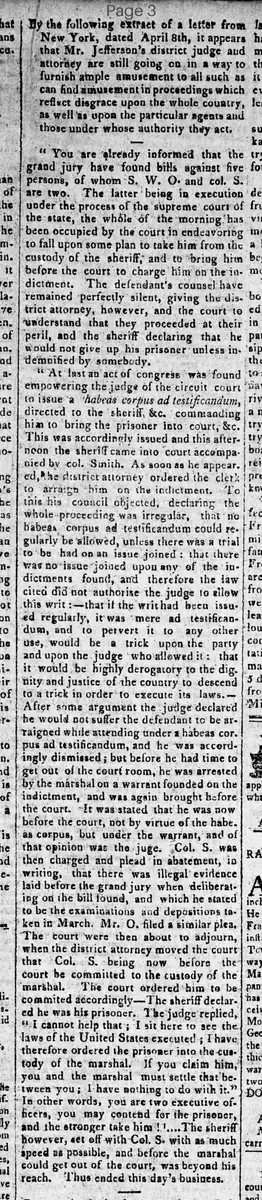
"You are already informed that the grand jury have found bills against five persons, of whom S. W. O. and col. S. are two. The latter being in execution under the process of the supreme court of the state, the whole of the morning has been occupied by the court in endeavoring to fall upon some plan to take him from the custody of the sheriff, and to bring him before the court to charge him on the indictment. The defendant's counsel have remained perfectly silent, giving the district attorney, however, and the court to understand that they proceeded at their peril, and the sheriff declaring that he would not give up his prisoner unless indemnified by somebody.
At last an act of congress was found empowering the judge of the circuit court to issue a habeas corpus ad testificandum directed to the sheriff, &c. commanding him to bring the prisoner into court, &c. This was accordingly issued and this afternoon the sheriff came into court accompanied by col. Smith. As soon as he appeared, the district attorney ordered the clerk to arraign him on the indictment. To this his counsel objected, declaring the whole proceeding was irregular, that no habeas corpus ad testificandum could regularly be allowed, unless there was a trial to be had on an issue joined: that there was no issue joined upon any of the indictments found, and therefore the law cited did not authorize the judge to allow this writ: that if the writ had been issued regularly, it was merely ad testificandum, and to pervert it to any other use, would be a trick upon the party and upon the judge who allowed it: that it would be highly derogatory to the dignity and justice of the country to descend to a trick in order to execute its laws.
After some argument the judge declared he would not suffer the defendant to be arraigned while attending under a habeas corpus ad testificandum, and he was accordingly dismissed; but before he had time to get out of the court room, he was arrested by the marshal on a warrant founded on the indictment, and was again brought before the court. It was stated that he was now before the court, not by virtue of the habeas corpus, but under the warrant, and of that opinion was the judge. Col. S. was then charged and plead in abatement, in writing, that there was illegal evidence laid before the grand jury when deliberating on the bill found, and which he stated to be the examinations and depositions taken in March. Mr. O. filed a similar plea. The court were then about to adjourn, when the district attorney moved the court that Col. S. being now before the court be committed to the custody of the marshal. The court ordered him to be committed accordingly--The sheriff declared he was his prisoner. The judge replied, "I cannot help that; I sit here to see the laws of the United States executed; I have therefore ordered the prisoner into the custody of the marshal. If you claim him, you and the marshal must settle that between you; I have nothing to do with it."
In other words, you are two executive officers, you may contend for the prisoner, and the stronger take him! The sheriff however, set off with Col. S. with as much speed as possible, and before the marshal could get out of the court, was beyond his reach. Thus ended this day's business."
What sub-type of article is it?
What keywords are associated?
What entities or persons were involved?
Where did it happen?
Domestic News Details
Primary Location
New York
Event Date
April 8th
Key Persons
Outcome
the court orders colonel smith committed to the marshal's custody, but the sheriff flees with him before the marshal can take possession.
Event Details
Grand jury indicts five persons including S. W. O. and Colonel Smith. Court attempts to bring Colonel Smith from state custody using habeas corpus ad testificandum, but after objections and dismissal, rearrests him on warrant. He pleads in abatement citing illegal evidence. Custody dispute arises between sheriff and marshal; sheriff escapes with prisoner.