Thank you for visiting SNEWPapers!
Sign up free
Story
May 31, 1822
The Rhode Island American, And General Advertiser
Providence, Providence County, Rhode Island
What is this article about?
Account of a private letter by Mr. Russell on Ghent Treaty disagreements surfacing in 1822 amid political attacks on Mr. Adams, leading to congressional demands and its publication with responses. (178 chars)
Clipping
OCR Quality
95%
Excellent
Full Text
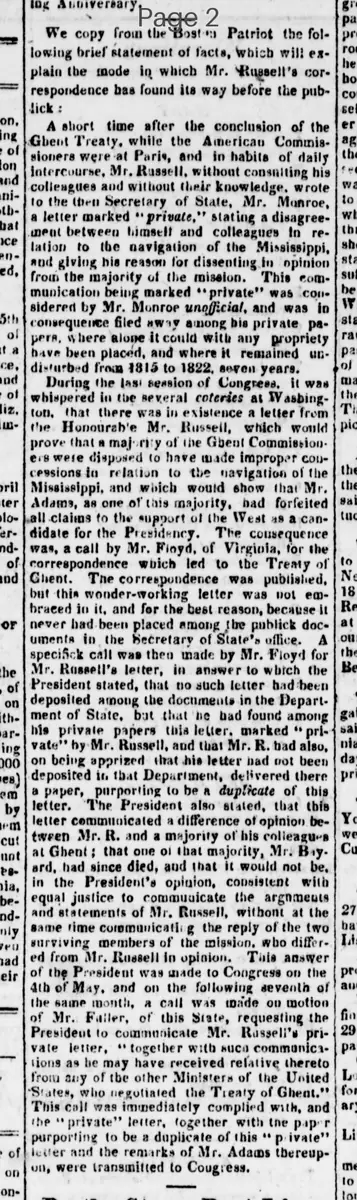
We copy from the Boston Patriot the following brief statement of facts, which will explain the mode in which Mr. Russell's correspondence has found its way before the publick:
A short time after the conclusion of the Ghent Treaty, while the American Commissioners were at Paris, and in habits of daily intercourse, Mr. Russell, without consulting his colleagues and without their knowledge, wrote to the then Secretary of State, Mr. Monroe, a letter marked "private," stating a disagreement between himself and colleagues in relation to the navigation of the Mississippi, and giving his reason for dissenting in opinion from the majority of the mission. This communication being marked "private" was considered by Mr. Monroe unofficial, and was in consequence filed away among his private papers, where alone it could with any propriety have been placed, and where it remained undisturbed from 1815 to 1822, seven years.
During the last session of Congress, it was whispered in the several coteries at Washington, that there was in existence a letter from the Honourable Mr. Russell, which would prove that a majority of the Ghent Commissioners were disposed to have made improper concessions in relation to the navigation of the Mississippi, and which would show that Mr. Adams, as one of this majority, had forfeited all claims to the support of the West as a candidate for the Presidency. The consequence was, a call by Mr. Floyd, of Virginia, for the correspondence which led to the Treaty of Ghent. The correspondence was published, but this wonder-working letter was not embraced in it, and for the best reason, because it never had been placed among the publick documents in the Secretary of State's office. A specific call was then made by Mr. Floyd for Mr. Russell's letter, in answer to which the President stated, that no such letter had been deposited among the documents in the Department of State, but that he had found among his private papers this letter, marked "private" by Mr. Russell, and that Mr. R. had also, on being apprised that his letter had not been deposited in that Department, delivered there a paper, purporting to be a duplicate of this letter. The President also stated, that this letter communicated a difference of opinion between Mr. R. and a majority of his colleagues at Ghent; that one of that majority, Mr. Bayard, had since died, and that it would not be, in the President's opinion, consistent with equal justice to communicate the arguments and statements of Mr. Russell, without at the same time communicating the reply of the two surviving members of the mission, who differed from Mr. Russell in opinion. This answer of the President was made to Congress on the 4th of May, and on the following 7th of the same month, a call was made on motion of Mr. Fuller, of this State, requesting the President to communicate Mr. Russell's private letter, "together with such communications as he may have received relative thereto from any of the other Ministers of the United States, who negotiated the Treaty of Ghent." This call was immediately complied with, and the "private" letter, together with the paper purporting to be a duplicate of this "private" letter and the remarks of Mr. Adams thereupon, were transmitted to Congress.
A short time after the conclusion of the Ghent Treaty, while the American Commissioners were at Paris, and in habits of daily intercourse, Mr. Russell, without consulting his colleagues and without their knowledge, wrote to the then Secretary of State, Mr. Monroe, a letter marked "private," stating a disagreement between himself and colleagues in relation to the navigation of the Mississippi, and giving his reason for dissenting in opinion from the majority of the mission. This communication being marked "private" was considered by Mr. Monroe unofficial, and was in consequence filed away among his private papers, where alone it could with any propriety have been placed, and where it remained undisturbed from 1815 to 1822, seven years.
During the last session of Congress, it was whispered in the several coteries at Washington, that there was in existence a letter from the Honourable Mr. Russell, which would prove that a majority of the Ghent Commissioners were disposed to have made improper concessions in relation to the navigation of the Mississippi, and which would show that Mr. Adams, as one of this majority, had forfeited all claims to the support of the West as a candidate for the Presidency. The consequence was, a call by Mr. Floyd, of Virginia, for the correspondence which led to the Treaty of Ghent. The correspondence was published, but this wonder-working letter was not embraced in it, and for the best reason, because it never had been placed among the publick documents in the Secretary of State's office. A specific call was then made by Mr. Floyd for Mr. Russell's letter, in answer to which the President stated, that no such letter had been deposited among the documents in the Department of State, but that he had found among his private papers this letter, marked "private" by Mr. Russell, and that Mr. R. had also, on being apprised that his letter had not been deposited in that Department, delivered there a paper, purporting to be a duplicate of this letter. The President also stated, that this letter communicated a difference of opinion between Mr. R. and a majority of his colleagues at Ghent; that one of that majority, Mr. Bayard, had since died, and that it would not be, in the President's opinion, consistent with equal justice to communicate the arguments and statements of Mr. Russell, without at the same time communicating the reply of the two surviving members of the mission, who differed from Mr. Russell in opinion. This answer of the President was made to Congress on the 4th of May, and on the following 7th of the same month, a call was made on motion of Mr. Fuller, of this State, requesting the President to communicate Mr. Russell's private letter, "together with such communications as he may have received relative thereto from any of the other Ministers of the United States, who negotiated the Treaty of Ghent." This call was immediately complied with, and the "private" letter, together with the paper purporting to be a duplicate of this "private" letter and the remarks of Mr. Adams thereupon, were transmitted to Congress.
What sub-type of article is it?
Historical Event
What themes does it cover?
Justice
What keywords are associated?
Ghent Treaty
Private Letter
Mississippi Navigation
Congressional Call
Political Disagreement
What entities or persons were involved?
Mr. Russell
Mr. Monroe
Mr. Adams
Mr. Bayard
Mr. Floyd
Mr. Fuller
Where did it happen?
Washington
Story Details
Key Persons
Mr. Russell
Mr. Monroe
Mr. Adams
Mr. Bayard
Mr. Floyd
Mr. Fuller
Location
Washington
Event Date
1815 To 1822
Story Details
Mr. Russell wrote a private letter to Mr. Monroe dissenting from colleagues on Mississippi navigation in the Ghent Treaty, filed privately until 1822. Political whispers led to congressional calls by Mr. Floyd and Mr. Fuller, resulting in its publication along with a duplicate and Mr. Adams' remarks.