Thank you for visiting SNEWPapers!
Sign up free
Letter to Editor
January 9, 1809
Norfolk Gazette And Publick Ledger
Norfolk, Virginia
What is this article about?
A critical commentary on the U.S. Embargo Act, accusing Jefferson, Giles, and Campbell of enacting it as submission to Napoleon's France rather than opposition to Britain, highlighting Napoleon's praise and implications for U.S. policy.
Clipping
OCR Quality
98%
Excellent
Full Text
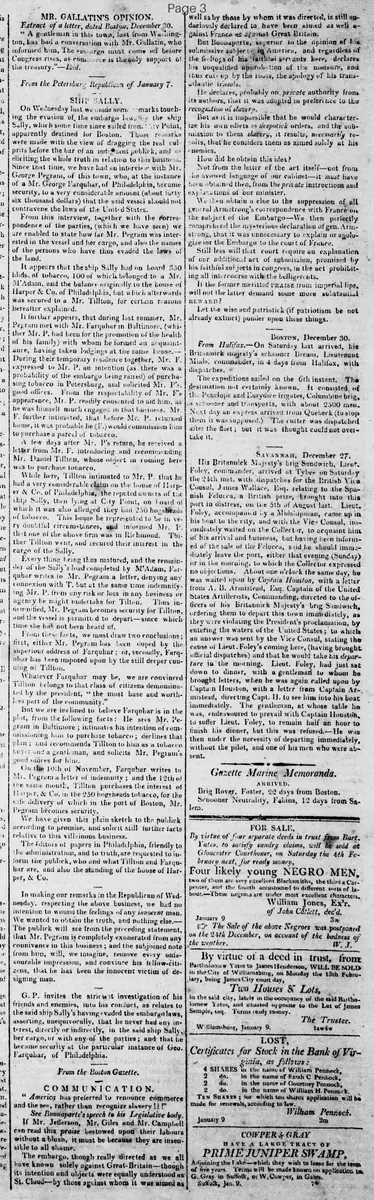
From the Boston Gazette.
COMMUNICATION.
"America has preferred to renounce commerce and the sea, rather than recognize slavery!!!"
See Buonaparte's speech to his Legislative body.
If Mr. Jefferson, Mr. Giles and Mr. Campbell can read this praise bestowed upon their labours without a blush, it must be because they are insensible to all shame.
The embargo, though really directed as we all have known solely against Great-Britain--though its intention and objects were equally understood as at St. Cloud--by those against whom it was aimed as well as by those by whom it was directed, is still audaciously declared to, have been aimed as well against France as against Great Britain.
But Buonaparte, superior to the opinion of his submissive subjects in America, and regardless of the echoings of his faithful servants here, declares his unqualified approbation of the measure, and thus cuts off by the roots, the apology of his transatlantic friends.
He declares, probably on private authority from its authors, that it was adopted in preference to the recognition of slavery.
But as it is impossible that he would characterize his own edicts as despotick orders, and the submission to them slavery, it results, necessarily, that he considers them as aimed solely at his enemies.
How did he obtain this idea?
Not from the letter of the act itself--not from the avowed language of our cabinet--it must have been obtained then, from the private instructions and explanations of our minister.
We then obtain a clue to the suppression of all general Armstrong's correspondence with France on the subject of the Embargo--We then perfectly comprehend the mysterious declaration of gen. Armstrong, that it was unnecessary to explain or apologize for the Embargo to the court of France.
Still less will that court require an explanation of our additional act of submission, promised by his faithful subjects in congress, in the act prohibiting all intercourse with the belligerents.
If the former meritted praise from imperial lips, will not the latter demand some more substantial REWARD?
Let the wise and patriotick (if patriotism be not already extinct) ponder upon these things.
COMMUNICATION.
"America has preferred to renounce commerce and the sea, rather than recognize slavery!!!"
See Buonaparte's speech to his Legislative body.
If Mr. Jefferson, Mr. Giles and Mr. Campbell can read this praise bestowed upon their labours without a blush, it must be because they are insensible to all shame.
The embargo, though really directed as we all have known solely against Great-Britain--though its intention and objects were equally understood as at St. Cloud--by those against whom it was aimed as well as by those by whom it was directed, is still audaciously declared to, have been aimed as well against France as against Great Britain.
But Buonaparte, superior to the opinion of his submissive subjects in America, and regardless of the echoings of his faithful servants here, declares his unqualified approbation of the measure, and thus cuts off by the roots, the apology of his transatlantic friends.
He declares, probably on private authority from its authors, that it was adopted in preference to the recognition of slavery.
But as it is impossible that he would characterize his own edicts as despotick orders, and the submission to them slavery, it results, necessarily, that he considers them as aimed solely at his enemies.
How did he obtain this idea?
Not from the letter of the act itself--not from the avowed language of our cabinet--it must have been obtained then, from the private instructions and explanations of our minister.
We then obtain a clue to the suppression of all general Armstrong's correspondence with France on the subject of the Embargo--We then perfectly comprehend the mysterious declaration of gen. Armstrong, that it was unnecessary to explain or apologize for the Embargo to the court of France.
Still less will that court require an explanation of our additional act of submission, promised by his faithful subjects in congress, in the act prohibiting all intercourse with the belligerents.
If the former meritted praise from imperial lips, will not the latter demand some more substantial REWARD?
Let the wise and patriotick (if patriotism be not already extinct) ponder upon these things.
What sub-type of article is it?
Political
Persuasive
Provocative
What themes does it cover?
Politics
Economic Policy
What keywords are associated?
Embargo Act
Buonaparte
Jefferson
Great Britain
France
Armstrong
Napoleon Praise
Letter to Editor Details
Main Argument
the u.s. embargo act was truly aimed only at great britain but is falsely claimed to target france as well; napoleon's praise reveals it as submission to french interests, not equal opposition, based on private communications from u.s. officials.
Notable Details
Buonaparte's Speech Praising The Embargo
Reference To Jefferson, Giles, And Campbell
Suppression Of Armstrong's Correspondence With France
Criticism Of Additional Act Prohibiting Intercourse With Belligerents