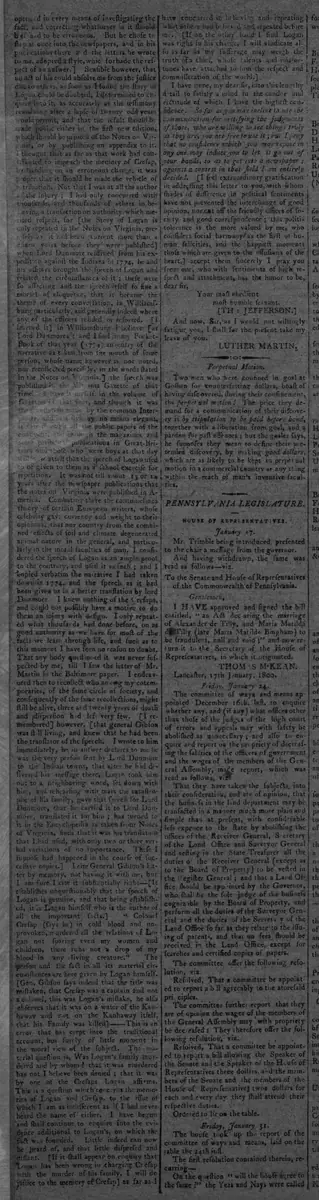
Opposed in every means of investigating the fact, and correcting whatsoever in it should be found to be erroneous. But he chose to step at once into the newspapers, and in his publications there and the letters he wrote to me, adopted a style, which forbade the prospect of an answer. Sensible however, that no act of his could absolve me from the justice due to others, as soon as I found the story of Logan could be doubted, I determined to enquire into it, as accurately as the testimony remaining after a lapse of twenty odd years would permit, and that the result should be made public either in the first new edition, which should be printed of the Notes on Virginia, or by publishing an appendix to it. I thought that as far as that work had contributed to impeach the memory of Creap, by handing on an erroneous charge, it was proper that it should be made the vehicle of retribution. Not that I was at all the author of the injury; I had only concurred with thousands, and thousands of others in believing a transaction on authority which merited respect, for the Story of Logan is only repeated in the Notes on Virginia, precisely as it had been current more than a dozen years before they were published when Lord Dunmore returned from his expedition against the Indians in 1774, he and his officers brought the speech of Logan and related the circumstances of it; these were so affecting and the speech itself so fine a model of eloquence, that it became the theme of every conversation, in Williamsburg particularly, and generally indeed where any of the officers resided or resorted. I learned it in Williamsburg I believe from Lord Dunmore's; and I find in my Pocket-Book of that year (1774) an entry of the narrative as taken from the mouth of one person, whose name however is not noted, nor recollected precisely, in the words stated in the Notes on Virginia. The speech was published in the Virginia Gazette of that time. I have it still in my possession in the volume of Gazettes of that year, and though it was the translation made by the common Interpreter, and as I suppose by no means elegant, it found its way into all the public papers of the continent, through the magazines and other periodical publications in Great-Britain, and those who were boys at that day will attest that the speech of Logan used to be given to them as a school exercise for repetition. It was not till about 13 or 14 years after the newspaper publications that the notes on Virginia were published in America. Combating there the contumelious theory of certain European writers, whose celebrity gave currency and weight to their opinions, that our country from the combined effects of soil and climate degenerated animal nature in the general, and particularly in the moral faculties of man. I considered the speech of Logan as an ample proof to the contrary, and used it as such: and I copied verbatim the narrative I had taken down in 1774, and the speech as it had been given us in a better translation by Lord Dunmore. I knew nothing of the Creaps. and could not possibly have a motive to do them an injury with design. I only repeated what thousands had done before, on as good authority as we have for most of the facts we learn through life, and such as to this moment I have seen no reason to doubt. That any body questioned it was never suspected by me, till I saw the letter of Mr. Martin in the Baltimore paper. I endeavored then to recollect who among my contemporaries, of the same circle of society, and consequently of the same recollections, might still be alive, three and twenty years of death and dispersion had left very few. I remembered, however, that general Gibson was still living, and knew that he had been the translator of the speech. I wrote to him immediately, he in answer declares to me he was the very person sent by Lord Dunmore to the Indian towns, that after he had delivered his message there, Logan took him out to a neighboring wood, sat down with him, and rehearsing with tears the catastrophe of his family, gave that speech for Lord Dunmore, that he carried it to Lord Dunmore, translated it for him; has turned to it in the Encyclopedia as taken from Notes of Virginia, finds that it was his translation that I had used, with only two or three verbal variations of no importance. These I suppose had happened in the course of successive copies.] I cite General Gibson's letter by memory, not having it with me, but I am sure I cite it substantially right-[It establishes unquestionably that the speech of Logan is genuine, and that being established, it is Logan himself who is the author of all the important facts.) Colonel Creap (says he) in cold blood and unprovoked, murdered all the relations of Logan not sparing even my women and children, there runs not a drop of my blood in any living creature." The person and the fact in all its material circumstances are here given by Logan himself. [Gen. Gibson says indeed that the title was mistaken, that Creap was a captain and not a colonel, this was Logan's mistake, he also observes that it was on a water of the Kanawha and not on the Kanawha itself, that his Family was killed] This is an error that has crept into the traditional account, but surely of little moment in the moral view of the subject. The material question is, Was Logan's family murdered and by whom? that it was murdered has not I believe been denied; that it was by one of the Creaps Logan affirms. This is a question which concerns the memories of Logan and Creap, to the issue of which I am as indifferent as if I had never heard the name of either. I have begun and shall continue to enquire into the evidence additional to Logan's, on which the fact was founded. Little indeed can now be heard of, and that little dispersed and distant. [If it shall appear on enquiry that Logan has been wrong in charging Creap with the murder of his family, I will do justice to the memory of Creap] as far as I have concurred in believing and repeating what others had believed and repeated before me., [If on the other hand I find Logan was right in his charge, I will vindicate also as far as my suffrage may weigh the truth of a chief, whose talents and misfortunes have attached to him the respect and commiseration of the world.]. I have gone, my dear sir, into this lengthy detail to satisfy a mind in the candor and rectitude of which I have the highest confidence. So far facts you may incline to use the communication for rectifying the judgments of those, who are willing to see things truly as they are, you are free to use it; but I pray that no confidence which you may repose in any one may induce you to let it go out of your hands, so as to get into a newspaper; against a contest in that field I am entirely decided. [I feel extraordinary gratification in addressing this letter to you, with whom shades of difference in political sentiments have not prevented the interchange of good opinion, nor cut off the friendly offices of society and good correspondence; this political tolerance is the more valued by me, who considers social harmony as the first of human felicity, and the happiest moments those which are given to the enjoinments of the heart,] accept them sincerely I pray you from one, who with sentiments of high respect and attachment, has the honor to be, dear sir, Your most obedient and most humble servant, [TH: JEFFERSON.] And now, Sir, as I would not willingly fatigue you, I shall for the present take my leave of you. LUTHER MARTIN.