Thank you for visiting SNEWPapers!
Sign up free
Alexandria Gazette
Alexandria, Alexandria County, District Of Columbia
What is this article about?
In the U.S. House, Rep. Thomasson of Kentucky introduces a bill granting public lands to fund a 4,000-mile railroad from Washington, D.C., through southern states to Oregon, to enhance mail, trade, settlement, and defense against Russia. Estimated cost: $171M, with land valued at $108M.
Clipping
OCR Quality
Full Text
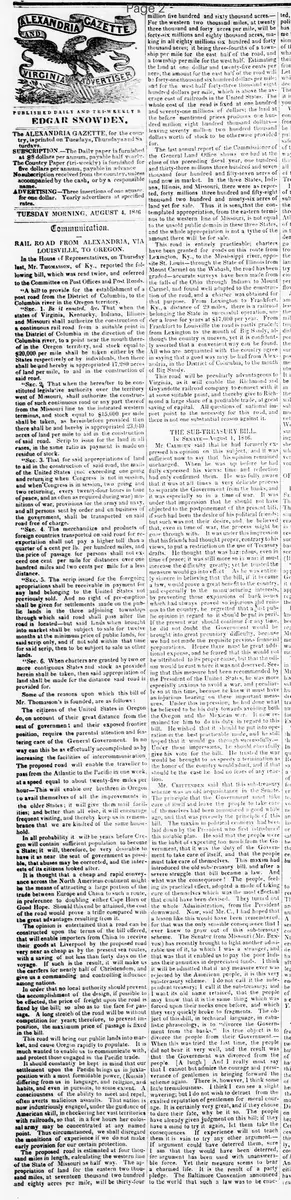
In the House of Representatives, on Thursday last, Mr. Thomasson, of Ky., reported the following bill, which was read twice, and referred to the Committee on Post Offices and Post Roads.
“A bill to provide for the establishment of a post road from the District of Columbia, to the Columbia river in the Oregon territory.
“Sec. 1. Be it enacted, &c. That when the States of Virginia, Kentucky, Indiana, Illinois and Missouri shall authorize the construction of a continuous rail road from a suitable point in the District of Columbia in the direction of the Columbia River, to a point near the mouth thereof in the Oregon territory, and stock equal to $20,000 per mile shall be taken either by the States respectively or by individuals, then there shall be and hereby is appropriated 17,280 acres of land per mile, to aid in the construction of said road.
“Sec. 2. That when the hereafter to be constituted legislative authority over the territory west of Missouri, shall authorize the construction of such continuous road or any part thereof from the Missouri line to the indicated western terminus, and stock equal to $15,000 per mile shall be taken, as hereinbefore provided then there shall be and hereby is appropriated 23,040 acres of land per mile to aid in the construction of said road.” Scrip to issue for the land in all cases, in the same ratio as payment is made on residue of stock.
“Sec. 3. That for said appropriations of land to aid in the construction of said road, the mails of the United States (not exceeding one going and returning when Congress is not in session, and when Congress is in session, two going and two returning, every twenty-four hours in time of peace, and as often as required during war) munitions of war, provisions for the army and navy, and all persons sent by order and on business of the government, shall be transported on said road free of charge.
“Sec. 4. The merchandize and products of foreign countries transported on said road for re-exportation shall not pay a higher toll than a quarter of a cent per lb. per hundred miles, and the price of passage for persons shall not exceed one cent per mile for distances over one hundred miles and two cents per mile for a less distance.
“Sec. 5. The scrip issued for the foregoing appropriations shall be receivable in payment for any land belonging to the United States not previously sold. And no right of pre-emption shall be given for settlements made on the public lands in the three adjoining townships through which said road shall pass after the road is located—but said lands when brought into market shall be subject to sale for twelve months at the minimum price of public lands, for said scrip only, and if not sold within that time for said scrip, then to be subject to sale as other lands.
“Sec. 6. When charters are granted by two or more contiguous States and stock as provided herein shall be taken, then said appropriation of land shall be made for the distance said road is provided for.
Some of the reasons upon which this bill of Mr. Thomasson's is founded, are as follows:
The citizens of the United States in Oregon do, on account of their great distance from the seat of government and their exposed frontier position, require the parental attention and fostering care of the General Government. In no way can this be as effectually accomplished as by increasing the facilities of intercommunication.
The proposed road will enable the traveller to pass from the Atlantic to the Pacific in one week at a speed equal to about twenty-five miles per hour. This will enable our brethren in Oregon to avail themselves of all the improvements in the older States; it will give them mail facilities; and better than all else, it will encourage frequent visiting, and thereby keep us in remembrance that we are kindred of the same household.
In all probability it will be years before Oregon will contain sufficient population to become a State; it will, therefore, be very desirable to have it as near the seat of government as possible, that abuses may be corrected, and the interests of its citizens looked after.
It is thought that a cheap and rapid conveyance across the North American continent might be the means of attracting a large portion of the trade between Europe and China to such a route, in preference to doubling either Cape Horn or Good Hope. Should this end be attained, the cost of the road would prove a trifle compared with the great advantages resulting from it.
The opinion is entertained that a road can be constructed upon the terms of the bill offered, that will enable importers from China to receive their goods at Liverpool by the proposed road very near as cheap as by the present sea routes, with a saving of not less than forty days on the voyage. If such is the result, it will make us give us a commanding and controlling influence the carriers for nearly half of Christendom, and among nations.
In order that no local authority should prevent the accomplishment of the design, if possible to be effected, the price of freight upon the road is fixed by the bill; so also as to the fare for passage. A long stretch of the road will be without competition for years; therefore, to prevent imposition, the maximum price of passage is fixed in the bill.
This road will bring our public lands into market, and cause Oregon rapidly to populate. It is much wanted to enable us to communicate with, and protect those engaged in the Pacific trade.
It should constantly be kept in mind that our settlement upon the Pacific brings us in juxtaposition with a most formidable power, (Russia) differing from us in language, and religion, and habits, and even in pursuits, to some extent. A consciousness of the ability to meet and repel, often averts malicious assaults. That nation is now industriously engaged, under the guidance of American skill, in checkering her vast territories with railroads, so that in a few hours her colossal army may be concentrated at any named point. Thus circumstanced, we shall disregard the monitions of experience if we do not make early provision for our certain protection.
The proposed road is estimated at four thousand miles in length, calculating the western line of the State of Missouri as half way. The appropriation of land for the eastern two thousand miles, at seventeen thousand two hundred and eighty acres per mile, will be thirty-four million five hundred and sixty thousand acres. For the western two thousand miles, at twenty-three thousand and forty acres per mile, will be forty-six millions and eighty thousand acres, making in all eighty millions six hundred and forty thousand acres; it being three-fourths of a township per mile for the east half of the road, and a township per mile for the west half. Estimating the land at one dollar and twenty-five cents per acre, the amount for the east half of the road will be forty-one thousand six hundred dollars per mile; and for the west half forty-three thousand eight hundred dollars per mile, which is above the average cost of railroads in the United States. The whole cost of the road is fixed at one hundred and seventy-one millions of dollars; the land at the before mentioned prices products one hundred million eight hundred thousand dollars—leaving seventy million two hundred thousand dollars worth of stock to be otherwise provided for.
The last annual report of the Commissioner of the General Land Office shows we had at the close of the preceding fiscal year, one hundred and thirty-three millions three hundred and seven thousand four hundred and fifty-seven acres of land now in market. In the three States, Indiana, Illinois, and Missouri, there were as reported, forty millions three hundred and fifty-eight thousand two hundred and ninety-six acres of land yet for sale. Thus it is seen that the contemplated appropriation, from the eastern terminus to the western line of Missouri, is not equal to the unsold public domain in these three States, and the whole appropriation is not a tythe of the amount there will be for sale.
This road is entirely practicable; charters have been granted for roads on this route from Lexington, Ky., to the Mississippi river, opposite St. Louis—through the State of Illinois from Mount Carmel on the Wabash, the road has been graded—accurate surveys have been made from the falls of the Ohio through Indiana to Mount Carmel, and found well adapted to the construction of the road, and a charter was obtained for that purpose. From Lexington to Frankfort, Ky., a distance of 29 miles, there is a railroad belonging the State in successful operation, under a lease for years at $17,000 per year. From Frankfort to Louisville the road is partly graded; from Lexington to the mouth of Big Sandy, although the country is uneven, yet it is confidently asserted that a convenient way can be found.
All who are acquainted with the country agree in saying that a good way may be had from Alexandria, in the District of Columbia, to the mouth of Big Sandy.
This road will be peculiarly advantageous to Virginia, as it will enable the Richmond and Guyandotte railroad company to connect with it at some suitable point, and thereby give to Richmond a large share of a profitable trade, at great saving of capital. All questions of national import point to the necessity for this road, and there is not one substantial reason against it.
What sub-type of article is it?
What themes does it cover?
What keywords are associated?
What entities or persons were involved?
Where did it happen?
Story Details
Key Persons
Location
From The District Of Columbia, Via Virginia, Kentucky, Indiana, Illinois, Missouri, To The Columbia River In The Oregon Territory
Story Details
Mr. Thomasson of Kentucky reports a bill in the House of Representatives to appropriate public lands to aid construction of a continuous railroad from a point in the District of Columbia to the Columbia River in Oregon, conditional on state authorizations and stock subscriptions; the bill includes provisions for free transport of mails and government goods, regulated tolls and fares, and land scrip; reasons include improving communication with Oregon settlers, facilitating trade between Europe and China, populating public lands, and providing protection against foreign powers like Russia.