Thank you for visiting SNEWPapers!
Sign up free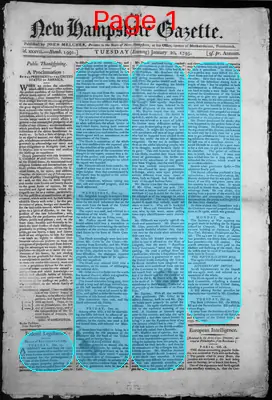
The New Hampshire Gazette
Portsmouth, Rockingham County, New Hampshire
What is this article about?
Detailed report of U.S. House of Representatives proceedings from Dec. 23-30, covering reports on law promulgation, post office execution, militia pay, public debt reduction, bank loans, territorial boundaries, naturalization bill debates, frigate construction, and supplementary impost acts.
Clipping
OCR Quality
Full Text
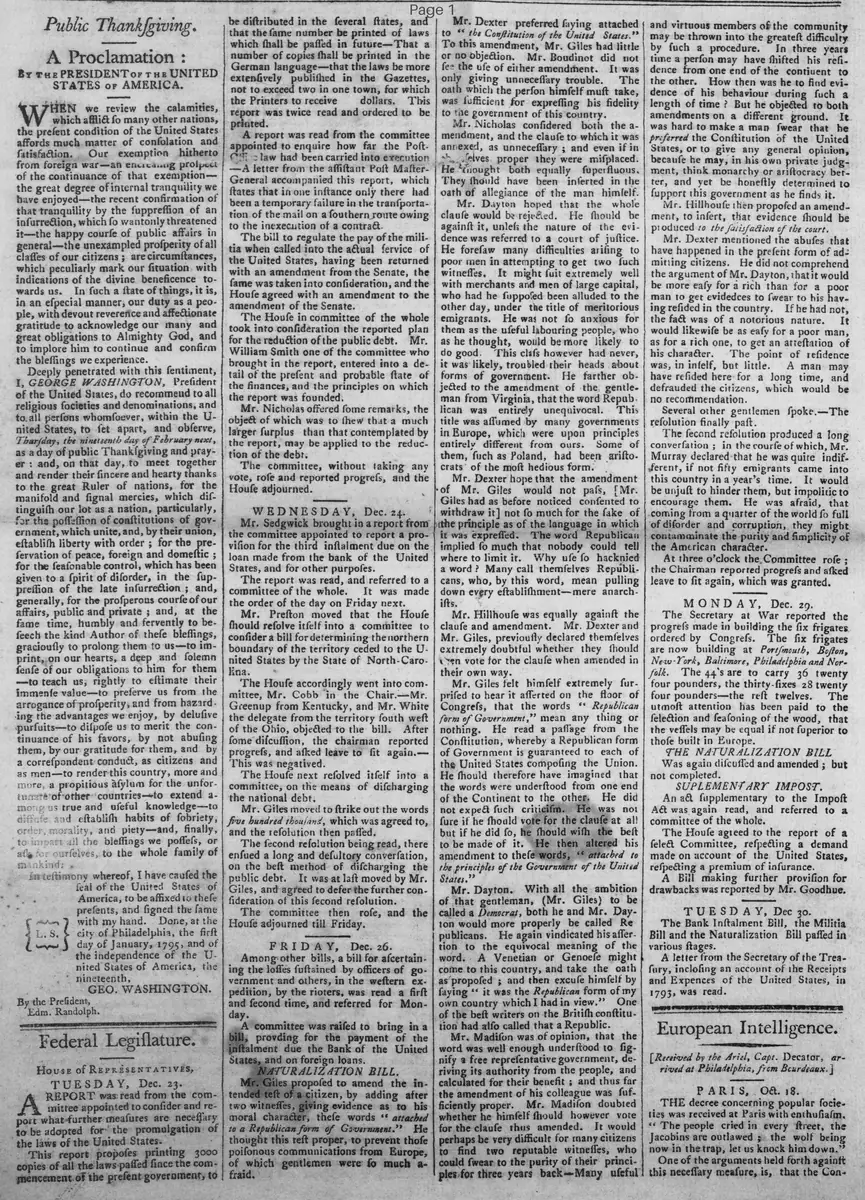
HOUSE OF REPRESENTATIVES,
TUESDAY, Dec. 23.
A REPORT was read from the committee appointed to consider and report what further measures are necessary to be adopted for the promulgation of the laws of the United States.
This report proposes printing 3000 copies of all the laws passed since the commencement of the present government, to be distributed in the several states, and that the same number be printed of laws which shall be passed in future--That a number of copies shall be printed in the German language--that the laws be more extensively published in the Gazettes, not to exceed two in one town, for which the Printers to receive 30 dollars. This report was twice read and ordered to be printed.
A report was read from the committee appointed to enquire how far the Post Office law had been carried into execution--A letter from the assistant Post Master General accompanied this report, which states that in one instance only there had been a temporary failure in the transportation of the mail on a southern route owing to the inexecution of a contract.
The bill to regulate the pay of the militia when called into the actual service of the United States, having been returned with an amendment from the Senate, the same was taken into consideration, and the House agreed with an amendment to the amendment of the Senate.
The House in committee of the whole took into consideration the reported plan for the reduction of the public debt. Mr. William Smith one of the committee who brought in the report, entered into a detail of the present and probable state of the finances, and the principles on which the report was founded.
Mr. Nicholas offered some remarks, the object of which was to shew that a much larger surplus than that contemplated by the report, may be applied to the reduction of the debt.
The committee, without taking any vote, rose and reported progress, and the House adjourned.
WEDNESDAY, Dec. 24.
Mr. Sedgwick brought in a report from the committee appointed to report a provision for the third instalment due on the loan made from the bank of the United States, and for other purposes.
The report was read, and referred to a committee of the whole. It was made the order of the day on Friday next.
Mr. Preston moved that the House should resolve itself into a committee to consider a bill for determining the northern boundary of the territory ceded to the United States by the State of North-Carolina.
The House accordingly went into committee, Mr. Cobb in the Chair. Mr. Greenup from Kentucky, and Mr. White the delegate from the territory south west of the Ohio, objected to the bill. After some discussion, the chairman reported progress, and asked leave to sit again.--This was negatived.
The House next resolved itself into a committee, on the means of discharging the national debt,
Mr. Giles moved to strike out the words five hundred thousand, which was agreed to, and the resolution then passed.
The second resolution being read, there ensued a long and desultory conversation, on the best method of discharging the public debt. It was at last moved by Mr. Giles, and agreed to defer the further consideration of this second resolution.
The committee then rose, and the House adjourned till Friday.
FRIDAY, Dec. 26.
Among other bills, a bill for ascertaining the losses sustained by officers of government and others, in the western expedition, by the rioters, was read a first and second time, and referred for Monday.
A committee was raised to bring in a bill, providing for the payment of the instalment due the Bank of the United States, and on foreign loans.
NATURALIZATION BILL.
Mr. Giles proposed to amend the intended test of a citizen, by adding after two witnesses, giving evidence as to his moral character, these words "attached to a Republican form of Government." He thought this test proper, to prevent those poisonous communications from Europe, of which gentlemen were so much afraid.
Mr. Dexter preferred saying attached to "the Constitution of the United States."
To this amendment, Mr. Giles had little or no objection. Mr. Boudinot did not see the use of either amendment. It was only giving unnecessary trouble. The oath which the person himself must take, was sufficient for expressing his fidelity to the government of this country.
Mr. Nicholas considered both the amendment, and the clause to which it was annexed, as unnecessary: and even if in themselves proper they were misapplied.
He thought both equally superfluous. They should have been inserted in the oath of allegiance of the man himself.
Mr. Dayton hoped that the whole clause would be rejected. He should be against it, unless the nature of the evidence was referred to a court of justice.
He foresaw many difficulties arising to poor men in attempting to get two such witnesses. It might suit extremely well with merchants and men of large capital, who had he supposed been alluded to the other day, under the title of meritorious emigrants. He was not so anxious for them as the useful labouring people, who as he thought, would be more likely to do good. This class however had never, it was likely, troubled their heads about forms of government. He farther objected to the amendment of the gentleman from Virginia, that the word Republican was entirely equivocal. This title was assumed by many governments in Europe, which were upon principles entirely different from ours. Some of them, such as Poland, had been aristocracies of the most hideous form.
Mr. Dexter hoped that the amendment of Mr. Giles would not pass, [Mr. Giles had as before noticed consented to withdraw it] not so much for the sake of the principle as of the language in which it was expressed. The word Republican implied so much that nobody could tell where to limit it. Why use so hackneyed a word? Many call themselves Republicans, who, by this word, mean pulling down every establishment--mere anarchists.
Mr. Hillhouse was equally against the clause and amendment. Mr. Dexter and Mr. Giles, previously declared themselves extremely doubtful whether they should even vote for the clause when amended in their own way.
Mr. Giles felt himself extremely surprised to hear it asserted on the floor of Congress, that the words "Republican form of Government," mean any thing or nothing. He read a passage from the Constitution, whereby a Republican form of Government is guaranteed to each of the United States composing the Union.
He should therefore have imagined that the words were understood from one end of the Continent to the other. He did not expect such criticism. He was not sure if he should vote for the clause at all but if he did so, he should wish the best to be made of it. He then altered his amendment to these words, "attached to the principles of the Government of the United States."
Mr. Dayton. With all the ambition of that gentleman, (Mr. Giles) to be called a Democrat, both he and Mr. Dayton would more properly be called Republicans. He again vindicated his assertion to the equivocal meaning of the word. A Venetian or Genoese might come to this country, and take the oath as proposed; and then excuse himself by saying "it was the Republican form of my own country which I had in view." One of the best writers on the British constitution had also called that a Republic.
Mr. Madison was of opinion, that the word was well enough understood to signify a free representative government, deriving its authority from the people, and calculated for their benefit; and thus far the amendment of his colleague was sufficiently proper. Mr. Madison doubted whether he himself should however vote for the clause thus amended. It would perhaps be very difficult for many citizens to find two reputable witnesses, who could swear to the purity of their principles for three years back Many useful and virtuous members of the community may be thrown into the greatest difficulty by such a procedure. In three years time a person may have shifted his residence from one end of the continent to the other. How then was he to find evidence of his behaviour during such a length of time? But he objected to both amendments on a different ground. It was hard to make a man swear that he preferred the Constitution of the United States, or to give any general opinion, because he may, in his own private judgment, think monarchy or aristocracy better, and yet be honestly determined to support this government as he finds it.
Mr. Hillhouse then proposed an amendment, to insert, that evidence should be produced to the satisfaction of the court.
Mr. Dexter mentioned the abuses that have happened in the present form of admitting citizens. He did not comprehend the argument of Mr. Dayton, that it would be more easy for a rich than for a poor man to get evidences to swear to his having resided in the country. If he had not, the fact was of a notorious nature.
It would likewise be as easy for a poor man, as for a rich one, to get an attestation of his character. The point of residence was, in itself, but little. A man may have resided here for a long time, and defrauded the citizens, which would be no recommendation.
Several other gentlemen spoke.--The resolution finally passed.
The second resolution produced a long conversation; in the course of which, Mr. Murray declared--that he was quite indifferent, if not fifty emigrants came into this country in a year's time. It would be unjust to hinder them, but impolitic to encourage them. He was afraid, that coming from a quarter of the world so full of disorder and corruption, they might contaminate the purity and simplicity of the American character.
At three o'clock the Committee rose: the Chairman reported progress and asked leave to sit again, which was granted.
MONDAY, Dec. 29.
The Secretary at War reported the progress made in building the six frigates ordered by Congress. The six frigates are now building at Portsmouth, Boston, New-York, Baltimore, Philadelphia and Norfolk. The 44's are to carry 36 twenty four pounders, the thirty-sixes 28 twenty four pounders--the rest twelves. The utmost attention has been paid to the election and seasoning of the wood, that the vessels may be equal if not superior to those built in Europe.
THE NATURALIZATION BILL
Was again discussed and amended; but not completed.
SUPPLEMENTARY IMPOST.
An act supplementary to the Impost Act was again read, and referred to a committee of the whole.
The House agreed to the report of a select Committee, respecting a demand made on account of the United States, respecting a premium of insurance.
A Bill making further provision for drawbacks was reported by Mr. Goodhue.
TUESDAY, Dec 30.
The Bank Instalment Bill, the Militia Bill and the Naturalization Bill passed in various stages.
A letter from the Secretary of the Treasury, enclosing an account of the Receipts and Expences of the United States, in 1793, was read.
What sub-type of article is it?
What keywords are associated?
What entities or persons were involved?
Domestic News Details
Event Date
Dec. 23 To Dec. 30
Key Persons
Outcome
various reports read and ordered printed; bills amended, referred, or passed including militia pay, public debt reduction, bank instalment, naturalization, supplementary impost; progress reported on frigate construction; discussions on naturalization amendments deferred or passed.
Event Details
Proceedings in the House of Representatives included committee reports on law promulgation, post office execution, public debt reduction, bank loans, territorial boundaries, and naturalization bill debates; updates on frigate building; bills advanced through readings and committees.