Thank you for visiting SNEWPapers!
Sign up free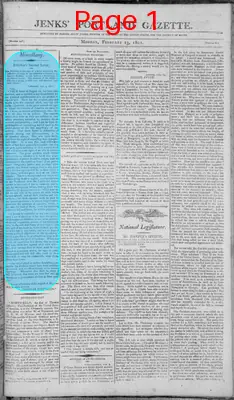
Jenks's Portland Gazette
Portland, Cumberland County, Maine
What is this article about?
Thomas Jefferson's letter from Monticello, dated September 4, 1800, replies to a Berkeley citizen, declining an active role in the election, discussing political divisions between monarchical and republican government branches, advocating for republicanism, and urging reconciliation among citizens.
Clipping
OCR Quality
Full Text
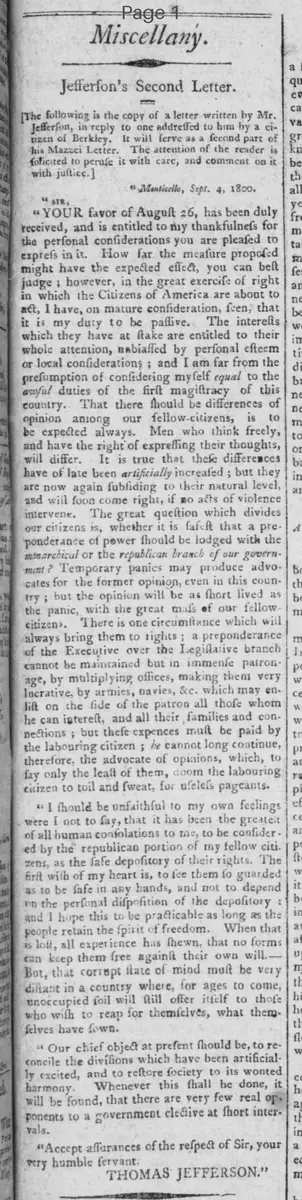
Jefferson's Second Letter.
The following is the copy of a letter written by Mr. Jefferson, in reply to one addressed to him by a citizen of Berkeley. It will serve as a second part of his Mazzei Letter. The attention of the reader is solicited to peruse it with care, and comment on it with justice.
"Monticello, Sept. 4, 1800.
"SIR,
"YOUR favor of August 26, has been duly received, and is entitled to my thankfulness for the personal considerations you are pleased to express in it. How far the measure proposed might have the expected effect, you can best judge; however, in the great exercise of right in which the Citizens of America are about to act, I have, on mature consideration, seen, that it is my duty to be passive. The interests which they have at stake are entitled to their whole attention, unbiased by personal esteem or local considerations; and I am far from the presumption of considering myself equal to the awful duties of the first magistracy of this country. That there should be differences of opinion among our fellow-citizens, is to be expected always. Men who think freely, and have the right of expressing their thoughts, will differ. It is true that these differences have of late been artificially increased; but they are now again subsiding to their natural level, and will soon come right, if no acts of violence intervene. The great question which divides our citizens is, whether it is safest that a preponderance of power should be lodged with the monarchical or the republican branch of our government? Temporary panics may produce advocates for the former opinion, even in this country; but the opinion will be as short lived as the panic, with the great mass of our fellow citizens. There is one circumstance which will always bring them to rights; a preponderance of the Executive over the Legislative branch cannot be maintained but in immense patronage, by multiplying offices, making them very lucrative, by armies, navies, &c. which may enlist on the side of the patron all those whom he can interest, and all their families and connections; but these expenses must be paid by the laboring citizen; he cannot long continue, therefore, the advocate of opinions, which, to say only the least of them, doom the laboring citizen to toil and sweat, for useless pageants.
"I should be unfaithful to my own feelings were I not to say, that it has been the greatest of all human consolations to me, to be considered by the republican portion of my fellow citizens, as the safe depository of their rights. The first wish of my heart is, to see them so guarded as to be safe in any hands, and not to depend on the personal disposition of the depository: and I hope this to be practicable as long as the people retain the spirit of freedom. When that is lost, all experience has shown, that no forms can keep them free against their own will.— But, that corrupt state of mind must be very distant in a country where, for ages to come, unoccupied soil will still offer itself to those who wish to reap for themselves, what themselves have sown.
"Our chief object at present should be, to reconcile the divisions which have been artificially excited, and to restore society to its wonted harmony. Whenever this shall be done, it will be found, that there are very few real opponents to a government elective at short intervals.
"Accept assurances of the respect of Sir, your very humble servant.
THOMAS JEFFERSON."
What sub-type of article is it?
What themes does it cover?
What keywords are associated?
What entities or persons were involved?
Where did it happen?
Story Details
Key Persons
Location
Monticello
Event Date
Sept. 4, 1800
Story Details
Jefferson responds to a letter from a Berkeley citizen, expresses gratitude, declines active involvement in the election deeming it his duty to remain passive, discusses political differences on government branches, criticizes monarchical power through patronage and military, affirms his role as guardian of republican rights, hopes for enduring freedom through the people's spirit and available land, and calls for reconciling divisions to restore harmony and support elective government.