Thank you for visiting SNEWPapers!
Sign up free
Letter to Editor
May 3, 1826
Phenix Gazette
Alexandria, Virginia
What is this article about?
An anonymous letter to the editor critiques Vice-President John C. Calhoun's partiality as Senate President, accusing him of selectively enforcing order rules to favor allies and excusing inaction through misinterpretation of Senate rules, referencing incidents involving Senator Dickerson and prolonged irrelevant speeches.
Clipping
OCR Quality
95%
Excellent
Full Text
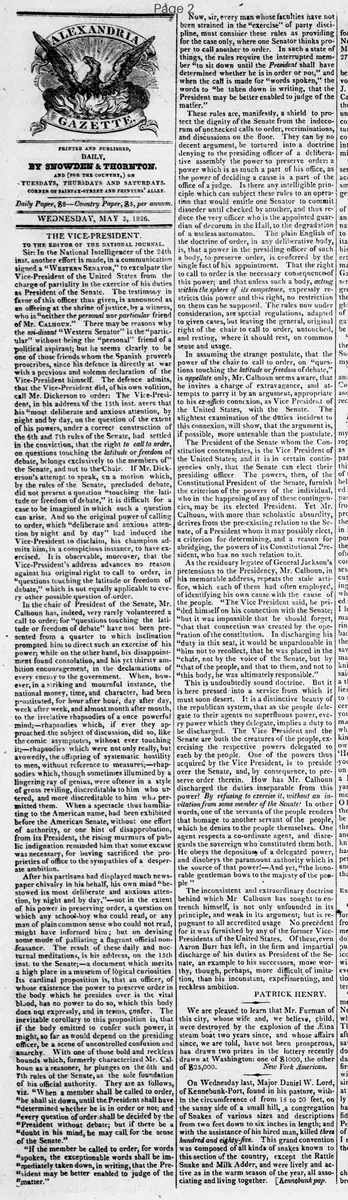
THE VICE-PRESIDENT.
TO THE EDITOR OF THE NATIONAL JOURNAL.
Sir: In the National Intelligencer of the 24th inst. another effort is made, in a communication signed 'Western Senator,' to exculpate the Vice-President of the United States from the charge of partiality in the exercise of his duties as President of the Senate. The testimony in favor of this officer thus given, is announced as an offering at the shrine of justice, by a witness, who is 'neither the personal nor particular friend of Mr. Calhoun.' There may be reasons why the soi-disant 'Western Senator' is the 'particular' without being the 'personal' friend of a political aspirant; but he seems clearly to be one of those friends whom the Spanish proverb proscribes, since his defence is directly at war with a previous and solemn declaration of the Vice-President himself. The defence admits, that the Vice-President did, of his own volition, call Mr. Dickerson to order: The Vice-President, in his address of the 15th inst. avers that his 'most deliberate and anxious attention, by night and by day, on the question of the extent of his powers, under a correct construction of the 6th and 7th rules of the Senate, had settled in the conviction, that the right to call to order on questions touching the latitude or freedom of debate, belongs exclusively to the members of the Senate, and not to the Chair. If Mr. Dickerson's attempt to speak, on a motion which, by the rules of the Senate, precluded debate, did not present a question 'touching the latitude or freedom of debate,' it is difficult for a case to be imagined in which such a question can arise. And so the original power of calling to order, which 'deliberate and anxious attention by night and by day' had induced the Vice-President to disclaim, his champion admits him, in a conspicuous instance, to have exercised. It is observable, moreover, that the Vice-President's address advances no reason against his original right to call to order, in 'questions touching the latitude or freedom of debate,' which is not equally applicable to every other possible question of order.
In the chair of President of the Senate, Mr. Calhoun has, indeed, very rarely volunteered a call to order; for 'questions touching the latitude or freedom of debate' have not been presented from a quarter to which inclination prompted him to direct such an exercise of his power; while on the other hand, his disappointment found consolation, and his yet thirsty ambition encouragement, in the declamations of every enemy to the government. When, however, in a striking and mournful instance, the national money, time, and character, had been prostituted, for hour after hour, day after day, week after week, and almost month after month, to the irrelevant rhapsodies of a once powerful mind;—rhapsodies which, if ever they approached the subject of discussion, did so, like the comic asymptotes, without ever touching it;—rhapsodies which were not only really, but avowedly, the offspring of systematic hostility to men, without reference to measures;—rhapsodies which, though sometimes illumined by a lingering ray of genius, were oftener in a style of gross reviling, discreditable to him who uttered, and more discreditable to him who permitted them. When a spectacle thus humiliating to the American name, had been exhibited before the American Senate, without one effort of authority, or one hint of disapprobation from its President, the rising murmurs of public indignation reminded him that some excuse was necessary, for having sacrificed the proprieties of office to the sympathies of a desperate ambition.
After his partisans had displayed much newspaper chivalry in his behalf, his own mind 'bestowed its most deliberate and anxious attention, by night and by day,'—not in the extent of his power in preserving order, a question on which any school-boy who could read, or any man of plain common sense who could not read, might have informed him; but on devising some mode of palliating a flagrant official non-feasance. The result of these daily and nocturnal meditations, is his address, on the 15th inst. to the Senate;—a document which merits a high place in a museum of logical curiosities. Its cardinal proposition is, that an officer, of whose existence the power to preserve order in the body which he presides over is the vital blood, has no power to do so, which this body does not expressly, and in terms, confer. The inevitable corollary to this proposition is, that if the body omitted to confer such power, it might, so far as would depend on the presiding officer, be a scene of uncontrolled confusion and anarchy. With one of those bold and reckless bounds which, formerly characterized Mr. Calhoun as a reasoner, he plunges on the 6th and 7th rules of the Senate, as the sole foundation of his official authority. They are as follows, viz. 'When a member shall be called to order, he shall sit down, until the President shall have determined whether he is in order or not; and every question of order shall be decided by the President without debate; but if there be a doubt in his mind, he may call for the sense of the Senate.
'If the member be called to order, for words spoken, the exceptionable words shall be immediately taken down in writing, that the President may be better enabled to judge of the matter.'
Now, sir, every man whose faculties have not been strained in the 'exercise' of party discipline, must consider these rules as providing for the case only, where one Senator thinks proper to call another to order. In such a state of things, the rules require the interrupted member 'to sit down until the President shall have determined whether he is in order or not,' and when the call is made for 'words spoken,' the words to 'be taken down in writing, that the President may be better enabled to judge of the matter.' These rules are, manifestly, a shield to protect the dignity of the Senate from the indecorum of unchecked calls to order, recriminations, and discussions on the floor. They can by no decent argument, be tortured into a doctrine denying to the presiding officer of a deliberative assembly the power to preserve order: a power which is as much a part of his office, as the power of deciding a cause is a part of the office of a judge. Is there any intelligible principle which can subject these rules to an operation that would entitle one Senator to commit disorder until checked by another, and thus reduce the very officer who is the appointed guardian of decorum in the Hall, to the degradation of a useless automaton. The plain English of the doctrine of order, in any deliberative body, is, that a power in the presiding officer of such a body, to preserve order, is conferred by the single fact of his appointment. That the right to call to order is the necessary consequence of this power; and that unless such a body, acting within the sphere of its competence, expressly restricts this power and this right, no restriction on them can be supposed. The rules now under consideration, are special regulations, adapted to given cases, but leaving the general, original right of the chair to call to order, untouched, and resting, where it should rest, on common sense and usage.
In assuming the strange postulate, that the power of the chair to call to order, on 'questions touching the latitude or freedom of debate,' is appellate only, Mr. Calhoun seems aware, that he invites a charge of extravagance, and attempts to parry it by an argument, appropriate to his ex-officio connexion, as Vice President of the United States, with the Senate. The slightest examination of the duties incident to this connexion, will show, that the argument is, if possible, more untenable than the postulate. The President of the Senate whom the Constitution contemplates, is the Vice President of the United States: and it is in certain contingencies only, that the Senate can elect their presiding officer. The powers, then, of the Constitutional President of the Senate, furnish the criterion of the powers of the individual, who in the happening of any of these contingencies, may be its elected President. Yet Mr. Calhoun, with more than scholastic absurdity, derives from the pre-existing relation to the Senate, of a President whom it may possibly elect, a criterion for determining, and a reason for abridging, the powers of its Constitutional President, who has no such relation to it.
As the residuary legatee of General Jackson's pretensions to the Presidency, Mr. Calhoun, in his memorable address, repeats the stale artifice, which each of them had often employed of identifying his own cause with the cause of the people. 'The Vice President said, he prided himself on his connection with the Senate; but it was impossible that he should forget, that that connection was created by the operation of the constitution. In discharging his duty in this seat, it would be unpardonable in him not to recollect, that he was placed in the chair, not by the voice of the Senate, but by that of the people, and that to them, and not to this body, he was ultimately responsible.' This is undoubtedly sound doctrine. But it is here pressed into a service from which it must soon desert. It is a distinctive beauty of the republican system, that as the people delegate to their agents no superfluous power, every power which they delegate, implies a duty to be discharged. The Vice President and the Senate are both the creatures of the people, exercising the respective powers delegated to each by the people. One of the powers thus acquired by the Vice President, is to preside over the Senate, and, by consequence, to preserve order therein. How has Mr. Calhoun discharged the duties inseparable from this power? By refusing to exercise it, without an invitation from some member of the Senate! In other words, one of the servants of the people renders that homage to another servant of the people, which he denies to the people themselves. One agent respects a co-ordinate agent, and disregards the sovereign who constituted them both. He obeys the depository of a delegated power, and disobeys the paramount authority which is the source of that power! And yet, 'the honorable gentleman bows to the majesty of the people.'
The inconsistent and extraordinary doctrine behind which Mr. Calhoun has sought to entrench himself, is not only unfounded in its principle, and weak in its argument; but is repugnant to all accredited usage. No precedent for it was furnished by any of the former Vice-Presidents of the United States. Of these, even Aaron Burr has left, in the firm and impartial discharge of his duties as President of the Senate, an example to his successors, more worthy, though, perhaps, more difficult of imitation, than his inconstant, experimenting, and reckless ambition.
TO THE EDITOR OF THE NATIONAL JOURNAL.
Sir: In the National Intelligencer of the 24th inst. another effort is made, in a communication signed 'Western Senator,' to exculpate the Vice-President of the United States from the charge of partiality in the exercise of his duties as President of the Senate. The testimony in favor of this officer thus given, is announced as an offering at the shrine of justice, by a witness, who is 'neither the personal nor particular friend of Mr. Calhoun.' There may be reasons why the soi-disant 'Western Senator' is the 'particular' without being the 'personal' friend of a political aspirant; but he seems clearly to be one of those friends whom the Spanish proverb proscribes, since his defence is directly at war with a previous and solemn declaration of the Vice-President himself. The defence admits, that the Vice-President did, of his own volition, call Mr. Dickerson to order: The Vice-President, in his address of the 15th inst. avers that his 'most deliberate and anxious attention, by night and by day, on the question of the extent of his powers, under a correct construction of the 6th and 7th rules of the Senate, had settled in the conviction, that the right to call to order on questions touching the latitude or freedom of debate, belongs exclusively to the members of the Senate, and not to the Chair. If Mr. Dickerson's attempt to speak, on a motion which, by the rules of the Senate, precluded debate, did not present a question 'touching the latitude or freedom of debate,' it is difficult for a case to be imagined in which such a question can arise. And so the original power of calling to order, which 'deliberate and anxious attention by night and by day' had induced the Vice-President to disclaim, his champion admits him, in a conspicuous instance, to have exercised. It is observable, moreover, that the Vice-President's address advances no reason against his original right to call to order, in 'questions touching the latitude or freedom of debate,' which is not equally applicable to every other possible question of order.
In the chair of President of the Senate, Mr. Calhoun has, indeed, very rarely volunteered a call to order; for 'questions touching the latitude or freedom of debate' have not been presented from a quarter to which inclination prompted him to direct such an exercise of his power; while on the other hand, his disappointment found consolation, and his yet thirsty ambition encouragement, in the declamations of every enemy to the government. When, however, in a striking and mournful instance, the national money, time, and character, had been prostituted, for hour after hour, day after day, week after week, and almost month after month, to the irrelevant rhapsodies of a once powerful mind;—rhapsodies which, if ever they approached the subject of discussion, did so, like the comic asymptotes, without ever touching it;—rhapsodies which were not only really, but avowedly, the offspring of systematic hostility to men, without reference to measures;—rhapsodies which, though sometimes illumined by a lingering ray of genius, were oftener in a style of gross reviling, discreditable to him who uttered, and more discreditable to him who permitted them. When a spectacle thus humiliating to the American name, had been exhibited before the American Senate, without one effort of authority, or one hint of disapprobation from its President, the rising murmurs of public indignation reminded him that some excuse was necessary, for having sacrificed the proprieties of office to the sympathies of a desperate ambition.
After his partisans had displayed much newspaper chivalry in his behalf, his own mind 'bestowed its most deliberate and anxious attention, by night and by day,'—not in the extent of his power in preserving order, a question on which any school-boy who could read, or any man of plain common sense who could not read, might have informed him; but on devising some mode of palliating a flagrant official non-feasance. The result of these daily and nocturnal meditations, is his address, on the 15th inst. to the Senate;—a document which merits a high place in a museum of logical curiosities. Its cardinal proposition is, that an officer, of whose existence the power to preserve order in the body which he presides over is the vital blood, has no power to do so, which this body does not expressly, and in terms, confer. The inevitable corollary to this proposition is, that if the body omitted to confer such power, it might, so far as would depend on the presiding officer, be a scene of uncontrolled confusion and anarchy. With one of those bold and reckless bounds which, formerly characterized Mr. Calhoun as a reasoner, he plunges on the 6th and 7th rules of the Senate, as the sole foundation of his official authority. They are as follows, viz. 'When a member shall be called to order, he shall sit down, until the President shall have determined whether he is in order or not; and every question of order shall be decided by the President without debate; but if there be a doubt in his mind, he may call for the sense of the Senate.
'If the member be called to order, for words spoken, the exceptionable words shall be immediately taken down in writing, that the President may be better enabled to judge of the matter.'
Now, sir, every man whose faculties have not been strained in the 'exercise' of party discipline, must consider these rules as providing for the case only, where one Senator thinks proper to call another to order. In such a state of things, the rules require the interrupted member 'to sit down until the President shall have determined whether he is in order or not,' and when the call is made for 'words spoken,' the words to 'be taken down in writing, that the President may be better enabled to judge of the matter.' These rules are, manifestly, a shield to protect the dignity of the Senate from the indecorum of unchecked calls to order, recriminations, and discussions on the floor. They can by no decent argument, be tortured into a doctrine denying to the presiding officer of a deliberative assembly the power to preserve order: a power which is as much a part of his office, as the power of deciding a cause is a part of the office of a judge. Is there any intelligible principle which can subject these rules to an operation that would entitle one Senator to commit disorder until checked by another, and thus reduce the very officer who is the appointed guardian of decorum in the Hall, to the degradation of a useless automaton. The plain English of the doctrine of order, in any deliberative body, is, that a power in the presiding officer of such a body, to preserve order, is conferred by the single fact of his appointment. That the right to call to order is the necessary consequence of this power; and that unless such a body, acting within the sphere of its competence, expressly restricts this power and this right, no restriction on them can be supposed. The rules now under consideration, are special regulations, adapted to given cases, but leaving the general, original right of the chair to call to order, untouched, and resting, where it should rest, on common sense and usage.
In assuming the strange postulate, that the power of the chair to call to order, on 'questions touching the latitude or freedom of debate,' is appellate only, Mr. Calhoun seems aware, that he invites a charge of extravagance, and attempts to parry it by an argument, appropriate to his ex-officio connexion, as Vice President of the United States, with the Senate. The slightest examination of the duties incident to this connexion, will show, that the argument is, if possible, more untenable than the postulate. The President of the Senate whom the Constitution contemplates, is the Vice President of the United States: and it is in certain contingencies only, that the Senate can elect their presiding officer. The powers, then, of the Constitutional President of the Senate, furnish the criterion of the powers of the individual, who in the happening of any of these contingencies, may be its elected President. Yet Mr. Calhoun, with more than scholastic absurdity, derives from the pre-existing relation to the Senate, of a President whom it may possibly elect, a criterion for determining, and a reason for abridging, the powers of its Constitutional President, who has no such relation to it.
As the residuary legatee of General Jackson's pretensions to the Presidency, Mr. Calhoun, in his memorable address, repeats the stale artifice, which each of them had often employed of identifying his own cause with the cause of the people. 'The Vice President said, he prided himself on his connection with the Senate; but it was impossible that he should forget, that that connection was created by the operation of the constitution. In discharging his duty in this seat, it would be unpardonable in him not to recollect, that he was placed in the chair, not by the voice of the Senate, but by that of the people, and that to them, and not to this body, he was ultimately responsible.' This is undoubtedly sound doctrine. But it is here pressed into a service from which it must soon desert. It is a distinctive beauty of the republican system, that as the people delegate to their agents no superfluous power, every power which they delegate, implies a duty to be discharged. The Vice President and the Senate are both the creatures of the people, exercising the respective powers delegated to each by the people. One of the powers thus acquired by the Vice President, is to preside over the Senate, and, by consequence, to preserve order therein. How has Mr. Calhoun discharged the duties inseparable from this power? By refusing to exercise it, without an invitation from some member of the Senate! In other words, one of the servants of the people renders that homage to another servant of the people, which he denies to the people themselves. One agent respects a co-ordinate agent, and disregards the sovereign who constituted them both. He obeys the depository of a delegated power, and disobeys the paramount authority which is the source of that power! And yet, 'the honorable gentleman bows to the majesty of the people.'
The inconsistent and extraordinary doctrine behind which Mr. Calhoun has sought to entrench himself, is not only unfounded in its principle, and weak in its argument; but is repugnant to all accredited usage. No precedent for it was furnished by any of the former Vice-Presidents of the United States. Of these, even Aaron Burr has left, in the firm and impartial discharge of his duties as President of the Senate, an example to his successors, more worthy, though, perhaps, more difficult of imitation, than his inconstant, experimenting, and reckless ambition.
What sub-type of article is it?
Persuasive
Political
Provocative
What themes does it cover?
Politics
Constitutional Rights
What keywords are associated?
Vice President Calhoun
Senate Partiality
Call To Order
Senate Rules
Constitutional Powers
Political Ambition
Debate Freedom
What entities or persons were involved?
Editor Of The National Journal
Letter to Editor Details
Recipient
Editor Of The National Journal
Main Argument
vice-president calhoun exhibits partiality by selectively calling senators to order only when it suits his political inclinations, misinterpreting senate rules to disclaim his inherent power to maintain order and excusing inaction during disruptive speeches by opponents.
Notable Details
References Calhoun's Address Of The 15th Inst.
Cites Incident With Mr. Dickerson Being Called To Order.
Quotes Senate Rules 6th And 7th.
Alludes To Prolonged Irrelevant Speeches By A 'Once Powerful Mind' (Likely Randolph).
Contrasts With Aaron Burr's Impartiality.
Critiques 'Western Senator' Defense.