Thank you for visiting SNEWPapers!
Sign up free
The Hawaiian Gazette
Honolulu, Honolulu County, Hawaii
What is this article about?
Article examines challenges in Hawaiian land surveying, including inconsistent measurement units, uncoordinated surveys causing overlaps and gaps, vague starting points, and local magnetic deviations; proposes uniform standards and methods for accuracy, amid past legislative efforts and upcoming government survey.
Clipping
OCR Quality
Full Text
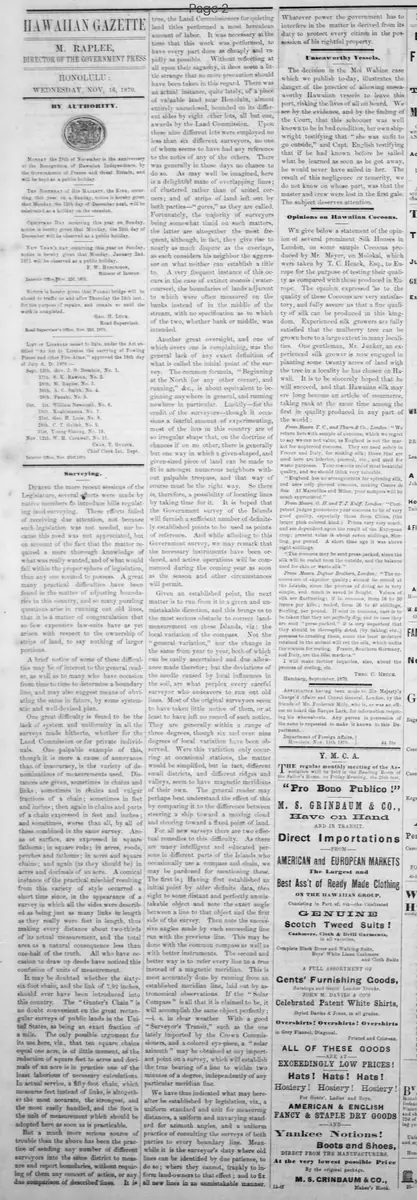
A brief notice of some of these difficulties may be of interest to the general reader, as well as to many who have occasion from time to time to determine a boundary line, and may also suggest means of obviating the same in future, by some systematic and well-devised plan.
One great difficulty is found to be the lack of system and uniformity in all the surveys made hitherto, whether for the Land Commission or for private individuals. One palpable example of this, though it is more a cause of annoyance than of inaccuracy, is the variety of denominations of measurements used. Distances are given, sometimes in chains and links; sometimes in chains and vulgar fractions of a chain; sometimes in feet and inches; then again in chains and parts of a chain expressed in feet and inches; and sometimes, worse than all, by all of these combined in the same survey. Areas of surface, are expressed in square fathoms; in square rods; in acres, roods, perches and fathoms; in acres and square chains; and again (as they should be) in acres and decimals of an acre. A comical instance of the practical mischief resulting from this variety of style occurred a short time since, in the appearance of a survey in which all the sides were described as being just as many links in length as they really were feet in length, thus making every distance about two-thirds of its actual measurement, and the total area as a natural consequence less than one-half of the truth. All who have occasion to draw up deeds have noticed this confusion of units of measurement.
It may be doubted whether the sixty-six foot chain, and the link of 7.92 inches, should ever have been introduced into this country. The "Gunter's Chain" is no doubt convenient on the great rectangular surveys of public lands in the United States, as being an exact fraction of a mile. The only possible argument for its use here, viz, that ten square chains equal one acre, is of little moment, as the reduction of square feet to acres and decimals of an acre is in practice one of the least laborious of necessary calculations.
In actual service, a fifty-foot chain, which measures feet instead of links, is altogether the most accurate, the strongest, and the most easily handled, and the foot is the unit of measurement which should be adopted here as soon as is practicable.
But a much more serious source of trouble than the above has been the practice of sending any number of different surveyors into the same district to measure and report boundaries, without requiring of them any concert of action, or any due comparison of described lines. It is true, the Land Commissioners for quieting land titles performed a most herculean amount of labor. It was necessary at the time that this work was performed, to have every part done as cheaply and rapidly as possible. Without reflecting at all upon their sagacity, it does seem a little strange that no more precaution should have been taken in this regard. There was an actual instance, quite lately, of a piece of valuable land near Honolulu, almost entirely unenclosed, bounded on its different sides by eight other lots, all but one, awards by the Land Commission. Upon these nine different lots were employed no less than six different surveyors, no one of whom seems to have had any reference to the notes of any of the others. There was generally in those days no chance to do so. As may well be imagined, here is a delightful maze of overlapping lines; of clustered rather than of united corners; and of strips of land left out by both parties-"gores," as they are called. Fortunately, the majority of surveyors being somewhat timid on such matters, the latter are altogether the most frequent, although, in fact, they give rise to nearly as much dispute as the overlaps as each considers his neighbor the aggressor on what neither can establish a title to. A very frequent instance of this occurs in the case of extinct anedies (watercourses), the boundaries of lands adjacent to which were often measured on the banks instead of in the middle of the stream, with no specification as to which of the two, whether bank or middle, was intended.
Another great oversight, and one of which every one is complaining, was the general lack of any exact definition of what is called the initial point of the survey. The common formula, -Beginning at the North (or any other corner), and running," &c. is about equivalent to beginning anywhere in general, and running nowhere in particular. Luckily-for the credit of the surveyors-though it occasions a fearful amount of experimenting, most of the lots in this country are of so irregular shape that, on the doctrine of chances if on no other, there is generally but one way in which a given-shaped, and given-sized piece of land can be made to fit in amongst numerous neighbors without palpable trespass, and that way of course must be the right way. So there is, therefore, a possibility of locating lines by taking time for it. It is hoped that the Government survey of the Islands will furnish a sufficient number of definitely established points to be used as points of reference. And while alluding to this Government survey, we may remark that the necessary instruments have been ordered, and active operations will be commenced during the coming year as soon as the season and other circumstances will permit.
Given an established point, the next matter is to run from it in a given and unmistakable direction, and this brings us to the most serious obstacle to correct land-measurement on these Islands, viz: the local variation of the compass. Not the "general variation," nor the change in the same from year to year, both of which can be easily ascertained and due allowance made therefor; but the deviations of the needle caused by local influences in the soil, are what perplex every careful surveyor who endeavors to run out old lines. Most of the original surveyors seem to have taken little notice of them, or at least to have left no record of such notice. They are generally within a range of three degrees, though six and even nine degrees of local variation have been observed. Were this variation only occurring at occasional stations, the matter would be simplified, but in fact, different small districts, and different ridges and valleys, seem to have magnetic meridians of their own. The general reader may perhaps best understand the effect of this by comparing it to the difference between steering a ship toward a moving cloud and steering toward a fixed point of land.
For all new surveys there are two effectual remedies to this difficulty. As there are many intelligent and educated persons in different parts of the Islands who occasionally use a compass and chain, we may be pardoned for mentioning these. The first is: Having first established an initial point by other definite data, then sight to some distant and perfectly unmistakable object and note the exact angle between a line to that object and the first side of the survey. Then note the successive angles made by each succeeding line run with the previous line. This may be done with the common compass as well as with better instruments. The second and better way is to refer every line to a true instead of a magnetic meridian. This is most accurately done by running from an established meridian line, laid out by astronomical observations. If the "Solar Compass" is all that it is claimed to be, it will accomplish the same object perfectly; -i. e. in clear weather. With a good "Surveyor's Transit," such as the one lately imported by the Crown Commissioners, and a colored eye-piece, a "solar azimuth" may be obtained at any important point on a survey, which will establish the true bearing of a line to within two minutes of a degree, independently of any particular meridian line.
We have thus indicated what may hereafter be established by legislation, viz, a uniform standard and unit for measuring distances, a uniform and unvarying standard for azimuth angles, and a uniform practice of consulting the surveys of both parties to every boundary line. Meanwhile it is the surveyor's duty where old lines can be identified by due patience, to do so; where they cannot, frankly to inform land-owners to that effect; and to fix all new lines in an unmistakable manner.
Whatever power the government has to interfere in the matter is derived from its duty to protect every citizen in the possession of his rightful property.
What sub-type of article is it?
What themes does it cover?
What keywords are associated?
Where did it happen?
Story Details
Location
This Country, Near Honolulu
Event Date
More Recent Sessions Of The Legislature
Story Details
Discusses difficulties in land surveying due to lack of uniformity in measurements, multiple surveyors without coordination leading to overlaps and gores, undefined initial points, and local compass variations; suggests remedies like uniform standards, referencing neighbors' surveys, and using true meridians; notes upcoming government survey.