Thank you for visiting SNEWPapers!
Sign up free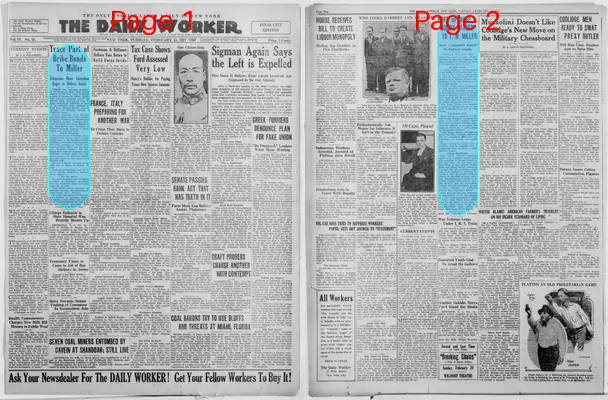
The Daily Worker
Chicago, Cook County, Illinois
What is this article about?
In the Daugherty-Miller conspiracy trial, evidence traces a $10,000 bond from a $391,000 bribe to Thomas W. Miller's New York brokerage account. Telegrams between Miller and his secretary reveal his involvement in approving a $7,000,000 German claim. Witnesses testify on negotiations, prior refusals, and investigations.
Merged-components note: Story about bribe bonds to Miller continued from page 1 to page 2; merging based on explicit continuation text.
Clippings
1 of 2
OCR Quality
Full Text
Bribe Bonds
To Miller
Telegrams Show
Custodian
Eager to Deliver Goods
Evidence was yesterday presented at the Daugherty-Miller trial tracing directly to the New York brokerage account of Thomas W. Miller, former alien property custodian, one of the $10,000 bonds received by John T. King, Connecticut politician, as part of the $391,000 bribe obtained by King from Richard Merton, German financier, for putting through a $7,000,000 claim.
Several witnesses from Shartout and Appenzellar, New York brokers, testified to receiving the $10,000 bond in Miller's account. Previous testimony last week had traced $40,000 in the King-Merton deal indirectly to Miller's brokerage accounts in Wilmington, Del., and New York.
Admits Telegram.
The government, following a protracted verbal battle, scored a long-sought point in the Daugherty-Miller conspiracy trial when it gained admission into evidence of several telegrams between Miller and his secretary, Frederick Wilson. The telegrams dealt with the approval of the $7,000,000 German claim for war-seized property, for which the defendants are alleged to have shared in a $391,000 bribe.
The next telegram was sent on the same day by Miller to Wilson. It read:
"Address all Saturday care of U. S. S. Talman, Sewickley, Pennsylvania. Miller."
Got My Swiss.
The third telegram, sent by Wilson to Miller at Sewickley, announced that the $7,000,000 claim had been approved. It read:
"Two Swiss claims approved by Goff this morning. Haviland case delayed several days. Wilson."
Guy Goff, who approved the claim, was assistant to Attorney General Daugherty, whose office had to pass on all recommendations for claims by the alien property custodian's office
(Continued on Page Two)
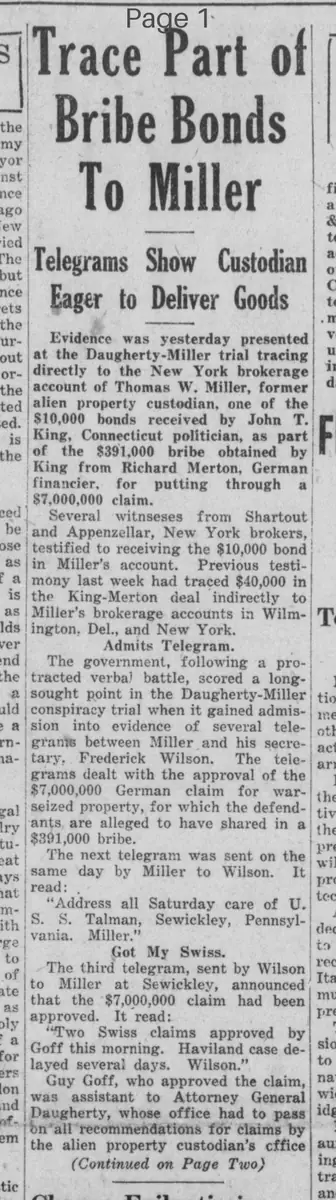
PART OF BRIBE
BONDS TRACED
TO T. W. MILLER
Show Custodian Eager
To Deliver Goods
(Continued from Page One)
before they could be paid. Wyant, mentioned in the first telegram, was Miller's orderly in France, and acted as his chauffeur after the war.
At Bribe Scene.
A fourth telegram was introduced for the purpose of showing that Miller was in New York on September 30, 1921, the day the $7,000,000 was handed over to Richard Merton, representing the German interests, at a champagne dinner.
Virginia Ware, pretty employe of the alien property custodian's office in Washington, identified papers in the files including a claim for twenty shares of American Metals Company stock owned by the Merton interests, which claim had been disallowed by the United States government.
John Foster Dulles, first retained as lawyer by Richard Merton to take up the $7,000,000 claim, was the next witness.
Negotiations Start.
Dulles told of a conference in 1921 with George Williams, managing director of the alien property custodian's office in which Williams questioned the validity of the claim and suggested Dulles get a ruling from the department of justice.
Lucien Boggs, lawyer and judge of Jacksonville, Fla., formerly connected with the custodian's office and the department of justice, was called next.
Boggs testified he talked with a lawyer in 1921 in connection with a hypothetical case involving a large amount of money.
Palmer Hard-Boiled.
Paul Smith testified regarding papers of the American Metals Company submitted to the government in 1917 and 1918. At that time two stockholders in the company, Julian Beatty and Henry Bruere, attempted to arrange the sale of German owned stock in the concern to American interests, so that the concern could be released by the alien property custodian. The release was refused by A. Mitchell Palmer, then attorney general, however, and the government contends that the defendants should not have released the $7,000,000 knowing that it had been refused.
There also was testimony regarding an investigation of the case started by a New York newspaper in 1922, at which time, Smith said, Miller asked for the papers in the case, to look them over. Later, at the first Daugherty-Miller trial, certain of these papers could not be located.
Read The Daily Worker Everyday
What sub-type of article is it?
What themes does it cover?
What keywords are associated?
What entities or persons were involved?
Where did it happen?
Story Details
Key Persons
Location
New York, Washington, Wilmington Del., Sewickley Pennsylvania
Event Date
September 30, 1921
Story Details
Evidence in the Daugherty-Miller trial traces bribe bonds to Miller's account and introduces telegrams showing his role in approving a $7,000,000 German claim amid a $391,000 bribe scandal. Witnesses detail negotiations, prior denials, and investigations.