Thank you for visiting SNEWPapers!
Sign up free
Editorial
December 28, 1802
Alexandria Advertiser And Commercial Intelligencer
Alexandria, Virginia
What is this article about?
The editorial argues that Napoleon Bonaparte, as First Consul, is unprepared for a new war, relying on intimidation rather than genuine military enthusiasm or resources. It warns of his potential temporizing with Austria to pursue designs on Switzerland, urging a spirited response to common dangers.
Clipping
OCR Quality
98%
Excellent
Full Text
Of a NEW WAR.
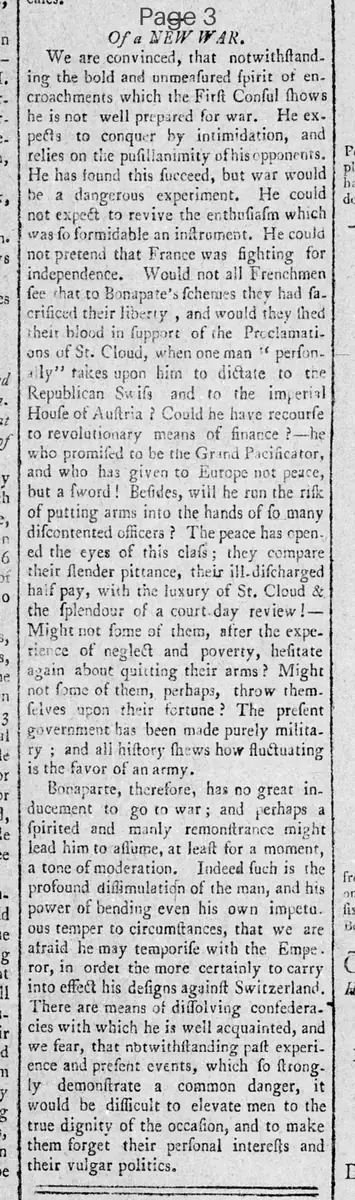
We are convinced, that notwithstanding the bold and unmeasured spirit of encroachments which the First Consul shows he is not well prepared for war. He expects to conquer by intimidation, and relies on the pusillanimity of his opponents. He has found this succeed, but war would be a dangerous experiment. He could not expect to revive the enthusiasm which was so formidable an instrument. He could not pretend that France was fighting for independence. Would not all Frenchmen see that to Bonaparte's schemes they had sacrificed their liberty, and would they shed their blood in support of the Proclamations of St. Cloud, when one man "personally" takes upon him to dictate to the Republican Swiss and to the imperial House of Austria? Could he have recourse to revolutionary means of finance?--he who promised to be the Grand Pacificator, and who has given to Europe not peace, but a sword! Besides, will he run the risk of putting arms into the hands of so many discontented officers? The peace has opened the eyes of this class; they compare their slender pittance, their ill-discharged half pay, with the luxury of St. Cloud & the splendour of a court day review!--
Might not some of them, after the experience of neglect and poverty, hesitate again about quitting their arms? Might not some of them, perhaps, throw themselves upon their fortune? The present government has been made purely military; and all history shows how fluctuating is the favor of an army.
Bonaparte, therefore, has no great inducement to go to war; and perhaps a spirited and manly remonstrance might lead him to assume, at least for a moment, a tone of moderation. Indeed such is the profound dissimulation of the man, and his power of bending even his own impetuous temper to circumstances, that we are afraid he may temporize with the Emperor, in order the more certainly to carry into effect his designs against Switzerland. There are means of dissolving confederacies with which he is well acquainted, and we fear, that notwithstanding past experience and present events, which so strongly demonstrate a common danger, it would be difficult to elevate men to the true dignity of the occasion, and to make them forget their personal interests and their vulgar politics.
We are convinced, that notwithstanding the bold and unmeasured spirit of encroachments which the First Consul shows he is not well prepared for war. He expects to conquer by intimidation, and relies on the pusillanimity of his opponents. He has found this succeed, but war would be a dangerous experiment. He could not expect to revive the enthusiasm which was so formidable an instrument. He could not pretend that France was fighting for independence. Would not all Frenchmen see that to Bonaparte's schemes they had sacrificed their liberty, and would they shed their blood in support of the Proclamations of St. Cloud, when one man "personally" takes upon him to dictate to the Republican Swiss and to the imperial House of Austria? Could he have recourse to revolutionary means of finance?--he who promised to be the Grand Pacificator, and who has given to Europe not peace, but a sword! Besides, will he run the risk of putting arms into the hands of so many discontented officers? The peace has opened the eyes of this class; they compare their slender pittance, their ill-discharged half pay, with the luxury of St. Cloud & the splendour of a court day review!--
Might not some of them, after the experience of neglect and poverty, hesitate again about quitting their arms? Might not some of them, perhaps, throw themselves upon their fortune? The present government has been made purely military; and all history shows how fluctuating is the favor of an army.
Bonaparte, therefore, has no great inducement to go to war; and perhaps a spirited and manly remonstrance might lead him to assume, at least for a moment, a tone of moderation. Indeed such is the profound dissimulation of the man, and his power of bending even his own impetuous temper to circumstances, that we are afraid he may temporize with the Emperor, in order the more certainly to carry into effect his designs against Switzerland. There are means of dissolving confederacies with which he is well acquainted, and we fear, that notwithstanding past experience and present events, which so strongly demonstrate a common danger, it would be difficult to elevate men to the true dignity of the occasion, and to make them forget their personal interests and their vulgar politics.
What sub-type of article is it?
War Or Peace
Foreign Affairs
What keywords are associated?
Bonaparte War Preparations
French Intimidation Tactics
Swiss Confederacy Threat
Austrian Temporizing
Military Discontent
European Peace Sword
What entities or persons were involved?
Bonaparte
First Consul
Frenchmen
Republican Swiss
Imperial House Of Austria
Emperor
Editorial Details
Primary Topic
Bonaparte's Unpreparedness For New War And Designs On Switzerland
Stance / Tone
Skeptical And Cautionary Against Bonaparte's Intentions
Key Figures
Bonaparte
First Consul
Frenchmen
Republican Swiss
Imperial House Of Austria
Emperor
Key Arguments
Bonaparte Relies On Intimidation Rather Than Military Readiness
Cannot Revive Revolutionary Enthusiasm Or Claim Fight For Independence
Frenchmen Would Resist Supporting His Personal Dictatorships
Risk Of Discontented Officers Turning Against Him
Military Government Unstable Due To Army's Fluctuating Favor
May Temporize With Austria To Target Switzerland
Need For Spirited Remonstrance And Unity Against Common Danger