Thank you for visiting SNEWPapers!
Sign up free
The New York Herald
New York, New York County, New York
What is this article about?
Burglars tried to rob Wickford National Bank's vault in Rhode Island early Friday morning, using gunpowder that exploded and set the building ablaze, destroying it and 160 years of town records. The safe was untouched; $1,000 reward offered.
Clipping
OCR Quality
Full Text
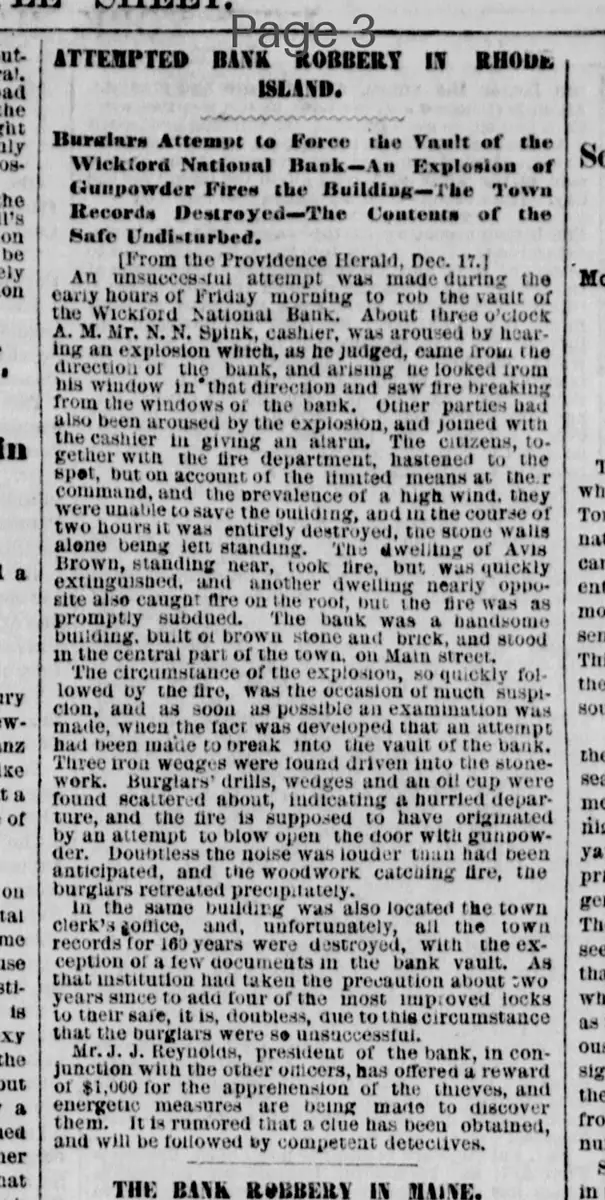
Burglars Attempt to Force the Vault of the Wickford National Bank—An Explosion of Gunpowder Fires the Building—The Town Records Destroyed—The Contents of the Safe Undisturbed.
[From the Providence Herald, Dec. 17.]
An unsuccessful attempt was made during the early hours of Friday morning to rob the vault of the Wickford National Bank. About three o'clock A. M. Mr. N. N. Spink, cashier, was aroused by hearing an explosion which, as he judged, came from the direction of the bank, and arising he looked from his window in that direction and saw fire breaking from the windows of the bank. Other parties had also been aroused by the explosion, and joined with the cashier in giving an alarm. The citizens, together with the fire department, hastened to the spot, but on account of the limited means at their command, and the prevalence of a high wind, they were unable to save the building, and in the course of two hours it was entirely destroyed, the stone walls alone being left standing. The dwelling of Avis Brown, standing near, took fire, but was quickly extinguished, and another dwelling nearly opposite also caught fire on the roof, but the fire was as promptly subdued. The bank was a handsome building, built of brown stone and brick, and stood in the central part of the town, on Main street.
The circumstance of the explosion, so quickly followed by the fire, was the occasion of much suspicion, and as soon as possible an examination was made, when the fact was developed that an attempt had been made to break into the vault of the bank. Three iron wedges were found driven into the stonework. Burglars' drills, wedges and an oil cup were found scattered about, indicating a hurried departure, and the fire is supposed to have originated by an attempt to blow open the door with gunpowder. Doubtless the noise was louder than had been anticipated, and the woodwork catching fire, the burglars retreated precipitately.
In the same building was also located the town clerk's office, and, unfortunately, all the town records for 160 years were destroyed, with the exception of a few documents in the bank vault. As that institution had taken the precaution about two years since to add four of the most improved locks to their safe, it is, doubtless, due to this circumstance that the burglars were so unsuccessful.
Mr. J. J. Reynolds, president of the bank, in conjunction with the other officers, has offered a reward of $1,000 for the apprehension of the thieves, and energetic measures are being made to discover them. It is rumored that a clue has been obtained, and will be followed by competent detectives.
What sub-type of article is it?
What keywords are associated?
What entities or persons were involved?
Where did it happen?
Domestic News Details
Primary Location
Wickford, Rhode Island
Event Date
Early Hours Of Friday Morning
Key Persons
Outcome
bank building entirely destroyed, town records for 160 years destroyed except a few in vault, contents of safe undisturbed, reward of $1,000 offered for apprehension of thieves, clue obtained
Event Details
Burglars attempted to force the vault of the Wickford National Bank using iron wedges, drills, and gunpowder, causing an explosion that ignited the building. The fire destroyed the bank and town clerk's office records, but nearby dwellings were saved. The safe remained secure due to improved locks.