Thank you for visiting SNEWPapers!
Sign up free
Story
May 3, 1866
The Richmond Palladium
Richmond, Wayne County, Indiana
What is this article about?
Curious account from Livingstone brothers' travels of African interior tribes' customs, focusing on women's pelele lip rings as beauty ornaments and their reactions to Europeans.
Clipping
OCR Quality
95%
Excellent
Full Text
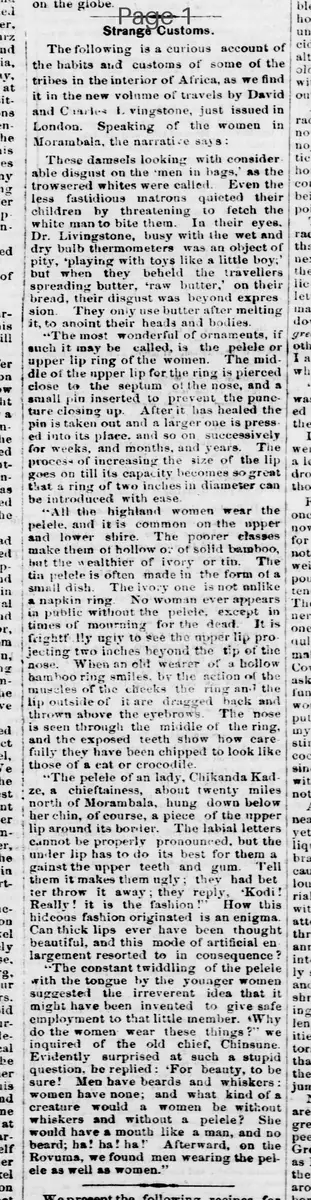
Strange Customs.
The following is a curious account of the habits and customs of some of the tribes in the interior of Africa, as we find it in the new volume of travels by David and Charles Livingstone, just issued in London. Speaking of the women in Morambala, the narrative says:
These damsels looking with considerable disgust on the 'men in bags,' as the trowsered whites were called. Even the less fastidious matrons quieted their children by threatening to fetch the white man to bite them. In their eyes, Dr. Livingstone, busy with the wet and dry bulb thermometers was an object of pity, playing with toys like a little boy; but when they beheld the travellers spreading butter, 'raw butter,' on their bread, their disgust was beyond expression. They only use butter after melting it, to anoint their heads and bodies.
The most wonderful of ornaments, if such it may be called, is the pelele or upper lip ring of the women. The middle of the upper lip for the ring is pierced close to the septum of the nose, and a small pin inserted to prevent the puncture closing up. After it has healed the pin is taken out and a larger one is pressed into its place, and so on successively for weeks, and months, and years. The process of increasing the size of the lip goes on till its capacity becomes so great that a ring of two inches in diameter can be introduced with ease.
"All the highland women wear the pelele, and it is common on the upper and lower Shire. The poorer classes make them of hollow or of solid bamboo, but the wealthier of ivory or tin. The tin pelele is often made in the form of a small dish. The ivory one is not unlike a napkin ring. No woman ever appears in public without the pelele, except in times of mourning for the dead. It is frightfully ugly to see the upper lip projecting two inches beyond the tip of the nose. When an old wearer of a hollow bamboo ring smiles, by the action of the muscles of the cheeks the ring and the lip outside of it are dragged back and thrown above the eyebrows. The nose is seen through the middle of the ring, and the exposed teeth show how carefully they have been chipped to look like those of a cat or crocodile.
"The pelele of an old lady, Chikanda Kadze, a chieftainess, about twenty miles north of Morambala, hung down below her chin, of course, a piece of the upper lip around its border. The labial letters cannot be properly pronounced, but the under lip has to do its best for them against the upper teeth and gum. Tell them it makes them ugly; they had better throw it away: they reply, Kodi! Really! it is the fashion!" How this hideous fashion originated is an enigma. Can thick lips ever have been thought beautiful, and this mode of artificial enlargement resorted to in consequence? with the tongue by the younger women suggested the irreverent idea that it might have been invented to give safe employment to that little member. Why do the women wear these things?" we inquired of the old chief, Chinsune. Evidently surprised at such a stupid question, he replied: For beauty, to be sure! Men have beards and whiskers: women have none; and what kind of a creature would a woman be without whiskers and without a pelele? She would have a mouth like a man, and no beard; ha! ha! ha!' Afterward, on the Rovuma, we found men wearing the pelele as well as women.
The following is a curious account of the habits and customs of some of the tribes in the interior of Africa, as we find it in the new volume of travels by David and Charles Livingstone, just issued in London. Speaking of the women in Morambala, the narrative says:
These damsels looking with considerable disgust on the 'men in bags,' as the trowsered whites were called. Even the less fastidious matrons quieted their children by threatening to fetch the white man to bite them. In their eyes, Dr. Livingstone, busy with the wet and dry bulb thermometers was an object of pity, playing with toys like a little boy; but when they beheld the travellers spreading butter, 'raw butter,' on their bread, their disgust was beyond expression. They only use butter after melting it, to anoint their heads and bodies.
The most wonderful of ornaments, if such it may be called, is the pelele or upper lip ring of the women. The middle of the upper lip for the ring is pierced close to the septum of the nose, and a small pin inserted to prevent the puncture closing up. After it has healed the pin is taken out and a larger one is pressed into its place, and so on successively for weeks, and months, and years. The process of increasing the size of the lip goes on till its capacity becomes so great that a ring of two inches in diameter can be introduced with ease.
"All the highland women wear the pelele, and it is common on the upper and lower Shire. The poorer classes make them of hollow or of solid bamboo, but the wealthier of ivory or tin. The tin pelele is often made in the form of a small dish. The ivory one is not unlike a napkin ring. No woman ever appears in public without the pelele, except in times of mourning for the dead. It is frightfully ugly to see the upper lip projecting two inches beyond the tip of the nose. When an old wearer of a hollow bamboo ring smiles, by the action of the muscles of the cheeks the ring and the lip outside of it are dragged back and thrown above the eyebrows. The nose is seen through the middle of the ring, and the exposed teeth show how carefully they have been chipped to look like those of a cat or crocodile.
"The pelele of an old lady, Chikanda Kadze, a chieftainess, about twenty miles north of Morambala, hung down below her chin, of course, a piece of the upper lip around its border. The labial letters cannot be properly pronounced, but the under lip has to do its best for them against the upper teeth and gum. Tell them it makes them ugly; they had better throw it away: they reply, Kodi! Really! it is the fashion!" How this hideous fashion originated is an enigma. Can thick lips ever have been thought beautiful, and this mode of artificial enlargement resorted to in consequence? with the tongue by the younger women suggested the irreverent idea that it might have been invented to give safe employment to that little member. Why do the women wear these things?" we inquired of the old chief, Chinsune. Evidently surprised at such a stupid question, he replied: For beauty, to be sure! Men have beards and whiskers: women have none; and what kind of a creature would a woman be without whiskers and without a pelele? She would have a mouth like a man, and no beard; ha! ha! ha!' Afterward, on the Rovuma, we found men wearing the pelele as well as women.
What sub-type of article is it?
Curiosity
What themes does it cover?
Social Manners
What keywords are associated?
African Customs
Pelele Lip Ring
Tribal Ornaments
Cultural Beauty
Livingstone Travels
What entities or persons were involved?
David Livingstone
Charles Livingstone
Dr. Livingstone
Chikanda Kadze
Chinsune
Where did it happen?
Interior Of Africa, Morambala, Upper And Lower Shire, Rovuma
Story Details
Key Persons
David Livingstone
Charles Livingstone
Dr. Livingstone
Chikanda Kadze
Chinsune
Location
Interior Of Africa, Morambala, Upper And Lower Shire, Rovuma
Story Details
Description of African tribal women's customs, including disgust towards European attire and food, and the pelele upper lip ring ornament, which enlarges the lip over time and is considered beautiful, with explanations from locals.