Thank you for visiting SNEWPapers!
Sign up free
The National Intelligencer And Washington Advertiser
Washington, District Of Columbia
What is this article about?
Thomas Jefferson's 1802 State of the Union address to Congress, delivered December 15, highlights national prosperity, peace, foreign trade issues, Louisiana cession, Barbary conflicts, Indian treaties, financial progress in reducing public debt, military and naval recommendations, and principles of governance.
Clipping
OCR Quality
Full Text
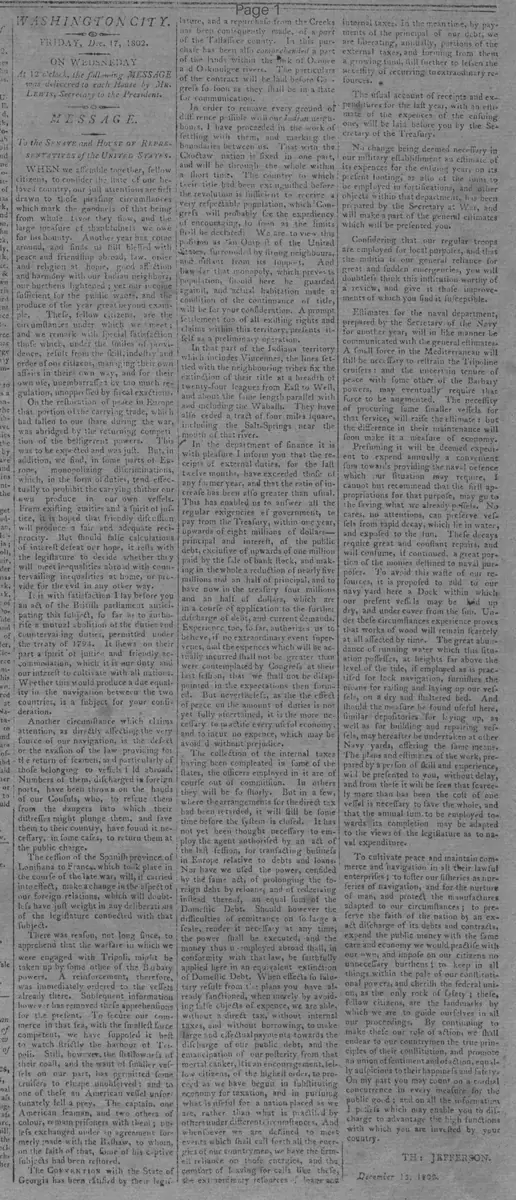
FRIDAY, Dec. 17, 1802.
ON WEDNESDAY
At 12 o'clock, the following MESSAGE
was delivered to each House by Mr.
Lewis, Secretary to the President.
MESSAGE.
To the Senate and House of Representa-
tives of the United States.
WHEN we assemble together, fellow-
citizens, to consider the state of our be-
loved country, our just attentions are first
drawn to those pleasing circumstances
which mark the goodness of that being
from whose favor they flow, and the
large measure of thankfulness we owe
for his bounty. Another year has come
around, and finds us still blessed with
peace and friendship abroad, law, order
and religion at home, good affection
and harmony with our Indian neighbors,
our burthens lightened; yet our income
sufficient for the public wants, and the
produce of the year great beyond exam-
ple. These, fellow-citizens, are the
circumstances under which we meet:
and we remark with special satisfaction
those which, under the smiles of provi-
dence, result from the skill, industry and
order of our citizens, managing their own
affairs in their own way, and for their
own use, unembarrassed by too much re-
gulation, unoppressed by fiscal exactions.
On the restoration of peace in Europe
that portion of the carrying trade, which
had fallen to our share during the war,
was abridged by the returning competi-
tion of the belligerent powers. This
was to be expected and was just. But, in
addition, we find, in some parts of Eu-
rope, monopolizing discriminations,
which, in the form of duties, tend effec-
tually to prohibit the carrying thither our
own produce in our own vessels.
From existing amities and a spirit of jus-
tice, it is hoped that friendly discussion
will produce a fair and adequate reci-
procity. But should false calculations
of interest defeat our hope, it rests with
the legislature to decide whether they
will meet inequalities abroad with coun-
tervailing inequalities at home, or pro-
vide for the evil in any other way.
It is with satisfaction I lay before you
an act of the British parliament antici-
pating this subject, so far as to autho-
rize a mutual abolition of the duties and
Countervailing duties, permitted under
the treaty of 1794. It shows on their
part a spirit of justice, and friendly ac-
commodation, which it is our duty and
our interest to cultivate with all nations.
Whether this would produce a due equal-
ity in the navigation between the two
countries, is a subject for your consi-
deration.
Another circumstance which claims
attention, as directly affecting the very
source of our navigation, is the desert-
or the evasion of the law providing for
the return of seamen, and particularly of
those belonging to vessels sold abroad.
Numbers of them, discharged in foreign
ports, have been thrown on the hands
of our Consuls, who, to rescue them
from the dangers into which their
distress might plunge them, and save
them to their Country, have found it ne-
cessary, in some cases, to return them at
the public charge.
The cession of the Spanish province of
Louisiana to France, which took place in
the course of the late war, will, if carried
into effect, make a change in the aspect of
our foreign relations, which will doubt-
less have just weight in any deliberations
of the legislature connected with that
subject.
There was reason, not long since, to
apprehend that the warfare in which we
were engaged with Tripoli, might be
taken up by some other of the Barbary
powers. A reinforcement, therefore,
was immediately ordered to the vessels
already there. Subsequent information
however has removed these apprehensions
for the present. To secure our com-
merce in that sea, with the smallest force
competent, we have supposed it best
to watch strictly the harbour of Tri-
poli. Still, however, the shallowness of
their coast, and the want of smaller ves-
sel on our part, has permitted some
cruisers to escape unobserved: and to
one of these an American vessel unfor-
tunately fell a prey. The captain, one
American seaman, and two others of
colour, remain prisoners with them; un-
less exchanged under an agreement for-
merly made with the Bashaw, to whom, on the faith of that, some of his captive
subjects had been restored.
The Convention with the State of
Georgia has been ratified by their legis-
larure, and a repurchase from the Creeks
has been consequently made, of a part
of the Talasseee county. In this pur-
chase has been also comprehended a part
of the lands within the forks of Oconee
and Oakmulgee rivers. The particulars
of the contract will be laid before Con-
gress as soon as they shall be in a state
for communication.
In order to remove every ground of
difference possible with our Indian neigh-
bours, I have proceeded in the work of
settling with them, and marking the
boundaries between us. That with the
Choctaw nation is fixed in one part,
and will be through the whole within
a short time. The country to which
their title had been extinguished before
the revolution is sufficient to receive a
very respectable population, which Con-
gress will probably require the expediency
of encouraging, so soon as the limits
shall be declared. We are to view this
portion as an Outpost of the United
States, surrounded by strong neighbours,
and distant from its support. And
lest that monopoly, which prevents
population, should here be guarded
against, and actual habitation made a
condition of the continuance of title,
will be for your consideration. A prompt
settlement too of all existing rights and
claims within this territory, presents it-
self as a preliminary operation.
In that part of the Indiana territory
which includes Vincennes, the lines es-
tablished with the neighbouring tribes fix the
extinction of their title at a breadth of
twenty-four leagues from East to West,
and about the same length parallel with
and including the Wabash. They have
also ceded a tract of four miles square,
including the Salt-Springs near the
mouth of that river.
In the department of finance it is
with pleasure I inform you that the re-
ceipts of external duties, for the last
twelve months, have exceeded those of
any former year, and that the ratio of in-
crease has been also greater than usual.
This has enabled us to answer all the
regular exigencies of government, to
pay from the Treasury, within one year,
upwards of eight millions of dollars—
principal and interest, of the public
debt, exclusive of upwards of one million
paid by the sale of bank stock, and mak-
ning in the whole a reduction of nearly five
millions and an half of principal, and to
have now in the treasury four millions
and an half of dollars, which are
in a course of application to the further
discharge of debt, and current demands.
Experience too, so far, authorizes us to
believe, if no extraordinary event su-
pervenes, and the expenses which will be ac-
tually incurred shall not be greater than
were contemplated by Congress at their
last session, that we shall not be disap-
pointed in the expectations then formed.
But nevertheless, as the effect of peace on the amount of duties is not
yet fully ascertained, it is the more ne-
cessary to practice every useful economy.
and to incur no expense, which may be
avoided without prejudice.
The collection of the internal taxes
having been completed in some of the
states, the officers employed in it are of
course out of commission. In others
they will be so shortly. But in a few,
where the arrangements or the direct tax
had been retarded, it will still be some
time before the system is closed. It has
not yet been thought necessary to em-
ploy the agent authorized by an act of
the last session, for transacting business
in Europe relative to debts and loans.
Nor have we used the power, confided
by the same act, of prolonging the for-
eign debt by relonas, and of redeeming
instead thereof, an equal sum of the
Domestic Debt. Should however the
difficulties of remittance on so large a
scale, render it necessary at any time,
the power shall be executed, and the
money thus unemployed abroad shall, in
conformity with that law, be faithfully
applied here in an equivalent extinction
of Domestic Debt. When effects so salu-
tary result from the plans you have al-
ready sanctioned, when merely by avoid-
ing all objects of expense, we are able,
without a direct tax, without internal
taxes, and without borrowing, to make
large and effectual payments towards the
discharge of our public debt, and the
emancipation of our posterity from that
mortal canker, it is an encouragement, fel-
low citizens, of the highest order, to pro-
ceed as we have begun in substituting
economy for taxation, and in pursuing
what is useful for a nation placed as we
are, rather than what is practiced by
others under different circumstances. And
whenever we are destined to meet
events which shall call forth all the ener-
gies of our countrymen, we have the sirm-
est reliance on those energies, and the
comfort of leaving for calls like these,
the extraordinary resources of loans and
internal taxes. In the mean time, by pay-
ments of the principal of our debt, we
are liberating, annually, portions of the
external taxes, and forming from them
a growing fund, still further to lessen the
necessity of recurring to extraordinary re-
sources.
The usual account of receipts and ex-
penditures for the last year, with an esti-
mate of the expenses of the ensuing
one, will be laid before you by the Sec-
retary of the Treasury.
No change being deemed necessary in
our military establishment an estimate of
its expenses for the ensuing year, on its
present footing; as also of the sums to
be employed in fortifications, and other
objects within that department, has been
prepared by the Secretary at War, and
will make a part of the general estimates
which will be presented you
Considering that our regular troops
are employed for local purposes, and that the militia is our general reliance for
great and sudden emergencies, you will
doubtless think this institution worthy of
a review, and give it those improve-
ments of which you find it susceptible.
Estimates of the naval department,
prepared by the Secretary of the Navy
for another year, will in like manner be
communicated with the general estimates.
A small force in the Mediterranean will
still be necessary to restrain the Tripoline
cruisers: and the uncertain tenure of
peace with some other of the Barbary
powers, may eventually require that
force to be augmented. The necessity
of procuring some smaller vessels for
that service, will raise the estimate: but the difference in their maintenance will
soon make it a measure of economy.
Presuming it will be deemed expe-
dient to expend annually a convenient
sum towards providing the naval defence
which our situation may require, I
cannot but recommend that the first ap-
propriations for that purpose, may go to
the saving what we already possess. No
cares, no attentions, can preserve ves-
sel from rapid decay, which lie in water,
and exposed to the sun. These decays
require great and constant repairs, and
will consume, if continued, a great por-
tion of the monies destined to naval pur-
poses. To avoid this waste of our re-
sources, it is proposed to add to our
navy yard here a Dock within which
our present vessels may be laid up
dry, and under cover from the sun. Un-
der these circumstances experience proves
that works of wood will remain scarcely
at all affected by time. The great abu-
dance of running water which this situ-
ation possesses, at heights far above the
level of the tide, if employed as is prac-
tised on lock navigation, furnishes the
means for raising and laying up our ves-
sel, on a dry and sheltered bed. And
should the measure be found useful here,
similar depositories for laying up, as
well as for building and repairing ves-
sel, may hereafter be undertaken at other
Navy yards, offering the same means.
The plans and estimates of the work, pre-
pared by a person of skill and experience,
will be presented to you, without delay,
and from these it will be seen that scarce-
ly more than has been the cost of one
vessel is necessary to save the whole, and
that the annual sum to be employed to-
wards its completion may be adapted
to the views of the legislature as to na-
val expenditure.
To cultivate peace and maintain com-
merce and navigation in all their lawful
enterprises; to foster our fisheries as nur-
series of navigation, and for the nurture
of man, and protect the manufactures
adapted to our circumstances; to pre-
serve the faith of the nation by an exact discharge of its debts and contracts.
Expend the public money with the same
care and economy we would practice with
our own, and impose on our citizens no
unnecessary burthens: to keep in all
things within the pale of our constitu-
tional powers, and cherish the federal uni-
on, as the only rock of safety; these,
fellow citizens, are the landmarks by
which we are to guide ourselves in all
our proceedings. By continuing to
make these our rule of action, we shall
endear to our countrymen the true prin-
ciples of their constitution, and promote
an union of sentiment and of action, equal-
ly auspicious to their happiness and safety.
On my part you may count on a cordial
concurrence in every measure for the
public good; and on all the information
I possess which may enable you to di-
charge to advantage the high functions
with which you are invested by your
country.
TH: JEFFERSON.
December 15, 1802
What sub-type of article is it?
What themes does it cover?
What keywords are associated?
What entities or persons were involved?
Where did it happen?
Story Details
Key Persons
Location
United States
Event Date
December 15, 1802
Story Details
Jefferson's annual message to Congress reviews national blessings of peace, prosperity, and harmony; addresses foreign trade discriminations, British act on duties, seamen issues, Louisiana cession, Barbary wars, Indian treaties and land cessions, financial receipts exceeding expectations with debt reduction, military and naval estimates, and principles of economy and constitutional governance.