Thank you for visiting SNEWPapers!
Sign up free
Editorial
July 29, 1807
Virginia Argus
Richmond, Virginia
What is this article about?
The Virginia Argus editorial defends a contributor against personal attacks and caricatures in the Virginia Gazette, denying accusations of disloyalty or opposition to national unity, and expresses hope for reconciliation between Federalists and Republicans on Republican principles.
Clipping
OCR Quality
98%
Excellent
Full Text
Virginia Argus.
RICHMOND:
WEDNESDAY, JULY 29, 1807.
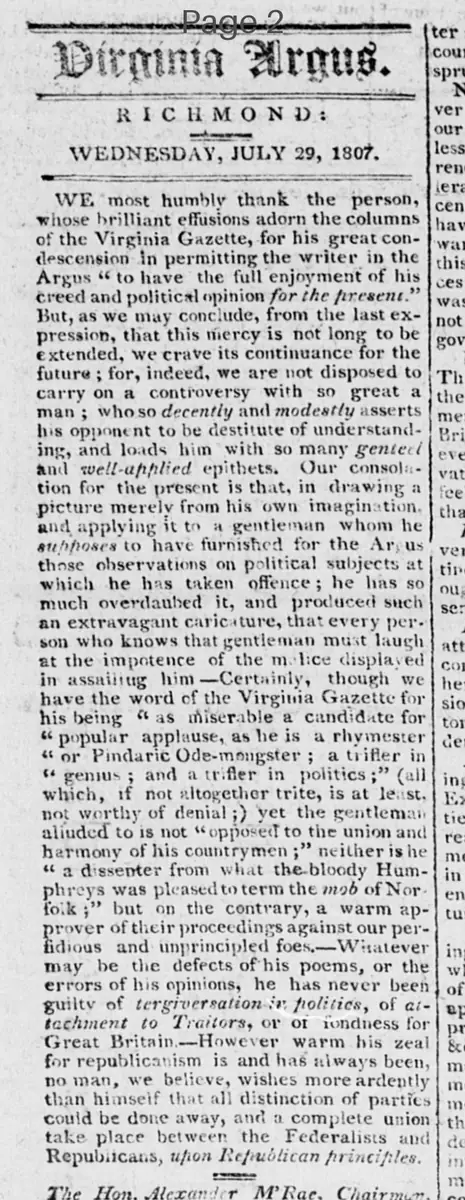
WE most humbly thank the person, whose brilliant effusions adorn the columns of the Virginia Gazette, for his great condescension in permitting the writer in the Argus "to have the full enjoyment of his creed and political opinion for the present."
But, as we may conclude, from the last expression, that this mercy is not long to be extended, we crave its continuance for the future: for, indeed, we are not disposed to carry on a controversy with so great a man; whose decency and modestly asserts his opponent to be destitute of understanding, and loads him with so many genteel and well-applied epithets. Our consolation for the present is that, in drawing a picture merely from his own imagination, and applying it to a gentleman whom he supposes to have furnished for the Argus those observations on political subjects at which he has taken offence; he has so much overdaubed it, and produced such an extravagant caricature, that every person who knows that gentleman must laugh at the impotence of the malice displayed in assailing him—Certainly, though we have the word of the Virginia Gazette for his being "as miserable a candidate for popular applause, as he is a rhymester or Pindaric Ode-monger; a trifler in genius; and a trifler in politics;" (all which, if not altogether trite, is at least, not worthy of denial;) yet the gentleman alluded to is not "opposed to the union and harmony of his countrymen:" neither is he "a dissenter from what the bloody Humphreys was pleased to term the mob of Norfolk;" but on the contrary, a warm approver of their proceedings against our perfidious and unprincipled foes.—Whatever may be the defects of his poems, or the errors of his opinions, he has never been guilty of tergiversation in politics, of attachment to Traitors, or of fondness for Great Britain.—However warm his zeal for republicanism is and has always been, no man, we believe, wishes more ardently than himself that all distinction of parties could be done away, and a complete union take place between the Federalists and Republicans, upon Republican principles.
RICHMOND:
WEDNESDAY, JULY 29, 1807.
WE most humbly thank the person, whose brilliant effusions adorn the columns of the Virginia Gazette, for his great condescension in permitting the writer in the Argus "to have the full enjoyment of his creed and political opinion for the present."
But, as we may conclude, from the last expression, that this mercy is not long to be extended, we crave its continuance for the future: for, indeed, we are not disposed to carry on a controversy with so great a man; whose decency and modestly asserts his opponent to be destitute of understanding, and loads him with so many genteel and well-applied epithets. Our consolation for the present is that, in drawing a picture merely from his own imagination, and applying it to a gentleman whom he supposes to have furnished for the Argus those observations on political subjects at which he has taken offence; he has so much overdaubed it, and produced such an extravagant caricature, that every person who knows that gentleman must laugh at the impotence of the malice displayed in assailing him—Certainly, though we have the word of the Virginia Gazette for his being "as miserable a candidate for popular applause, as he is a rhymester or Pindaric Ode-monger; a trifler in genius; and a trifler in politics;" (all which, if not altogether trite, is at least, not worthy of denial;) yet the gentleman alluded to is not "opposed to the union and harmony of his countrymen:" neither is he "a dissenter from what the bloody Humphreys was pleased to term the mob of Norfolk;" but on the contrary, a warm approver of their proceedings against our perfidious and unprincipled foes.—Whatever may be the defects of his poems, or the errors of his opinions, he has never been guilty of tergiversation in politics, of attachment to Traitors, or of fondness for Great Britain.—However warm his zeal for republicanism is and has always been, no man, we believe, wishes more ardently than himself that all distinction of parties could be done away, and a complete union take place between the Federalists and Republicans, upon Republican principles.
What sub-type of article is it?
Partisan Politics
What keywords are associated?
Political Controversy
Party Union
Republicanism
Virginia Gazette
Federalists
Republicans
What entities or persons were involved?
Virginia Gazette Writer
The Gentleman
Humphreys
Federalists
Republicans
Great Britain
Editorial Details
Primary Topic
Defense Against Political Attacks From Virginia Gazette
Stance / Tone
Defensive And Conciliatory
Key Figures
Virginia Gazette Writer
The Gentleman
Humphreys
Federalists
Republicans
Great Britain
Key Arguments
The Caricature Is Exaggerated And Laughable To Those Who Know The Gentleman.
The Gentleman Supports Union And Harmony Of Countrymen.
He Approves Of Norfolk Proceedings Against Foes.
No Tergiversation, Attachment To Traitors, Or Fondness For Great Britain.
Wishes For Union Of Federalists And Republicans On Republican Principles.