Thank you for visiting SNEWPapers!
Sign up free
Editorial
December 1, 1815
The Rhode Island American, And General Advertiser
Providence, Providence County, Rhode Island
What is this article about?
An American Farmer defends U.S. moral, legal, and institutional progress during 30 years of peace before 1812, critiquing war panegyrists like Ripley's biographer and the Port-Folio for portraying Americans as sordid money-worshippers, arguing peace fosters true virtue over empty martial glory.
Clipping
OCR Quality
95%
Excellent
Full Text
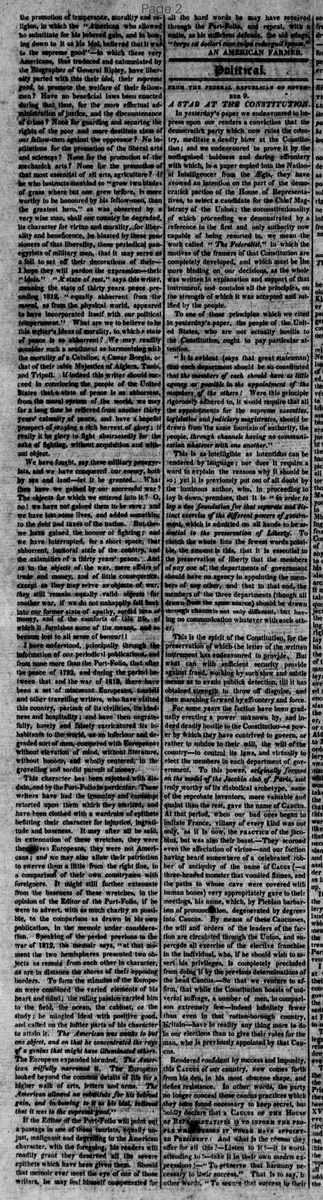
the promotion of temperance, morality and religion, in which the "American who allowed no substitute for his beloved gain, and in bowing down to it as his idol, believed that it was to the supreme good" in which these very Americans, thus traduced and calumniated by the Biographer of General Ripley, have liberally parted with this their idol, their supreme good, to promote the welfare of their fellow-men? Have no beneficial laws been enacted during that time, or the more effectual administration of justice, and the discountenance of crime? None for guarding and securing the rights of the poor and more destitute class of our fellow-men against the oppressor? No institutions for the promotion of the liberal arts and sciences? None for the promotion of the mechanic arts? None for the promotion of that most essential of all arts, agriculture?—If he who instructs mankind to "grow two blades of grass where but one grew before, is more worthy to be honoured by his fellow-men, than the greatest hero," as was observed by a very wise man, shall our country be degraded, its character for virtue and morality, or liberality and beneficence, be blasted by these pensioners of that liberality, those periodical panegyrists of military men, that it may serve as a foil to set off their decorations of their—I hope they will pardon the expression—their "idols."
"A state of rest," says this writer, meaning the state of thirty years peace preceding 1812, "equally abhorrent from the moral, as from the physical world, appeared to have incorporated itself with our political temperament." What are we to believe to be this writer's ideas of morality, to which a state of peace is so abhorrent? We may readily consider such a sentiment as harmonizing with the morality of Cataline; a Cesar Borgia, or that of their sable Majesties of Algiers, Tunis, and Tripoli: If indeed this writer should succeed in convincing the people of the United States—that a state of peace is so abhorrent, from the moral system of the world, we may for a long time be relieved from another thirty years' calamity of peace, and have a hopeful prospect of reaping a rich harvest of glory; if really it be glory to fight abstractedly for the sake of fighting, without acquisition and without object.
We have fought, say these military panegyrists, and we have conquered our enemy, both by sea and land—let it be granted. What then have we gained by our successful war? The objects for which we entered into it? O, no! we have not gained them to be sure; and we have lost some lives, and added something to the debt and taxes of the nation. But then we have gained, the honour of fighting; and we have interrupted, for a short space, that abhorrent, immoral state of the country; and the calamities of a thirty years' peace. And as to the objects of the war, mere affairs of trade and money, and of little consequence, except as they may serve as objects of war, they still remain equally valid objects for another war, if we do not unhappily fall back into our former state of apathy, sordid love of money, and of the comforts of this life of which it furnishes some of the means, and so become lost to all sense of honour!!
I have understood, principally, through the information of our periodical publications, and from none more than the Port-Folio, that after the peace of 1783, and during the period between that and the war of 1812, there have been a set of miscreant Europeans, tourists and other travelling writers, who have visited this country, partook of its civilities, its kindness and hospitality; and have then ungratefully, basely and falsely caricatured its inhabitants to the world, as an inferior and degraded sort of men, compared with Europeans; without elevation of mind, without literature, without honour,—and wholly centered, in the grovelling and sordid pursuit of money. This character has been reflected with disdain, (and by the Port-Folio in particular. These writers have had the ignominy and contempt retorted upon them which they merited, and have been clothed with a wardrobe of epithets besitting their character for injustice, ingratitude and baseness.
It may after all be said, in extenuation of these wretches, they were themselves Europeans, they were not Americans; and we may also allow their patriotism to swerve them a little from the right line, in a comparison of their own countrymen with foreigners. It might still further extenuate from the baseness of these wretches, in the opinion of the Editor of the Port-Folio, if he were to advert, with as much charity as possible, to the comparison as drawn in his own publication, in the memoir under consideration. Speaking of the period previous to the war of 1812, the memoir says, "at that moment the two hemispheres presented two objects as remote from each other in character, as are in distance the shores of their opposing borders. To form the stimulus of the European were combined the varied elements of his heart and mind; the ruling passion carried him to the field, the ocean, the cabinet, or the study: he mingled ideal with positive good, and called on the loftier parts of his character to attain it. The American was awake to but one object, and on that he concentrated the rays of a genius that might have illuminated others. The European expanded his mind. The American willfully narrowed it. The European looked beyond the common details of life for a higher walk of arts, letters and arms. The American allowed no substitute for his beloved gain, and in bowing to it as his idol, believed that it was to the supreme good."
If the Editor of the Port-Folio will point out a passage in one of those tourists, equally unjust, malignant and degrading to the American character, with the foregoing, his readers will readily grant they deserved all the severe epithets which have been given them. Should that memoir ever meet the eye of one of those writers, he may feel himself compensated for all the hard words he may have received through the Port-Folio, and repeat, with smile, as his sufficient defence, the old adage—stultum est doceri cum culpa redargui ipsum.
AN AMERICAN FARMER.
"A state of rest," says this writer, meaning the state of thirty years peace preceding 1812, "equally abhorrent from the moral, as from the physical world, appeared to have incorporated itself with our political temperament." What are we to believe to be this writer's ideas of morality, to which a state of peace is so abhorrent? We may readily consider such a sentiment as harmonizing with the morality of Cataline; a Cesar Borgia, or that of their sable Majesties of Algiers, Tunis, and Tripoli: If indeed this writer should succeed in convincing the people of the United States—that a state of peace is so abhorrent, from the moral system of the world, we may for a long time be relieved from another thirty years' calamity of peace, and have a hopeful prospect of reaping a rich harvest of glory; if really it be glory to fight abstractedly for the sake of fighting, without acquisition and without object.
We have fought, say these military panegyrists, and we have conquered our enemy, both by sea and land—let it be granted. What then have we gained by our successful war? The objects for which we entered into it? O, no! we have not gained them to be sure; and we have lost some lives, and added something to the debt and taxes of the nation. But then we have gained, the honour of fighting; and we have interrupted, for a short space, that abhorrent, immoral state of the country; and the calamities of a thirty years' peace. And as to the objects of the war, mere affairs of trade and money, and of little consequence, except as they may serve as objects of war, they still remain equally valid objects for another war, if we do not unhappily fall back into our former state of apathy, sordid love of money, and of the comforts of this life of which it furnishes some of the means, and so become lost to all sense of honour!!
I have understood, principally, through the information of our periodical publications, and from none more than the Port-Folio, that after the peace of 1783, and during the period between that and the war of 1812, there have been a set of miscreant Europeans, tourists and other travelling writers, who have visited this country, partook of its civilities, its kindness and hospitality; and have then ungratefully, basely and falsely caricatured its inhabitants to the world, as an inferior and degraded sort of men, compared with Europeans; without elevation of mind, without literature, without honour,—and wholly centered, in the grovelling and sordid pursuit of money. This character has been reflected with disdain, (and by the Port-Folio in particular. These writers have had the ignominy and contempt retorted upon them which they merited, and have been clothed with a wardrobe of epithets besitting their character for injustice, ingratitude and baseness.
It may after all be said, in extenuation of these wretches, they were themselves Europeans, they were not Americans; and we may also allow their patriotism to swerve them a little from the right line, in a comparison of their own countrymen with foreigners. It might still further extenuate from the baseness of these wretches, in the opinion of the Editor of the Port-Folio, if he were to advert, with as much charity as possible, to the comparison as drawn in his own publication, in the memoir under consideration. Speaking of the period previous to the war of 1812, the memoir says, "at that moment the two hemispheres presented two objects as remote from each other in character, as are in distance the shores of their opposing borders. To form the stimulus of the European were combined the varied elements of his heart and mind; the ruling passion carried him to the field, the ocean, the cabinet, or the study: he mingled ideal with positive good, and called on the loftier parts of his character to attain it. The American was awake to but one object, and on that he concentrated the rays of a genius that might have illuminated others. The European expanded his mind. The American willfully narrowed it. The European looked beyond the common details of life for a higher walk of arts, letters and arms. The American allowed no substitute for his beloved gain, and in bowing to it as his idol, believed that it was to the supreme good."
If the Editor of the Port-Folio will point out a passage in one of those tourists, equally unjust, malignant and degrading to the American character, with the foregoing, his readers will readily grant they deserved all the severe epithets which have been given them. Should that memoir ever meet the eye of one of those writers, he may feel himself compensated for all the hard words he may have received through the Port-Folio, and repeat, with smile, as his sufficient defence, the old adage—stultum est doceri cum culpa redargui ipsum.
AN AMERICAN FARMER.
What sub-type of article is it?
War Or Peace
Moral Or Religious
Social Reform
What keywords are associated?
American Character
Peace Morality
Anti Militarism
War Glorification
European Critics
Social Progress
What entities or persons were involved?
General Ripley
Biographer Of General Ripley
Port Folio
European Tourists
Cataline
Cesar Borgia
Algiers
Tunis
Tripoli
Editorial Details
Primary Topic
Defense Of American Peace Time Morality And Achievements Against War Glorifiers
Stance / Tone
Strongly Pro Peace And Defensive Of American Character
Key Figures
General Ripley
Biographer Of General Ripley
Port Folio
European Tourists
Cataline
Cesar Borgia
Algiers
Tunis
Tripoli
Key Arguments
Peace Promotes Temperance, Morality, Religion, And Welfare
Americans Have Enacted Laws For Justice, Rights Of The Poor, And Institutions For Arts, Sciences, Mechanics, Agriculture
Peace Is Not Abhorrent To Morality, Unlike Sentiments Of Villains Like Cataline Or Borgia
War Achieves No Real Objects, Only Loss Of Lives, Debt, Taxes, And False Honor
Critics Like European Tourists And Port Folio Degrade Americans As Money Obsessed And Lacking Elevation
Port Folio's Memoir Unjustly Contrasts American Focus On Gain With European Expansiveness