Thank you for visiting SNEWPapers!
Sign up free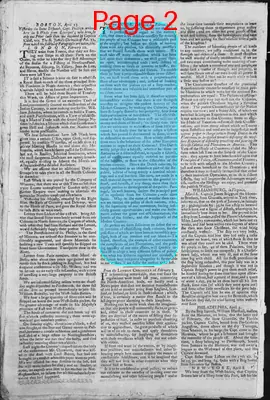
Editorial
April 19, 1765
The New Hampshire Gazette And Historical Chronicle
Portsmouth, Greenland, Rockingham County, New Hampshire
What is this article about?
An editorial from the Public Ledger urges Britain to lift trade restrictions on its colonies, treat them as equals to share in prosperity and burdens like the national debt, and emulate policies of the Dutch, Portugal, and Spain for mutual benefit.
Clipping
OCR Quality
98%
Excellent
Full Text
From the PUBLIC LEDGER. February 8.
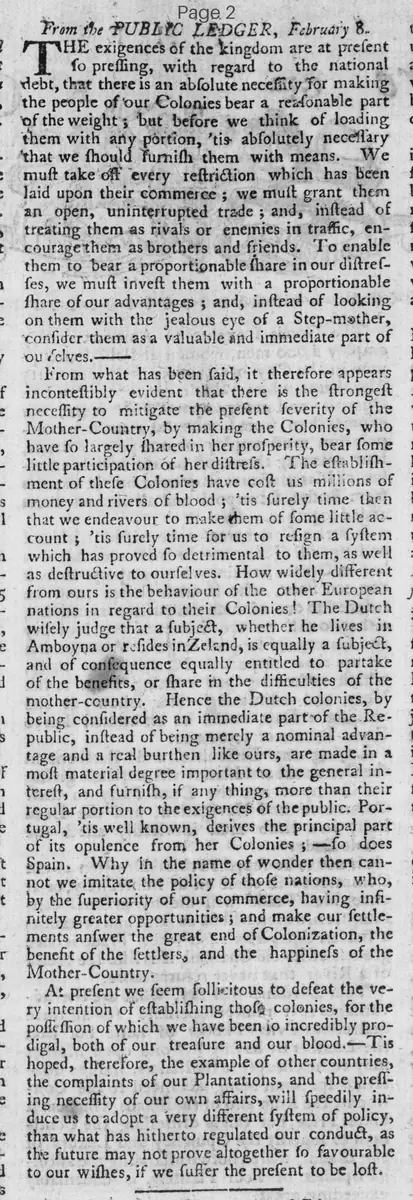
The exigencies of the kingdom are at present so pressing, with regard to the national debt, that there is an absolute necessity for making the people of our Colonies bear a reasonable part of the weight; but before we think of loading them with any portion, 'tis absolutely necessary that we should furnish them with means. We must take off every restriction which has been laid upon their commerce; we must grant them an open, uninterrupted trade; and, instead of treating them as rivals or enemies in traffic, encourage them as brothers and friends. To enable them to bear a proportionable share in our distresses, we must invest them with a proportionable share of our advantages; and, instead of looking on them with the jealous eye of a Step-mother, consider them as a valuable and immediate part of ourselves.
From what has been said, it therefore appears incontestibly evident that there is the strongest necessity to mitigate the present severity of the Mother-Country, by making the Colonies, who have so largely shared in her prosperity, bear some little participation of her distresses. The establishment of these Colonies have cost us millions of money and rivers of blood: 'tis surely time then that we endeavour to make them of some little account; tis surely time for us to resign a system which has proved so detrimental to them, as well as destructive to ourselves. How widely different from ours is the behaviour of the other European nations in regard to their Colonies! The Dutch wisely judge that a subject, whether he lives in Amboyna or resides in Zealand, is equally a subject, and of consequence equally entitled to partake of the benefits, or share in the difficulties of the mother-country. Hence the Dutch colonies, by being considered as an immediate part of the Republic, instead of being merely a nominal advantage and a real burthen like ours, are made in a most material degree important to the general interest, and furnish, if any thing, more than their regular portion to the exigences of the public. Portugal, 'tis well known, derives the principal part of its opulence from her Colonies; so does Spain. Why in the name of wonder then cannot we imitate the policy of those nations, who, by the superiority of our commerce, having infinitely greater opportunities; and make our settlements answer the great end of Colonization, the benefit of the settlers, and the happiness of the Mother-Country.
At present we seem solicitous to defeat the very intention of establishing those colonies, for the possession of which we have been so incredibly prodigal, both of our treasure and our blood. 'Tis hoped, therefore, the example of other countries, the complaints of our Plantations, and the pressing necessity of our own affairs, will speedily induce us to adopt a very different system of policy, than what has hitherto regulated our conduct, as the future may not prove altogether so favourable to our wishes, if we suffer the present to be lost.
The exigencies of the kingdom are at present so pressing, with regard to the national debt, that there is an absolute necessity for making the people of our Colonies bear a reasonable part of the weight; but before we think of loading them with any portion, 'tis absolutely necessary that we should furnish them with means. We must take off every restriction which has been laid upon their commerce; we must grant them an open, uninterrupted trade; and, instead of treating them as rivals or enemies in traffic, encourage them as brothers and friends. To enable them to bear a proportionable share in our distresses, we must invest them with a proportionable share of our advantages; and, instead of looking on them with the jealous eye of a Step-mother, consider them as a valuable and immediate part of ourselves.
From what has been said, it therefore appears incontestibly evident that there is the strongest necessity to mitigate the present severity of the Mother-Country, by making the Colonies, who have so largely shared in her prosperity, bear some little participation of her distresses. The establishment of these Colonies have cost us millions of money and rivers of blood: 'tis surely time then that we endeavour to make them of some little account; tis surely time for us to resign a system which has proved so detrimental to them, as well as destructive to ourselves. How widely different from ours is the behaviour of the other European nations in regard to their Colonies! The Dutch wisely judge that a subject, whether he lives in Amboyna or resides in Zealand, is equally a subject, and of consequence equally entitled to partake of the benefits, or share in the difficulties of the mother-country. Hence the Dutch colonies, by being considered as an immediate part of the Republic, instead of being merely a nominal advantage and a real burthen like ours, are made in a most material degree important to the general interest, and furnish, if any thing, more than their regular portion to the exigences of the public. Portugal, 'tis well known, derives the principal part of its opulence from her Colonies; so does Spain. Why in the name of wonder then cannot we imitate the policy of those nations, who, by the superiority of our commerce, having infinitely greater opportunities; and make our settlements answer the great end of Colonization, the benefit of the settlers, and the happiness of the Mother-Country.
At present we seem solicitous to defeat the very intention of establishing those colonies, for the possession of which we have been so incredibly prodigal, both of our treasure and our blood. 'Tis hoped, therefore, the example of other countries, the complaints of our Plantations, and the pressing necessity of our own affairs, will speedily induce us to adopt a very different system of policy, than what has hitherto regulated our conduct, as the future may not prove altogether so favourable to our wishes, if we suffer the present to be lost.
What sub-type of article is it?
Economic Policy
Trade Or Commerce
Imperialism
What keywords are associated?
Colonial Policy
Trade Restrictions
National Debt
Mother Country
European Colonies
British Commerce
What entities or persons were involved?
Britain
Colonies
Dutch
Portugal
Spain
Editorial Details
Primary Topic
Reforming British Colonial Trade Policy For Mutual Benefit
Stance / Tone
Advocating Fairer Treatment And Open Trade With Colonies
Key Figures
Britain
Colonies
Dutch
Portugal
Spain
Key Arguments
Lift Trade Restrictions To Enable Colonies To Contribute To National Debt
Treat Colonies As Brothers, Not Rivals, Sharing Advantages And Distresses
Abandon Detrimental System That Harms Both Colonies And Britain
Emulate Dutch Policy Of Equal Subject Rights For Colonies
Portugal And Spain Derive Wealth From Colonies; Britain Should Imitate
Current Policy Defeats Purpose Of Colonization, Wasting Treasure And Blood