Thank you for visiting SNEWPapers!
Sign up free
Editorial
March 3, 1891
Kansas Agitator
Garnett, Greeley, Topeka, Anderson County, Shawnee County, Kansas
What is this article about?
Terence V. Powderly, in an address, argues for total abstinence by pointing out how workers' resources spent on saloons could fund homes, education, and industrial institutes, while criticizing alcohol's role in enabling high taxes, land monopolies, and political corruption.
Clipping
OCR Quality
98%
Excellent
Full Text
Red Cross.
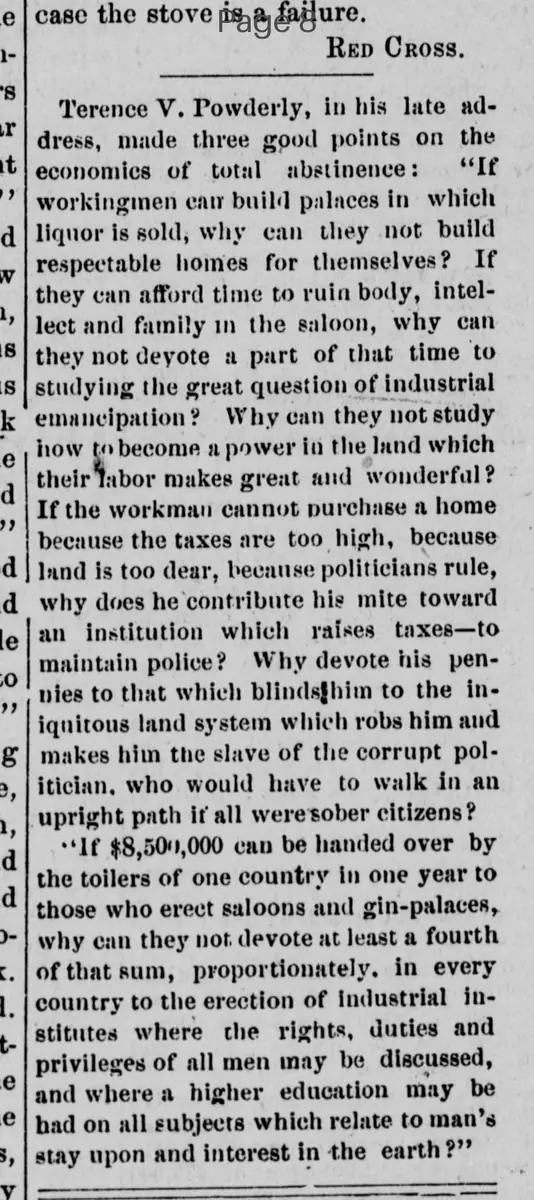
Terence V. Powderly, in his late address, made three good points on the economics of total abstinence: "If workingmen can build palaces in which liquor is sold, why can they not build respectable homes for themselves? If they can afford time to ruin body, intellect and family in the saloon, why can they not devote a part of that time to studying the great question of industrial emancipation? Why can they not study how to become a power in the land which their labor makes great and wonderful? If the workman cannot purchase a home because the taxes are too high, because land is too dear, because politicians rule, why does he contribute his mite toward an institution which raises taxes to maintain police? Why devote his pennies to that which blinds him to the iniquitous land system which robs him and makes him the slave of the corrupt politician, who would have to walk in an upright path if all were sober citizens? If $85,000,000 can be handed over by the toilers of one country in one year to those who erect saloons and gin-palaces, why can they not devote at least a fourth of that sum, proportionately, in every country to the erection of industrial institutes where the rights, duties and privileges of all men may be discussed, and where a higher education may be had on all subjects which relate to man's stay upon and interest in the earth?"
Terence V. Powderly, in his late address, made three good points on the economics of total abstinence: "If workingmen can build palaces in which liquor is sold, why can they not build respectable homes for themselves? If they can afford time to ruin body, intellect and family in the saloon, why can they not devote a part of that time to studying the great question of industrial emancipation? Why can they not study how to become a power in the land which their labor makes great and wonderful? If the workman cannot purchase a home because the taxes are too high, because land is too dear, because politicians rule, why does he contribute his mite toward an institution which raises taxes to maintain police? Why devote his pennies to that which blinds him to the iniquitous land system which robs him and makes him the slave of the corrupt politician, who would have to walk in an upright path if all were sober citizens? If $85,000,000 can be handed over by the toilers of one country in one year to those who erect saloons and gin-palaces, why can they not devote at least a fourth of that sum, proportionately, in every country to the erection of industrial institutes where the rights, duties and privileges of all men may be discussed, and where a higher education may be had on all subjects which relate to man's stay upon and interest in the earth?"
What sub-type of article is it?
Temperance
Labor
Economic Policy
What keywords are associated?
Total Abstinence
Workingmen
Industrial Emancipation
Saloons
Temperance Economics
Labor Reform
Political Corruption
What entities or persons were involved?
Terence V. Powderly
Editorial Details
Primary Topic
Economics Of Total Abstinence For Workers
Stance / Tone
Advocacy For Total Abstinence And Industrial Reform
Key Figures
Terence V. Powderly
Key Arguments
Workers Can Build Homes Instead Of Saloons If They Abstain From Liquor.
Time Spent In Saloons Ruining Health And Family Could Be Used To Study Industrial Emancipation.
Workers Should Become A Political Power Through Labor And Education Rather Than Supporting Saloons That Fund Police And Taxes.
Alcohol Blinds Workers To Land System Injustices And Enables Corrupt Politicians.
$85,000,000 Spent On Saloons Annually Could Fund Industrial Institutes For Education On Rights And Duties.