Thank you for visiting SNEWPapers!
Sign up free
Editorial
March 19, 1953
Miami Labor Citizen
Miami, Dade County, Florida
What is this article about?
A Congressman explains challenges of blockading Communist China to end the Korean War, noting limited impact on Soviet land imports, sea trade from Ceylon, Pakistan, and India, reduced Hong Kong trade from prior bill, need to blockade additional ports risking WW3, and preference for UN-approved embargoes.
Clipping
OCR Quality
98%
Excellent
Full Text
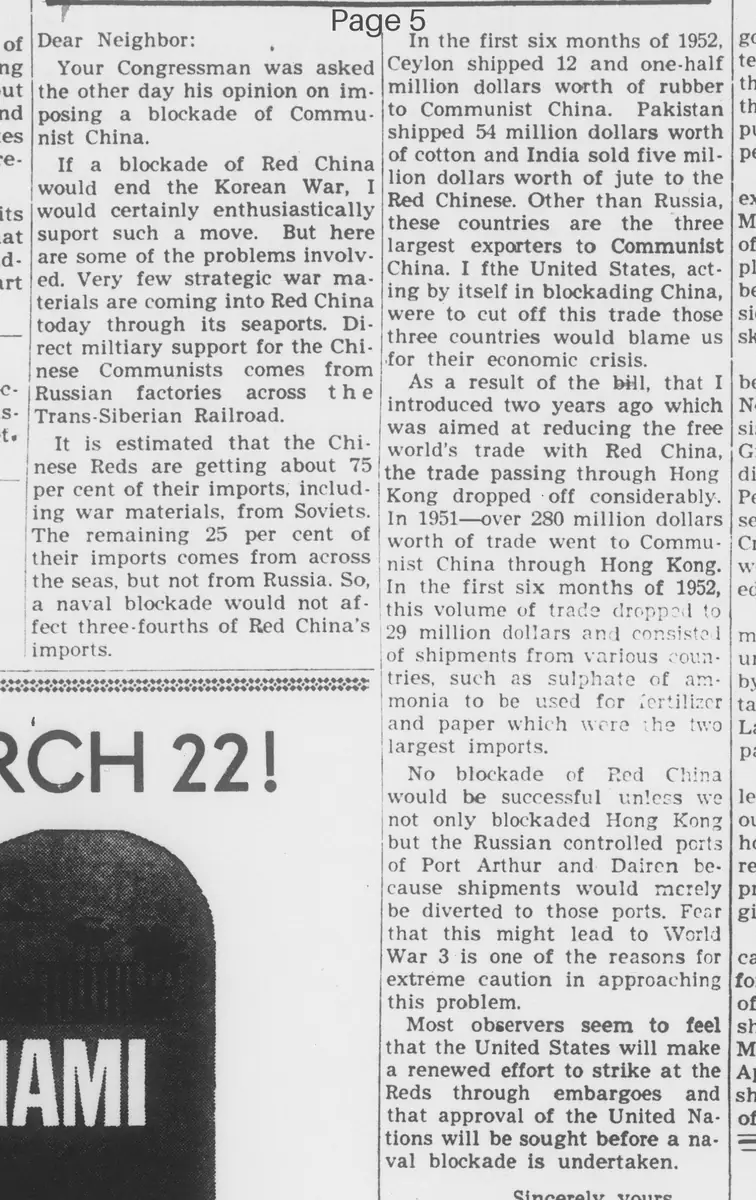
Dear Neighbor:
Your Congressman was asked the other day his opinion on imposing a blockade of Communist China.
If a blockade of Red China would end the Korean War, I would certainly enthusiastically support such a move.
But here are some of the problems involved. Very few strategic war materials are coming into Red China today through its seaports. Direct military support for the Chinese Communists comes from Russian factories across the Trans-Siberian Railroad.
It is estimated that the Chinese Reds are getting about 75 per cent of their imports, including war materials, from Soviets. The remaining 25 per cent of their imports comes from across the seas, but not from Russia. So, a naval blockade would not affect three-fourths of Red China's imports.
In the first six months of 1952, Ceylon shipped 12 and one-half million dollars worth of rubber to Communist China. Pakistan shipped 54 million dollars worth of cotton and India sold five million dollars worth of jute to the Red Chinese. Other than Russia, these countries are the three largest exporters to Communist China.
If the United States, acting by itself in blockading China, were to cut off this trade those three countries would blame us for their economic crisis.
As a result of the bill that I introduced two years ago which was aimed at reducing the free world's trade with Red China, the trade passing through Hong Kong dropped off considerably.
In 1951—over 280 million dollars worth of trade went to Communist China through Hong Kong. In the first six months of 1952, this volume of trade dropped to 29 million dollars and consisted of shipments from various countries, such as sulphate of ammonia to be used for fertilizer and paper which were the two largest imports.
No blockade of Red China would be successful unless we not only blockaded Hong Kong but the Russian controlled ports of Port Arthur and Dairen because shipments would merely be diverted to those ports. Fear that this might lead to World War 3 is one of the reasons for extreme caution in approaching this problem.
Most observers seem to feel that the United States will make a renewed effort to strike at the Reds through embargoes and that approval of the United Nations will be sought before a naval blockade is undertaken.
Your Congressman was asked the other day his opinion on imposing a blockade of Communist China.
If a blockade of Red China would end the Korean War, I would certainly enthusiastically support such a move.
But here are some of the problems involved. Very few strategic war materials are coming into Red China today through its seaports. Direct military support for the Chinese Communists comes from Russian factories across the Trans-Siberian Railroad.
It is estimated that the Chinese Reds are getting about 75 per cent of their imports, including war materials, from Soviets. The remaining 25 per cent of their imports comes from across the seas, but not from Russia. So, a naval blockade would not affect three-fourths of Red China's imports.
In the first six months of 1952, Ceylon shipped 12 and one-half million dollars worth of rubber to Communist China. Pakistan shipped 54 million dollars worth of cotton and India sold five million dollars worth of jute to the Red Chinese. Other than Russia, these countries are the three largest exporters to Communist China.
If the United States, acting by itself in blockading China, were to cut off this trade those three countries would blame us for their economic crisis.
As a result of the bill that I introduced two years ago which was aimed at reducing the free world's trade with Red China, the trade passing through Hong Kong dropped off considerably.
In 1951—over 280 million dollars worth of trade went to Communist China through Hong Kong. In the first six months of 1952, this volume of trade dropped to 29 million dollars and consisted of shipments from various countries, such as sulphate of ammonia to be used for fertilizer and paper which were the two largest imports.
No blockade of Red China would be successful unless we not only blockaded Hong Kong but the Russian controlled ports of Port Arthur and Dairen because shipments would merely be diverted to those ports. Fear that this might lead to World War 3 is one of the reasons for extreme caution in approaching this problem.
Most observers seem to feel that the United States will make a renewed effort to strike at the Reds through embargoes and that approval of the United Nations will be sought before a naval blockade is undertaken.
What sub-type of article is it?
Foreign Affairs
War Or Peace
What keywords are associated?
China Blockade
Korean War
Communist Imports
Soviet Support
Hong Kong Trade
Un Embargo
What entities or persons were involved?
Communist China
United States
Soviets
Ceylon
Pakistan
India
Hong Kong
Port Arthur
Dairen
United Nations
Editorial Details
Primary Topic
Problems With Blockading Communist China
Stance / Tone
Cautious Support Conditional On Ending Korean War But Highlighting Risks
Key Figures
Communist China
United States
Soviets
Ceylon
Pakistan
India
Hong Kong
Port Arthur
Dairen
United Nations
Key Arguments
Blockade Would Not Affect 75% Of Imports From Soviets Via Land
25% Sea Imports Mainly From Ceylon Rubber, Pakistan Cotton, India Jute
Unilateral Us Blockade Would Cause Economic Blame From Those Countries
Prior Bill Reduced Hong Kong Trade From 280m In 1951 To 29m In 1952 H1
Successful Blockade Requires Including Hong Kong And Russian Ports, Risking Ww3
Us Likely To Pursue Embargoes With Un Approval Instead