Thank you for visiting SNEWPapers!
Sign up free
Story
April 21, 1874
Oxford Democrat
Paris, South Paris, Oxford County, Maine
What is this article about?
At a Portland Board of Trade session, members debate and pass resolutions opposing expansion of irredeemable paper currency, urging Congress to promote specie payments resumption and appealing to the President against inflation bills.
Clipping
OCR Quality
98%
Excellent
Full Text
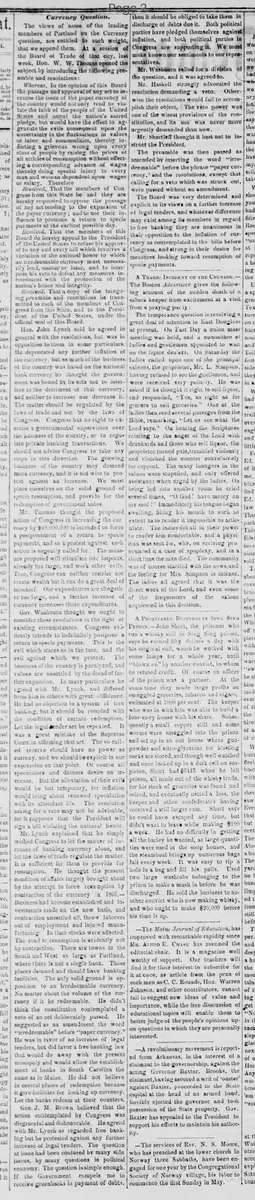
Currency Question.
The views of some of the leading members of Portland on the Currency question, are entitled to such weight, that we append them. At a session of the Board of Trade of that city, last week, Hon. W. W. Thomas opened the subject by introducing the following preamble and resolutions:
Whereas, In the opinion of this Board the passage and approval of any act to increase the issue of the paper currency of the country would not only tend to violate the faith of the people of the United States and annul the nation's sacred pledge, but would have the effect to aggravate the evils consequent upon the uncertainty in the fluctuations in values of labor and commodities, thereby inflicting a grievous wrong upon every class of people by raising the prices of all articles of consumption without effecting a corresponding advance of wages thereby doing special injury to every man and woman dependent upon wages or salary. Therefore
Resolved, That the members of Congress from this State be and they are hereby requested to oppose the passage of any act tending to the expansion of the paper currency; and to use their influence to promote a return to specie payments at the earliest possible day.
Resolved, That the members of this Board do hereby appeal to the President of the United States to refuse his approval to any and every bill which involves a violation of the national honor to which an irredeemable currency must necessarily lead, sooner or later, and to interpose his veto to defeat any measures inconsistent with the promotion of the nation's honor and integrity.
Resolved, That a copy of the foregoing preamble and resolutions be transmitted to each of the members of Congress from this State, and to the President of the United States, under the official seal of this Board.
Hon. John Lynch said he agreed in general with the resolutions, but was in opposition to them in some particulars. He deprecated any further inflation of the currency, but as much of the business of the country was based on the national bank currency he thought the government was bound by its acts not to interfere to the detriment of that currency, and neither to increase nor decrease it. The matter should be regulated by the laws of trade and not by the laws of Congress. Congress has no right to exercise a governmental supervision over the business of the country, or to regulate private banking transactions. We should not advise Congress to take any steps in this direction.
The growing business of the country may demand more currency, and it is not wise to protest against an increase. We must place ourselves on the solid ground of specie resumption, and provide for the redemption of government notes.
Mr. Thomas thought the proposed action of Congress in increasing the currency by $10,000,000 is intended to force a postponement of a return to specie payments, and so a protest against such action is urgently called for. The measure proposed will stimulate our imports, already too large, and work other evils. True, Congress can neither restrict nor create wealth but it can do a great deal of mischief. Our expenditures are altogether too large, and a farther increase of currency increases those expenditures.
Gov. Washburn thought we ought to consider these resolutions in the light of existing circumstances. Congress evidently intends to indefinitely postpone a return to specie payments. This is the evil which stares us in the face, and the evil against which we protest. The business of the country is paralyzed, and values are unsettled by the dread of further expansion. In many particulars he agreed with Mr. Lynch, and differed from him in others with great diffidence. He had no objection to a system of free banking, but it should be coupled with the condition of certain redemption. Let the legal tender act be repealed. It was a great mistake of the Supreme Court in affirming that act. The so called reserve should have no power as currency, and we should be explicit in our expression on that point. Of course all speculators and debtors desire an increase. But the alleviation of their evils would be but temporary, for inflation would bring about renewed speculation with its attendant ills. The resolution asking for a veto may not be advisable, for it supposes that the President will sign a bill violating the national honor.
Mr. Lynch explained that he simply wished Congress to let the matter of increase of banking currency alone, and let the laws of trade regulate the matter. It is sufficient for them to provide for resumption. He thought the present condition of affairs largely brought about by the attempt to force resumption by contraction of the currency in 1866,—Business had become established and investments made on the new basis, and contraction unsettled all, threw laborers out of employment and injured manufacturing. In time stocks were affected. The road to resumption is evidently not by contraction. There are towns in the South and West as large as Portland, where there is not a single bank. These places demand and should have banking facilities. The only solid ground is opposition to an irredeemable currency. No matter about the volume of the currency if it be redeemable. He didn't think the constitution contemplated a veto of an act deliberately passed. He suggested as an amendment the word "irredeemable" before "paper currency." He was in favor of no increase of legal tenders, but did favor a free banking law that would do away with the present monopoly and would allow the establishment of banks in South Carolina the same as in Maine. He did not believe in central places of redemption because it gives facilities for locking up currency. Let the banks redeem at their counters.
Gen. J. M. Brown believed that the action contemplated by Congress was disgraceful and dishonorable. He agreed with Mr. Lynch as regarded free banking but he protested against any further increase of legal tenders. The question at issue had been confused by many side issues, by many questions in political economy. The question is simple enough. If the Government compels me to receive greenbacks in payment of debts, then it should be obliged to take them in discharge of debts due it. Both political parties have pledged themselves against inflation, and both political parties in Congress are supporting it. We must make known our sentiments to our representatives.
Mr. Washburn called for a division of the question, and it was agreed to.
Mr. Haskell strongly advocated the resolution demanding a veto. Otherwise the resolutions would fail to accomplish their object. The veto power was one of the wisest provisions of the constitution, and its use was never more urgently demanded than now.
Mr. Shurtleff thought it best not to instruct the President.
The preamble was then passed as amended by inserting the word "irredeemable" before the phrase "paper currency." and the resolutions, except that calling for a veto which was struck out, were passed without an amendment.
The Board was very determined and explicit in its views on a further increase of legal tenders, and whatever difference may exist among its members in regard to free banking they are unanimous in their opposition to the inflation of currency as contemplated in the bills before Congress, and strong in their desire for measures looking toward resumption of specie payments.
The views of some of the leading members of Portland on the Currency question, are entitled to such weight, that we append them. At a session of the Board of Trade of that city, last week, Hon. W. W. Thomas opened the subject by introducing the following preamble and resolutions:
Whereas, In the opinion of this Board the passage and approval of any act to increase the issue of the paper currency of the country would not only tend to violate the faith of the people of the United States and annul the nation's sacred pledge, but would have the effect to aggravate the evils consequent upon the uncertainty in the fluctuations in values of labor and commodities, thereby inflicting a grievous wrong upon every class of people by raising the prices of all articles of consumption without effecting a corresponding advance of wages thereby doing special injury to every man and woman dependent upon wages or salary. Therefore
Resolved, That the members of Congress from this State be and they are hereby requested to oppose the passage of any act tending to the expansion of the paper currency; and to use their influence to promote a return to specie payments at the earliest possible day.
Resolved, That the members of this Board do hereby appeal to the President of the United States to refuse his approval to any and every bill which involves a violation of the national honor to which an irredeemable currency must necessarily lead, sooner or later, and to interpose his veto to defeat any measures inconsistent with the promotion of the nation's honor and integrity.
Resolved, That a copy of the foregoing preamble and resolutions be transmitted to each of the members of Congress from this State, and to the President of the United States, under the official seal of this Board.
Hon. John Lynch said he agreed in general with the resolutions, but was in opposition to them in some particulars. He deprecated any further inflation of the currency, but as much of the business of the country was based on the national bank currency he thought the government was bound by its acts not to interfere to the detriment of that currency, and neither to increase nor decrease it. The matter should be regulated by the laws of trade and not by the laws of Congress. Congress has no right to exercise a governmental supervision over the business of the country, or to regulate private banking transactions. We should not advise Congress to take any steps in this direction.
The growing business of the country may demand more currency, and it is not wise to protest against an increase. We must place ourselves on the solid ground of specie resumption, and provide for the redemption of government notes.
Mr. Thomas thought the proposed action of Congress in increasing the currency by $10,000,000 is intended to force a postponement of a return to specie payments, and so a protest against such action is urgently called for. The measure proposed will stimulate our imports, already too large, and work other evils. True, Congress can neither restrict nor create wealth but it can do a great deal of mischief. Our expenditures are altogether too large, and a farther increase of currency increases those expenditures.
Gov. Washburn thought we ought to consider these resolutions in the light of existing circumstances. Congress evidently intends to indefinitely postpone a return to specie payments. This is the evil which stares us in the face, and the evil against which we protest. The business of the country is paralyzed, and values are unsettled by the dread of further expansion. In many particulars he agreed with Mr. Lynch, and differed from him in others with great diffidence. He had no objection to a system of free banking, but it should be coupled with the condition of certain redemption. Let the legal tender act be repealed. It was a great mistake of the Supreme Court in affirming that act. The so called reserve should have no power as currency, and we should be explicit in our expression on that point. Of course all speculators and debtors desire an increase. But the alleviation of their evils would be but temporary, for inflation would bring about renewed speculation with its attendant ills. The resolution asking for a veto may not be advisable, for it supposes that the President will sign a bill violating the national honor.
Mr. Lynch explained that he simply wished Congress to let the matter of increase of banking currency alone, and let the laws of trade regulate the matter. It is sufficient for them to provide for resumption. He thought the present condition of affairs largely brought about by the attempt to force resumption by contraction of the currency in 1866,—Business had become established and investments made on the new basis, and contraction unsettled all, threw laborers out of employment and injured manufacturing. In time stocks were affected. The road to resumption is evidently not by contraction. There are towns in the South and West as large as Portland, where there is not a single bank. These places demand and should have banking facilities. The only solid ground is opposition to an irredeemable currency. No matter about the volume of the currency if it be redeemable. He didn't think the constitution contemplated a veto of an act deliberately passed. He suggested as an amendment the word "irredeemable" before "paper currency." He was in favor of no increase of legal tenders, but did favor a free banking law that would do away with the present monopoly and would allow the establishment of banks in South Carolina the same as in Maine. He did not believe in central places of redemption because it gives facilities for locking up currency. Let the banks redeem at their counters.
Gen. J. M. Brown believed that the action contemplated by Congress was disgraceful and dishonorable. He agreed with Mr. Lynch as regarded free banking but he protested against any further increase of legal tenders. The question at issue had been confused by many side issues, by many questions in political economy. The question is simple enough. If the Government compels me to receive greenbacks in payment of debts, then it should be obliged to take them in discharge of debts due it. Both political parties have pledged themselves against inflation, and both political parties in Congress are supporting it. We must make known our sentiments to our representatives.
Mr. Washburn called for a division of the question, and it was agreed to.
Mr. Haskell strongly advocated the resolution demanding a veto. Otherwise the resolutions would fail to accomplish their object. The veto power was one of the wisest provisions of the constitution, and its use was never more urgently demanded than now.
Mr. Shurtleff thought it best not to instruct the President.
The preamble was then passed as amended by inserting the word "irredeemable" before the phrase "paper currency." and the resolutions, except that calling for a veto which was struck out, were passed without an amendment.
The Board was very determined and explicit in its views on a further increase of legal tenders, and whatever difference may exist among its members in regard to free banking they are unanimous in their opposition to the inflation of currency as contemplated in the bills before Congress, and strong in their desire for measures looking toward resumption of specie payments.
What sub-type of article is it?
Historical Event
What themes does it cover?
Justice
Moral Virtue
What keywords are associated?
Currency Debate
Paper Currency
Specie Payments
Board Of Trade
Inflation Opposition
Free Banking
What entities or persons were involved?
W. W. Thomas
John Lynch
Washburn
J. M. Brown
Haskell
Shurtleff
Where did it happen?
Portland
Story Details
Key Persons
W. W. Thomas
John Lynch
Washburn
J. M. Brown
Haskell
Shurtleff
Location
Portland
Event Date
Last Week
Story Details
Hon. W. W. Thomas introduces preamble and resolutions opposing expansion of paper currency and urging return to specie payments; debate ensues with agreements and oppositions from John Lynch, Gov. Washburn, and others on inflation, free banking, and veto; resolutions passed with amendments excluding veto call.