Thank you for visiting SNEWPapers!
Sign up free
The Weekly Arizona Miner
Prescott, Yavapai County, Arizona
What is this article about?
A journalist recounts a 17-day ambulance and mule-back journey from Prescott through northern Arizona to Hardyville on the Colorado River and back, describing landscapes, settlements, military posts, mining areas, and hospitable locals met along the way.
Clipping
OCR Quality
Full Text
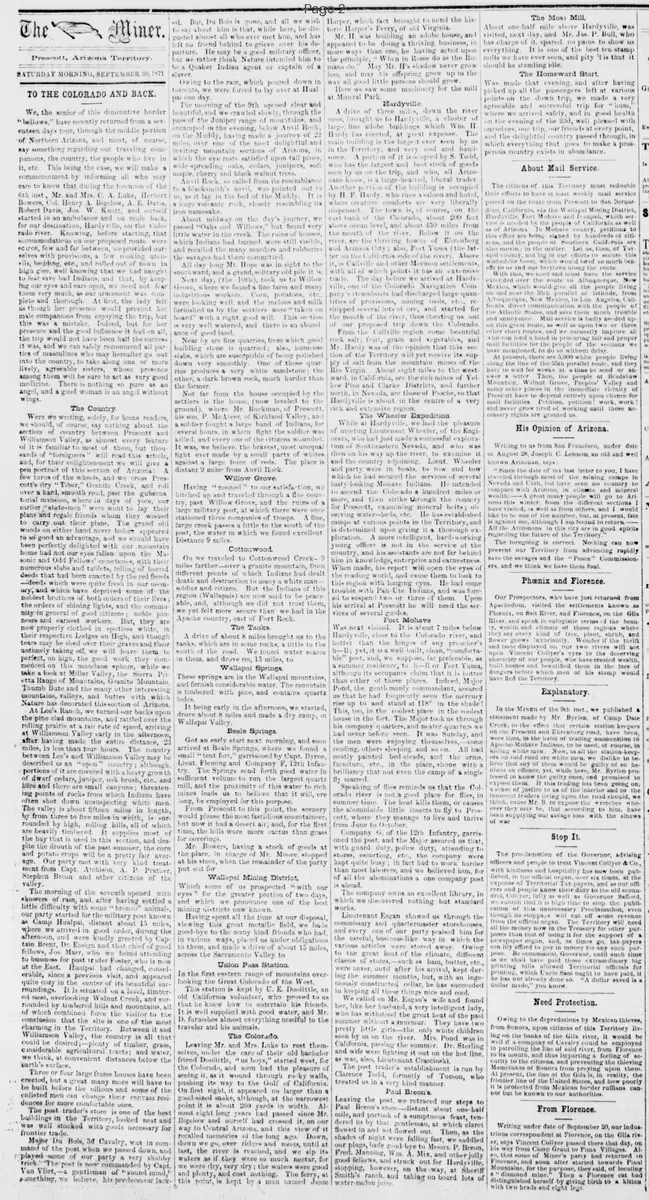
We, the senior of this diminutive border "bellows," have recently returned from a seventeen days tour, through the middle portion of Northern Arizona, and must, of course, say something regarding our traveling companions, the country, the people who live in it, etc. This being the case, we will make a commencement by informing all who may care to know that during the forenoon of the 6th inst., Mr. and Mrs. C. A. Luke, Herbert Bowers, Col. Henry A. Bigelow, A. E. Davis, Robert Davis, Jos. W. Knott, and ourself started in an ambulance and on mule back, for our destination, Hardyville, on the Colorado river. Knowing, before starting, that accommodations on our proposed route were scarce, few and far between, we provided ourselves with provisions, a few cooking utensils, bedding, etc., and rolled out of town in high glee, well knowing that we had naught to fear save bad Indians, and that, by keeping our eyes and ears open, we need not fear them very much, as our armament was complete and thorough. At first, the lady felt as though her presence would prevent her male companions from enjoying the trip, but this was a mistake. Indeed, but for her presence and the good influence it had on all, the trip would not have been half the success it was, and we can safely recommend all parties of masculines who may hereafter go out into the country, to take along one or more lively, agreeable sisters, whose presence among them will be sure to act as very good medicine. There is nothing so pure as an angel, and a good woman is an angel without wings.
The Country
Were we writing, solely, for home readers, we should, of course, say nothing about the section of country between Prescott and Williamson Valley, as almost every feature of it is familiar to most of them, but thousands of "foreigners" will read this article, and, for their enlightenment we will give a pen portrait of this section of Arizona: A few turns of the wheels, and we cross Prescott's dry "Tiber," Granite Creek, and roll over a hard, smooth road, past the gubernatorial mansion, where in days of yore, our earlier "statesmen" were wont to lay their plans and regale friends whom they wished to carry out their plan. The grand old woods on either hand never before appeared to so good an advantage, and we should have been perfectly delighted with our mountain home had not our eyes fallen upon the Masonic and Odd Fellows' cemeteries, with their numerous slabs and tablets, telling of horrid deeds that had been enacted by the red fiends—deeds which were quite fresh in our memory, and which have deprived some of the noblest brothers of both orders of their lives; the orders of shining lights, and the community in general of good citizens; noble pioneers and earnest workers. But, they are now properly clothed in spotless white, in their respective Lodges on High, and though tears may be shed over their graves and their untimely taking off, we will leave them to perfect, on high, the good work they commenced on this mundane sphere, while we take a look at Miller Valley, the Sierra Prieta Range of Mountains, Granite Mountain, Thumb Butte and the many other interesting mountains, valleys, and buttes with which Nature has decorated this section of Arizona.
At Lee's Ranch, we turned our backs upon the pine clad mountains, and rattled over the rolling prairie at a fair rate of speed, arriving at Williamson Valley early in the afternoon, after having made the entire distance, 23 miles, in less than four hours. The country between Lee's and Williamson Valley may be described as an "open" country; although, portions of it are covered with a heavy growth of dwarf cedars, juniper, oak brush, etc., and here and there are small canyons; threatening points of rocks from which Indians have often shot down unsuspecting white men.
The valley is about fifteen miles in length, by from three to five miles in width, is surrounded by light, rolling hills, all of which are heavily timbered. It supplies most of the hay that is used in this section, and despite the drouth of the past summer, the corn and potato crops will be a pretty fair average. Our party met with very kind treatment from Capt. Atchison, A. P. Prather, Stephen Brown and other citizens of the valley.
The morning of the seventh opened with showers of rain, and, after having settled a little difficulty with some "bronco" animals, our party started for the military post known as Camp Hualpai, distant about 15 miles, where we arrived in good order, during the afternoon, and were kindly greeted by Capt. Brent, Dr. Ensign and that chief of good fellows, Jos. Marr, who we found attending to business for post trader Foster, who is now at the East. Hualpai had changed, considerably, since a previous visit, and appeared quite cozy in the center of its beautiful surroundings. It is situated on a level, timbered mesa, overlooking Walnut Creek, and surrounded by timbered hills and mountains, all of which combined force the visitor to the conclusion that the site is one of the most charming in the Territory. Between it and Williamson Valley, the country is all that could be desired;—plenty of timber, grass, considerable agricultural tracts; and water, we think, at convenient distances below the earth's surface.
Three or four large frame houses have been erected, but a great many more will have to be built before the officers and some of the enlisted men can change their canvass residences for more comfortable ones.
The post trader's store is one of the best buildings in the Territory, looked neat and was well stocked with goods necessary for frontier trade.
Major Du Bois, 3d Cavalry, was in command of the post when we passed down, and played—some of our party a very shabby trick. The post is now commanded by Capt. Van Vliet,—a gentleman of "sound mind," something, we believe, his predecessor lacked.
But, Du Bois is gone, and all we wish to say about him is that, while here, he disgusted almost all who ever met him, and has left no friend behind to grieve over his departure. He may be a good military officer, but we rather think Nature intended him to be a Quaker Indian agent or captain of a slaver.
Owing to the rain, which poured down in torrents, we were forced to lay over at Hualpai one day.
The morning of the 8th opened clear and beautiful, and we crawled slowly, through the pass of the Juniper range of mountains, and encamped in the evening, below Anvil Rock, on the Muddy, having made a journey of 22 miles, over one of the most delightful and inviting mountain sections of Arizona, in which the eye rests satisfied upon tall pines, wide-spreading oaks, cedars, junipers, soft maple, cherry and black walnut trees.
Anvil Rock, so called from its resemblance to a blacksmith's anvil, was pointed out to us, as it lay in the bed of the Muddy. It is a huge volcanic rock, closely resembling its iron namesake.
About midway on the day's journey, we passed "Oaks and Willows," but found very little water in the creek. The ruins of houses, which Indians had burned, were still visible, and recalled the many murders and robberies the savages had there committed.
All day long Mt. Hope was in sight to the southward, and a grand, solitary old pile it is.
Next day, (the 9th), took us to Willow Grove, where we found a fine farm and many industrious workers. Corn, potatoes, etc., were looking well, and the melons and milk furnished us by the settlers were "taken on board" with a right good will. This section is very well watered, and there is an abundance of good land.
Near by are fine quarries, from which good building stone is quarried: also, immense slabs, which are susceptible of being polished down very smoothly. One of these quarries produces a very white sandstone; the other, a dark brown rock, much harder than the former.
Not far from the house occupied by the settlers is the house, (now leveled to the ground), where Mr. Buckman, of Prescott, his son, P. McAteer, of Kirkland Valley, and a soldier fought a large band of Indians, for several hours, in which fight the soldier was killed, and every one of the citizens wounded. It was, we believe, the bravest, most unequal fight ever made by a small party of whites against a large force of reds. The place is distant 9 miles from Anvil Rock.
Willow Grove.
Having "nooned" to our satisfaction, we hitched up and traveled through a fine country, past Willow Grove, and the ruins of a large military post, at which there were once stationed three companies of troops. A fine, large creek passes a little to the south of the post, the water in which we found excellent. Distance 9 miles.
Cottonwood.
On we traveled to Cottonwood Creek—11 miles farther—over a granite mountain, from different points of which Indians had dealt death and destruction to many a white man—soldier and citizen. But the Indians of this region (Wallapais) are now said to be peaceable, and, although we did not trust them, we yet felt more secure than we had in the Apache country, east of Fort Rock.
The Tanks.
A drive of about 8 miles brought us to the tanks, which are in some rocks, a little to the south of the road. We found water scarce in them, and drove on, 13 miles, to
Wallapai Springs.
These springs are in the Wallapai mountains, and furnish considerable water. The mountain is timbered with pine, and contains quartz lodes.
It being early in the afternoon, we started, drove about 8 miles and made a dry camp, in Wallapai Valley.
Beale Springs.
Got an early start next morning, and soon arrived at Beale Springs, where we found a small "tent fort," garrisoned by Capt. Byrne, Lieut. Fleming and Company F, 12th Infantry. The Springs send forth good water in sufficient volume to run the largest quartz mill, and the proximity of this water to rich mines leads us to believe that it will, ere long, be employed for this purpose.
From Prescott to this point, the scenery would please the most fastidious mountaineer, but now it had a desert air, and, for the first time, the hills wore more cactus than grass for coverings.
Mr. Bowers, having a stock of goods at the place, in charge of Mr. Moore, stopped at his store, when the remainder of the party put out for
Wallapai Mining District,
Which some of us prospected "with our eyes" for the greater portion of two days, and which we pronounce one of the best mining districts now known.
Having spent all the time at our disposal, viewing this great metallic field, we bade good-bye to the many kind friends who had, in various ways, placed us under obligations to them, and made a drive of about 15 miles, across the Sacramento Valley to
Union Pass Station.
In the first eastern range of mountains overlooking the Great Colorado of the West.
This station is kept by U. E. Doolittle, an old California volunteer, who proved to us that he knew how to entertain his friends. It is well supplied with good water, and Mr. D. furnishes almost everything needful to the traveler and his animals.
The Colorado.
Leaving Mr. and Mrs. Luke to rest themselves, under the care of their old bachelor friend Doolittle, "us boys," started west, for the Colorado, and soon had the pleasure of seeing it, as it wound through rocky walls, pushing its way to the Gulf of California.
On first sight, it appeared no larger than a good-sized snake, although, at the narrowest point it is about 200 yards in width. Almost eight long years had passed since Mr. Bigelow and ourself had crossed it, on our way to Central Arizona, and this view of it recalled memories of the long ago. Down, down we go, over ridges and mesas, until at last, the river is reached, and we sip its waters as if they were so much nectar, for we were very, very dry; the waters were good and plenty, and cost nothing. The ferry, at this point, is kept by a man named Jesse
Harper, which fact brought to mind the historic Harper's Ferry, of old Virginia.
Mr. H. was building an adobe house, and appeared to be doing a thriving business, in more ways than one, he having acted upon the principle, "When in Rome do as the Romans do." May Mr. H's shadow never grow less, and may his offspring grow up in the way all good little persons should grow.
Here we saw some machinery for the mill at Mineral Park.
Hardyville
A drive of three miles, down the river mesa, brought us to Hardyville, a cluster of large, fine adobe buildings which Wm. H. Hardy has erected, at great expense. The main building is the largest ever seen by us in the Territory, and very cool and handsome. A portion of it is occupied by S. Todd, who has the largest and best stock of goods seen by us on the trip, and who, all Arizo-nans know, is a large-hearted, liberal trader. Another portion of the building is occupied by H. F. Hardy, who runs a saloon and hotel, where creature comforts are very liberally dispensed. The town is, of course, on the east bank of the Colorado, about 200 feet above ocean level, and about 450 miles from the mouth of the river. Below it on the river, are the thriving towns of Ehrenberg and Arizona City; also, Fort Yuma (the lat-ter on the California side of the river. Above it, is Callville and other Mormon settlements, with all of which points it has an extensive trade. The day before we arrived at Hardy-ville, one of the Colorado Navigation Com-pany's steamboats had discharged large quan-tities of provisions, mining tools, etc., re-shipped several lots of ore, and started for the mouth of the river, thus cheating us out of our proposed trip down the Colorado.
From the Callville region come beautiful rock salt: fruit, grain and vegetables, and Mr. Hardy was of the opinion that this sec-tion of the Territory will yet receive its sup-ply of salt from the mountain mines of the Rio Virgin. About eight miles to the west-ward, in California, are the rich mines of Yel-low Pine and Clarke Districts, and further north, in Nevada, are those of Pioche, so that Hardyville is about in the centre of a very rich and extensive region.
The Wheeler Expedition
While at Hardyville, we had the pleasure of meeting Lieutenant Wheeler, of the Engi-neers, who had just made a successful explora-tion of Southeastern Nevada, and who was then on his way up the river, to examine it and the country adjoining. Lieut. Wheeler and party were in boats, to row and tow which he had secured the services of several lusty-looking Mohave Indians. He intended to ascend the Colorado a hundred miles or more, and then strike through the country for Prescott, examining mineral belts, ob-serving water-sheds, etc. He has established camps at various points in the Territory, and is determined upon giving it a thorough ex-ploration. A more intelligent, hard-working young officer is not in the service of the country, and his assistants are not far behind him in knowledge, enterprise and earnestness. When made, his report will open the eyes of the reading world, and cause them to look to this region with longing eyes. He had some trouble with Pah-Ute Indians, and was forc-ed to suspend two or three of them. Upon his arrival at Prescott he will need the ser-vices of several guides.
Fort Mohave
Was next visited. It is about 7 miles below Hardyville, close to the Colorado river, and hotter than the hinges of any preacher's h-ll: yet, it is a well-built, clean, "comforta-ble" post, and, we suppose, far preferable, as a summer residence, to h-ll or Fort Yuma, although its occupants claim that it is hotter than either of these places. Indeed, Major Pond, the gentlemanly commandant, assured us that he had frequently seen the mercury rise up to and stand at 118 in the shade! This, too, in the coolest place in the coolest house in the fort. The Major took us through his company quarters, and neater quarters we had never before seen. It was Sunday, and the men were enjoying themselves,—some reading, others sleeping, and so on. All had neatly painted bed steads, and the arms, furniture, etc., in the place, shone with a brilliancy that not even the camp of a single fly marred.
Speaking of flies reminds us that the Colorado river is not a good place for flies, in summer time. The heat kills them, or causes the abominable little insects to fly to Pres-cott, where they manage to live and thrive from June to October.
Company G, of the 12th Infantry, garri-soned the post, and the Major assured us that, with guard duty, police duty, attending to stores, escorting, etc., the company were kept quite busy: in fact had to work harder than most laborers, and we believed him, for of all the abominations a one company post is ahead.
The company owns an excellent library, in which we discovered nothing but standard works.
Lieutenant Eagan showed us through the commissary and quartermaster storehouses, and every one of our party praised him for the careful, business-like way in which the various articles were stored away. Owing to the great heat of the climate, different classes of stores,—such as ham, butter, etc., were never, until after his arrival, kept dur-ing the summer months, but, with an inge-niously constructed cellar, he has succeeded in keeping all these things nice and cool.
We called on Mr. Eagan's wife and found her, like her husband, a very intelligent lady, who has withstood the great heat of the past summer without a murmur. They have two pretty little girls—the only white children seen by us on the river. Mrs. Pond was in California, passing the summer. Dr. Sterling and wife were fighting it out on the hot line, as was, also, Lieutenant Krascinski.
The post trader's establishment is run by Clarence Todd, formerly of Tucson, who treated us in a very kind manner.
Paul Breon's.
Leaving the post, we retraced our steps to Paul Breon's store—distant about one-half mile, and partook of a sumptuous feast, ten-dered us by that gentleman, at which claret flowed in and ale flowed out. Then, as the shades of night were falling fast, we saddled our plugs, bade good-bye to Messrs. P. Breon, Fred. Manning, Wm. A. Mix, and other jolly good fellows, and struck out for Hardyville, stopping, however, on the way, at Sheriff Smith's ranch, and taking on board lots of water-melon juice.
The Most Mill,
About one-half mile above Hardyville, was visited, next day, and Mr. Jas. P. Bull, who has charge of it, spared no pains to show us everything. It is one of the best ten-stamp mills we have ever seen, and pity 't is that it should be standing idle.
The Homeward Start
Was made that evening, and after having picked up all the passengers left at various points on the down trip, we made a very agreeable and successful trip for home, where we arrived safely, and in good health on the evening of the 23d, well pleased with ourselves, our trip, our friends at every point, and the delightful country passed through, in which everything that goes to make a pros-perous country exists in abundance.
What sub-type of article is it?
What themes does it cover?
What keywords are associated?
What entities or persons were involved?
Where did it happen?
Story Details
Key Persons
Location
Northern Arizona, From Prescott To Hardyville On The Colorado River
Event Date
Forenoon Of The 6th Inst. To Evening Of The 23d
Story Details
A party travels by ambulance and mule from Prescott through Williamson Valley, Camp Hualpai, Willow Grove, Wallapai Mining District, to Hardyville, visiting Fort Mohave and other sites, describing scenery, settlements, military posts, and mining prospects before returning home safely.