Thank you for visiting SNEWPapers!
Sign up free
Letter to Editor
May 25, 1824
Edwardsville Spectator
Edwardsville, Madison County, Illinois
What is this article about?
A witness reports a dialogue between a Quaker and a dram-drinker, where the Quaker persuasively argues against the common use of whiskey, highlighting its harms to health, wealth, society, and souls, and criticizes religious involvement in its production and sale.
Clipping
OCR Quality
98%
Excellent
Full Text
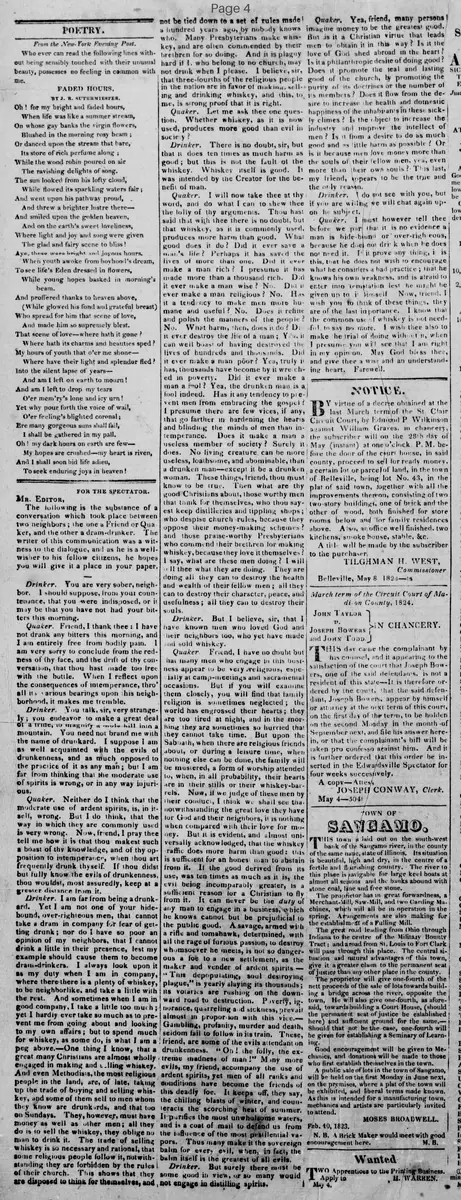
FOR THE SPECTATOR.
Mr. Editor,
The following is the substance of a conversation which took place between two neighbors; the one a Friend or Quaker, and the other a dram-drinker. The writer of this communication was a witness to the dialogue, and as he is a well-wisher to his fellow citizens, he hopes you will give it a place in your paper.
Drinker. You are very sober, neighbor. I should suppose, from your countenance, that you were indisposed, or it may be that you have not had your bitters this morning.
Quaker. Friend, I thank thee: I have not drank any bitters this morning, and I am entirely free from bodily pain. I am very sorry to conclude from the redness of thy face, and the drift of thy conversation, that thou hast made too free with the bottle. When I reflect upon the consequences of intemperance, thro' all its various bearings upon this neighborhood, it makes me tremble.
Drinker. You talk, sir, very strangely; you endeavor to make a great deal of a trifle, to magnify a mole hill into a mountain. You need not brand me with the name of drunkard. I suppose I am as well acquainted with the evils of drunkenness, and as much opposed to the practice of it as any man; but I am far from thinking that the moderate use of spirits is wrong, or in any way injurious.
Quaker. Neither do I think that the moderate use of ardent spirits, is, in itself, wrong. But I do think, that the way in which they are commonly used is very wrong. Now, friend, I pray thee tell me how it is that thou makest such a boast of thy knowledge, and of thy opposition to intemperance, when thou art frequently drunk thyself. If thou didst but fully know the evils of drunkenness, thou wouldst, most assuredly, keep at a greater distance from it.
Drinker. I am far from being a drunkard. Yet I am not one of your hide-bound, over-righteous men, that cannot take a dram in company for fear of getting drunk; nor do I have so poor an opinion of my neighbors, that I cannot drink a little in their presence, lest my example should cause them to become dram-drinkers. I always look upon it as my duty when I am in company, where there is a plenty of whiskey, to be neighborlike, and take a little with the rest. And sometimes when I am in good company, I take a little too much; yet I hardly ever take so much as to prevent me from going about and looking to my own affairs; but to spend much for whiskey, as some do, is what I am a peg above. One thing I know, that a great many Christians are almost wholly engaged in making and selling whiskey. And even Methodists, the most religious people in the land, are, of late, taking up the trade of buying and selling whiskey, and some of them sell to men whom they know are drunkards, and that too on Sundays. They, however, must have money as well as other men; all they do is to sell the whiskey, they oblige no man to drink it. The trade of selling whiskey is so necessary and rational, that some religious people follow it, notwithstanding they are forbidden by the rules of their church. This shows that they are disposed to think for themselves, and not be tied down to a set of rules made a hundred years ago, by nobody knows who. Many Presbyterians make whiskey, and are often commended by their brethren for so doing. And it is plaguy hard if I, who belong to no church, may not drink when I please. I believe, sir, that three-fourths of the religious people in the nation are in favor of making, selling and drinking whiskey, and this, to me, is strong proof that it is right.
Quaker. Let me ask thee one question. Whether whiskey, as it is now used, produces more good than evil in society?
Drinker. There is no doubt, sir, but that it does ten times as much harm as good; but this is not the fault of the whiskey. Whiskey itself is good. It was intended by the Creator for the benefit of man.
Quaker. I will now take thee at thy word, and do what I can to show thee the folly of thy arguments. Thou hast said that with thee there is no doubt, but that whiskey, as it is commonly used, produces more harm than good. What good does it do? Did it ever save a man's life? Perhaps it has saved the lives of more than one. Did it ever make a man rich? I presume it has made more than a thousand rich. Did it ever make a man wise? No. Did it ever make a man religious? No. Has it a tendency to make men more humane and useful? No. Does it refine and polish the manners of the people? No. What harm, then, does it do? Did it ever destroy the life of a man? Yea, it can well boast of having destroyed the lives of hundreds and thousands. Did it ever make a man poor? Yea, truly it has, thousands have become wretched in poverty: Did it ever make a man a fool? Yea, the drunken man is a fool indeed. Has it any tendency to prevent men from embracing the gospel? I presume there are few vices, if any, that go farther in hardening the hearts and blinding the minds of men than intemperance. Does it make a man a useless member of society? Surely it does. No living creature can be more useless, loathsome, and abominable, than a drunken man--except it be a drunken woman. These things, friend, thou must know to be true. Then what are thy good Christians about, those worthy men that think for themselves, who thou sayest keep distilleries and tippling shops; who despise church rules, because they oppose their money-making schemes? and those praise-worthy Presbyterians who commend their brethren for making whiskey, because they love it themselves? I say, what are these men doing? I will tell thee what they are doing. They are doing all they can to destroy the health and wealth of their fellow men; all they can to destroy their character, peace, and usefulness; all they can to destroy their souls.
Drinker. But I believe, sir, that I have known men who loved God and their neighbors too, who yet have made and sold whiskey.
Quaker. Friend, I have no doubt but that many men who engage in this business appear to be very religious, especially at camp-meetings and sacramental occasions. But if you will examine them closely, you will find that family religion is sometimes neglected; the world has engrossed their hearts; they are too tired at night, and in the morning they are sometimes so hurried that they cannot take time. But upon the Sabbath, when there are religious friends about, or during a leisure time, when nothing else can be done, the family will be mustered, a form of worship attended to, when, in all probability, their hearts are in their stills or their whiskey-barrels. Now, if we judge of these men by their conduct, I think we shall see that, notwithstanding the great love they have for God and their neighbors, it is nothing when compared with their love for money. But it is evident, and almost universally acknowledged, that the whiskey traffic does more harm than good: this is sufficient for an honest man to abstain from it. If the good derived from its use, was ten times as much as it is, the evil being incomparably greater, is a sufficient reason for a Christian to fly from it. It can never be the duty of any man to engage in a business, which he knows cannot but be prejudicial to the public good. A savage, armed with a rifle and tomahawk, determined, with all the rage of furious passion, to destroy whomsoever he meets, is not so dangerous a foe to a new settlement, as the maker and vender of ardent spirits. "This depopulating, soul destroying plague," is yearly slaying its thousands; its votaries are rushing on the downward road to destruction. Poverty, ignorance, quarreling and sickness, prevail almost in proportion with this vice. Gambling, profanity, murder and death, seldom fail to follow in its train. These, friend, are some of the evils attendant on drunkenness. "Oh! the folly, the extreme madness of man!" Many more evils, my friend, accompany the use of ardent spirits, yet men of all ranks and conditions have become the friends of this deadly foe. It keeps off, they say, the chilling blasts of winter, and counteracts the scorching heat of summer. It purifies the most unwholesome waters, and is a coat of mail to defend us from the influence of the most pestilential vapors. Thus many make it the sovereign balm for every evil, when, in fact, the balm itself is the greatest of all evils.
Drinker. But surely there must be some good in view, or so many would not engage in distilling spirits.
Quaker. Yea, friend, many persons imagine money to be the greatest good. But is it a Christian virtue that leads men to obtain it in this way? Is it the love of God shed abroad in the heart? Is it a philanthropic desire of doing good? Does it promote the real and lasting good of the church, by promoting the purity of its doctrines or the number of its members? Does it flow from the desire to increase the health and domestic happiness of the inhabitants in these sickly climes? Is the object to increase the industry and improve the intellect of men? Is it from a desire to do as much good and as little harm as possible? Or is it because men love money more than the souls of their fellow men, yea, even more than their own souls? This last, my friend, appears to be the true and the only reason.
Drinker. I do not see with you, but if you are willing we will chat again upon the subject.
Quaker. I must however tell thee before we part that it is no evidence a man is hide-bound or over-righteous, because he does not drink when he does not need it. If it prove any thing, it is this, that he does not wish to encourage what he considers a bad practice; that he knows his own weakness, and is afraid to enter into temptation lest he might be given unto it himself. Now, friend, I wish you to think of these things. They are of the last importance. I know that the common use of whiskey is not needful, to say no more. I wish thee also to make the trial of doing without it, when I presume you will see that I am right in my opinion. May God bless thee, and give thee a wise and an understanding heart. Farewell.
Mr. Editor,
The following is the substance of a conversation which took place between two neighbors; the one a Friend or Quaker, and the other a dram-drinker. The writer of this communication was a witness to the dialogue, and as he is a well-wisher to his fellow citizens, he hopes you will give it a place in your paper.
Drinker. You are very sober, neighbor. I should suppose, from your countenance, that you were indisposed, or it may be that you have not had your bitters this morning.
Quaker. Friend, I thank thee: I have not drank any bitters this morning, and I am entirely free from bodily pain. I am very sorry to conclude from the redness of thy face, and the drift of thy conversation, that thou hast made too free with the bottle. When I reflect upon the consequences of intemperance, thro' all its various bearings upon this neighborhood, it makes me tremble.
Drinker. You talk, sir, very strangely; you endeavor to make a great deal of a trifle, to magnify a mole hill into a mountain. You need not brand me with the name of drunkard. I suppose I am as well acquainted with the evils of drunkenness, and as much opposed to the practice of it as any man; but I am far from thinking that the moderate use of spirits is wrong, or in any way injurious.
Quaker. Neither do I think that the moderate use of ardent spirits, is, in itself, wrong. But I do think, that the way in which they are commonly used is very wrong. Now, friend, I pray thee tell me how it is that thou makest such a boast of thy knowledge, and of thy opposition to intemperance, when thou art frequently drunk thyself. If thou didst but fully know the evils of drunkenness, thou wouldst, most assuredly, keep at a greater distance from it.
Drinker. I am far from being a drunkard. Yet I am not one of your hide-bound, over-righteous men, that cannot take a dram in company for fear of getting drunk; nor do I have so poor an opinion of my neighbors, that I cannot drink a little in their presence, lest my example should cause them to become dram-drinkers. I always look upon it as my duty when I am in company, where there is a plenty of whiskey, to be neighborlike, and take a little with the rest. And sometimes when I am in good company, I take a little too much; yet I hardly ever take so much as to prevent me from going about and looking to my own affairs; but to spend much for whiskey, as some do, is what I am a peg above. One thing I know, that a great many Christians are almost wholly engaged in making and selling whiskey. And even Methodists, the most religious people in the land, are, of late, taking up the trade of buying and selling whiskey, and some of them sell to men whom they know are drunkards, and that too on Sundays. They, however, must have money as well as other men; all they do is to sell the whiskey, they oblige no man to drink it. The trade of selling whiskey is so necessary and rational, that some religious people follow it, notwithstanding they are forbidden by the rules of their church. This shows that they are disposed to think for themselves, and not be tied down to a set of rules made a hundred years ago, by nobody knows who. Many Presbyterians make whiskey, and are often commended by their brethren for so doing. And it is plaguy hard if I, who belong to no church, may not drink when I please. I believe, sir, that three-fourths of the religious people in the nation are in favor of making, selling and drinking whiskey, and this, to me, is strong proof that it is right.
Quaker. Let me ask thee one question. Whether whiskey, as it is now used, produces more good than evil in society?
Drinker. There is no doubt, sir, but that it does ten times as much harm as good; but this is not the fault of the whiskey. Whiskey itself is good. It was intended by the Creator for the benefit of man.
Quaker. I will now take thee at thy word, and do what I can to show thee the folly of thy arguments. Thou hast said that with thee there is no doubt, but that whiskey, as it is commonly used, produces more harm than good. What good does it do? Did it ever save a man's life? Perhaps it has saved the lives of more than one. Did it ever make a man rich? I presume it has made more than a thousand rich. Did it ever make a man wise? No. Did it ever make a man religious? No. Has it a tendency to make men more humane and useful? No. Does it refine and polish the manners of the people? No. What harm, then, does it do? Did it ever destroy the life of a man? Yea, it can well boast of having destroyed the lives of hundreds and thousands. Did it ever make a man poor? Yea, truly it has, thousands have become wretched in poverty: Did it ever make a man a fool? Yea, the drunken man is a fool indeed. Has it any tendency to prevent men from embracing the gospel? I presume there are few vices, if any, that go farther in hardening the hearts and blinding the minds of men than intemperance. Does it make a man a useless member of society? Surely it does. No living creature can be more useless, loathsome, and abominable, than a drunken man--except it be a drunken woman. These things, friend, thou must know to be true. Then what are thy good Christians about, those worthy men that think for themselves, who thou sayest keep distilleries and tippling shops; who despise church rules, because they oppose their money-making schemes? and those praise-worthy Presbyterians who commend their brethren for making whiskey, because they love it themselves? I say, what are these men doing? I will tell thee what they are doing. They are doing all they can to destroy the health and wealth of their fellow men; all they can to destroy their character, peace, and usefulness; all they can to destroy their souls.
Drinker. But I believe, sir, that I have known men who loved God and their neighbors too, who yet have made and sold whiskey.
Quaker. Friend, I have no doubt but that many men who engage in this business appear to be very religious, especially at camp-meetings and sacramental occasions. But if you will examine them closely, you will find that family religion is sometimes neglected; the world has engrossed their hearts; they are too tired at night, and in the morning they are sometimes so hurried that they cannot take time. But upon the Sabbath, when there are religious friends about, or during a leisure time, when nothing else can be done, the family will be mustered, a form of worship attended to, when, in all probability, their hearts are in their stills or their whiskey-barrels. Now, if we judge of these men by their conduct, I think we shall see that, notwithstanding the great love they have for God and their neighbors, it is nothing when compared with their love for money. But it is evident, and almost universally acknowledged, that the whiskey traffic does more harm than good: this is sufficient for an honest man to abstain from it. If the good derived from its use, was ten times as much as it is, the evil being incomparably greater, is a sufficient reason for a Christian to fly from it. It can never be the duty of any man to engage in a business, which he knows cannot but be prejudicial to the public good. A savage, armed with a rifle and tomahawk, determined, with all the rage of furious passion, to destroy whomsoever he meets, is not so dangerous a foe to a new settlement, as the maker and vender of ardent spirits. "This depopulating, soul destroying plague," is yearly slaying its thousands; its votaries are rushing on the downward road to destruction. Poverty, ignorance, quarreling and sickness, prevail almost in proportion with this vice. Gambling, profanity, murder and death, seldom fail to follow in its train. These, friend, are some of the evils attendant on drunkenness. "Oh! the folly, the extreme madness of man!" Many more evils, my friend, accompany the use of ardent spirits, yet men of all ranks and conditions have become the friends of this deadly foe. It keeps off, they say, the chilling blasts of winter, and counteracts the scorching heat of summer. It purifies the most unwholesome waters, and is a coat of mail to defend us from the influence of the most pestilential vapors. Thus many make it the sovereign balm for every evil, when, in fact, the balm itself is the greatest of all evils.
Drinker. But surely there must be some good in view, or so many would not engage in distilling spirits.
Quaker. Yea, friend, many persons imagine money to be the greatest good. But is it a Christian virtue that leads men to obtain it in this way? Is it the love of God shed abroad in the heart? Is it a philanthropic desire of doing good? Does it promote the real and lasting good of the church, by promoting the purity of its doctrines or the number of its members? Does it flow from the desire to increase the health and domestic happiness of the inhabitants in these sickly climes? Is the object to increase the industry and improve the intellect of men? Is it from a desire to do as much good and as little harm as possible? Or is it because men love money more than the souls of their fellow men, yea, even more than their own souls? This last, my friend, appears to be the true and the only reason.
Drinker. I do not see with you, but if you are willing we will chat again upon the subject.
Quaker. I must however tell thee before we part that it is no evidence a man is hide-bound or over-righteous, because he does not drink when he does not need it. If it prove any thing, it is this, that he does not wish to encourage what he considers a bad practice; that he knows his own weakness, and is afraid to enter into temptation lest he might be given unto it himself. Now, friend, I wish you to think of these things. They are of the last importance. I know that the common use of whiskey is not needful, to say no more. I wish thee also to make the trial of doing without it, when I presume you will see that I am right in my opinion. May God bless thee, and give thee a wise and an understanding heart. Farewell.
What sub-type of article is it?
Persuasive
Ethical Moral
Religious
What themes does it cover?
Temperance
Morality
Religion
What keywords are associated?
Temperance
Intemperance
Whiskey
Quaker
Dialogue
Moral Reform
Religious Hypocrisy
Ardent Spirits
What entities or persons were involved?
Mr. Editor
Letter to Editor Details
Recipient
Mr. Editor
Main Argument
the common use of whiskey produces far more harm than good in society, destroying lives, wealth, character, and souls, and no honest or christian person should engage in its production, sale, or consumption.
Notable Details
Dialogue Between Quaker And Drinker
Criticism Of Methodists And Presbyterians In Whiskey Trade
Lists Harms: Poverty, Ignorance, Quarreling, Sickness, Gambling, Profanity, Murder
Quotes: 'This Depopulating, Soul Destroying Plague'
'Oh! The Folly, The Extreme Madness Of Man!'