Thank you for visiting SNEWPapers!
Sign up free
Gazette Of The United States & Evening Advertiser
Philadelphia, Philadelphia County, Pennsylvania
What is this article about?
On January 20, in the House of Representatives, Mr. Lee spoke in committee of the whole on Mr. Madison's resolutions, arguing for national self-determination in government and commerce, emphasizing that each nation best judges its own interests without foreign interference.
Clipping
OCR Quality
Full Text
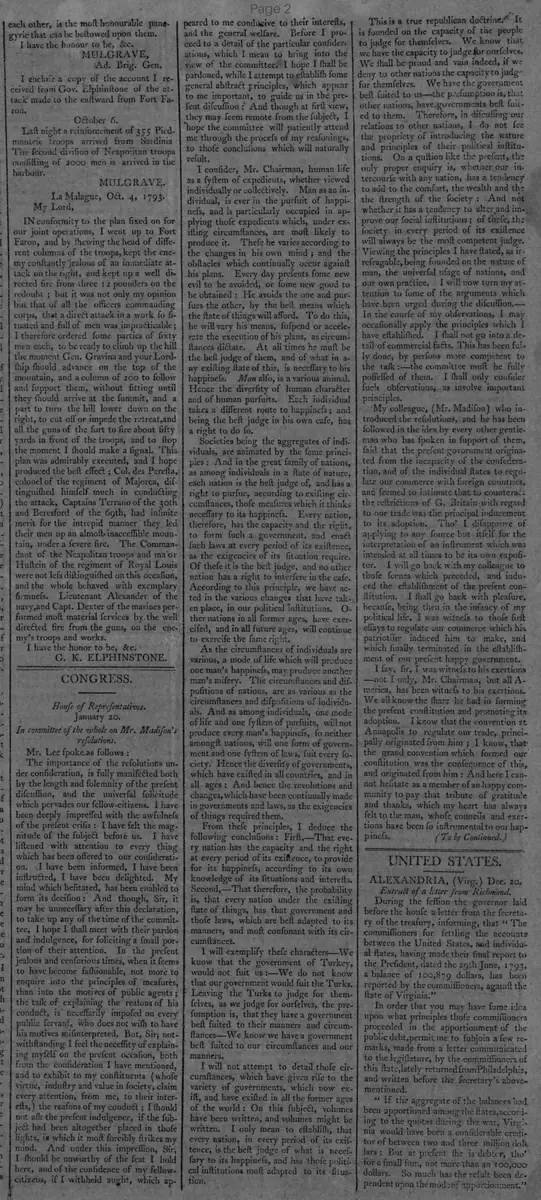
House of Representatives.
January 20.
In committee of the whole on Mr. Madison's resolutions.
Mr. Lee spoke as follows:
The importance of the resolutions under consideration, is fully manifested both by the length and solemnity of the present discussion, and the universal solicitude which pervades our fellow-citizens. I have been deeply impressed with the awfulness of the present crisis: I have felt the magnitude of the subject before us. I have listened with attention to every thing which has been offered to our consideration. I have been informed, I have been instructed, I have been delighted. My mind which hesitated, has been enabled to form its decision: And though, Sir, it may be unnecessary after this declaration, to take up any of the time of the committee, I hope I shall meet with their pardon and indulgence, for soliciting a small portion of their attention. In the present jealous and censorious times, when it seems to have become fashionable, not more to enquire into the principles of measures, than into the motives of public agents; the task of explaining the reasons of his conduct, is necessarily imposed on every public servant, who does not wish to have his motives misinterpreted. But, Sir; notwithstanding I feel the necessity of explaining myself on the present occasion, both from the consideration I have mentioned, and to exhibit to my constituents (whose virtue, industry and value in society, claim every attention, from me, to their interests,) the reasons of my conduct; I should not ask the present indulgence, if the subject had been altogether placed in those lights, in which it most forcibly strikes my mind. And under this impression, Sir, I should be unworthy of the seat I hold here, and of the confidence of my fellow citizens, if I withheld aught, which appeared to me conducive to their interests, and the general welfare. Before I proceed to a detail of the particular considerations, which I mean to bring into the view of the committee. I hope I shall be pardoned, while I attempt to establish some general abstract principles, which appear to me important, to guide us in the present discussion: And though at first view, they may seem remote from the subject, I hope the committee will patiently attend me through the process of my reasonings, to those conclusions which will naturally result.
I consider, Mr. Chairman, human life as a system of expedients, whether viewed individually or collectively. Man as an individual, is ever in the pursuit of happiness, and is particularly occupied in applying those expedients which, under existing circumstances, are most likely to produce it. These he varies according to the changes in his own mind; and the obstacles which continually occur against his plans. Every day presents some new evil to be avoided, or some new good to be obtained: He avoids the one and pursues the other, by the best means which the state of things will afford. To do this, he will vary his means, suspend or accelerate the execution of his plans, as circumstances dictate. At all times he must be the best judge of them, and of what in any existing state of this, is necessary to his happiness. Man also, is a various animal. Hence the diversity of human character and of human pursuits. Each individual takes a different route to happiness; and being the best judge in his own case, has a right to do so.
Societies being the aggregates of individuals, are animated by the same principles: And in the great family of nations, as among individuals in a state of nature, each nation is the best judge of, and has a right to pursue, according to existing circumstances, those measures which it thinks necessary to its happiness. Every nation, therefore, has the capacity and the right, to form such a government, and enact such laws at every period of its existence, as the exigencies of its situation require. Of these it is the best judge, and no other nation has a right to interfere in the case.
According to this principle, we have acted in the various changes that have taken place, in our political institutions. Other nations in all former ages, have exercised, and in all future ages, will continue to exercise the same right.
As the circumstances of individuals are various, a mode of life which will produce one man's happiness, may produce another man's misery. The circumstances and dispositions of nations, are as various as the circumstances and dispositions of individuals. And as among individuals, one mode of life and one system of pursuits, will not produce every man's happiness, so neither amongst nations, will one form of government and one system of laws, suit every society. Hence the diversity of governments, which have existed in all countries, and in all ages: And hence the revolutions and changes, which have been continually made in governments and laws, as the exigencies of things required them.
From these principles, I deduce the following conclusions: First,—That every nation has the capacity and the right at every period of its existence, to provide for its happiness, according to its own knowledge of its situations and interests. Second, -That therefore, the probability is, that every nation under the existing state of things, has that government and those laws, which are best adapted to its manners, and most consonant with its circumstances.
I will exemplify these characters We know that the government of Turkey, would not suit us:-We do not know that our government would suit the Turks. Leaving the Turks to judge for themselves, as we judge for ourselves, the presumption is, that they have a government best suited to their manners and circumstances-We know we have a government best suited to our circumstances and our manners.
I will not attempt to detail those circumstances, which have given rise to the variety of governments, which now exist, and have existed in all the former ages of the world: On this subject, volumes have been written, and volumes might be written. I only mean to establish, that every nation, in every period of its existence, is the best judge of what is necessary to its happiness, and has those political institutions most adapted to its situation.
This is a true republican doctrine. It is founded on the capacity of the people to judge for themselves. We know that we have the capacity to judge for ourselves. We shall be proud and vain indeed, if we deny to other nations the capacity to judge for themselves. We have the government best suited to us--the presumption is, that other nations, have governments best suited to them. Therefore, in discussing our relations to other nations, I do not see the propriety of introducing the nature and principles of their political institutions. On a question like the present, the only proper enquiry is, whether our intercourse with any nation, has a tendency to add to the comfort, the wealth and the strength of the society: And not whether it has a tendency to alter and improve our social institutions; of these, the society in every period of its existence will always be the most competent judge.
Viewing the principles I have stated, as irrefragable, being founded on the nature of man, the universal usage of nations, and our own practice. I will now turn my attention to some of the arguments which have been urged during the discussion.-- In the course of my observations, I may occasionally apply the principles which I have established. I shall not go into a detail of commercial facts. This has been fully done, by persons more competent to the task :-the committee must be fully possessed of them. I shall only consider such observations, as involve important principles.
My colleague, (Mr. Madison) who introduced the resolutions, and he has been followed in the idea by every other gentleman who has spoken in support of them, said that the present government originated from the incapacity of the confederation, and of the individual states to regulate our commerce with foreign countries, and seemed to intimate that to counteract the restrictions of G. Britain with regard to our trade was the principal inducement to its adoption. Tho' I disapprove of applying to any source but itself for the interpretation of an instrument which was intended at all times to be its own expositor. I will go back with my colleague to those scenes which preceded, and induced the establishment of the present constitution. I shall go back with pleasure, because, being then in the infancy of my political life, I was witness to those first essays to regulate our commerce which his patriotism induced him to make, and which finally terminated in the establishment of our present happy government.
I say, sir, I was witness to his exertions —not I only, Mr. Chairman, but all America, has been witness to his exertions. We all know the share he had in forming the present constitution and promoting its adoption. I know that the convention at Annapolis to regulate our trade, principally originated from him ; I know, that the grand convention which formed our constitution was the consequence of this, and originated from him : And here I cannot hesitate as a member of an happy community to pay that tribute of gratitude and thanks, which my heart has always felt to the man, whose councils and exertions have been so instrumental to our happiness.
(To be Continued.)
What sub-type of article is it?
What keywords are associated?
What entities or persons were involved?
Where did it happen?
Domestic News Details
Primary Location
House Of Representatives
Event Date
January 20
Key Persons
Event Details
Mr. Lee delivered a speech in committee of the whole, establishing principles of national self-determination and the right of each nation to form its own government suited to its circumstances, applying these to the discussion of Mr. Madison's resolutions on commerce and relations with other nations, and praising Mr. Madison's role in forming the constitution.