Thank you for visiting SNEWPapers!
Sign up free
The National Intelligencer And Washington Advertiser
Washington, District Of Columbia
What is this article about?
Report on Jacques Von's Tribunate proposal for French public instruction system, dividing into primary town schools, secondary schools, lyceums, and special schools, funded publicly and privately, aimed at educating citizens for republic and military.
Clipping
OCR Quality
Full Text
ASPECT
Of Jacques Von's report in the Tribunate, on a plan of public instruction.
Concluded from our last.
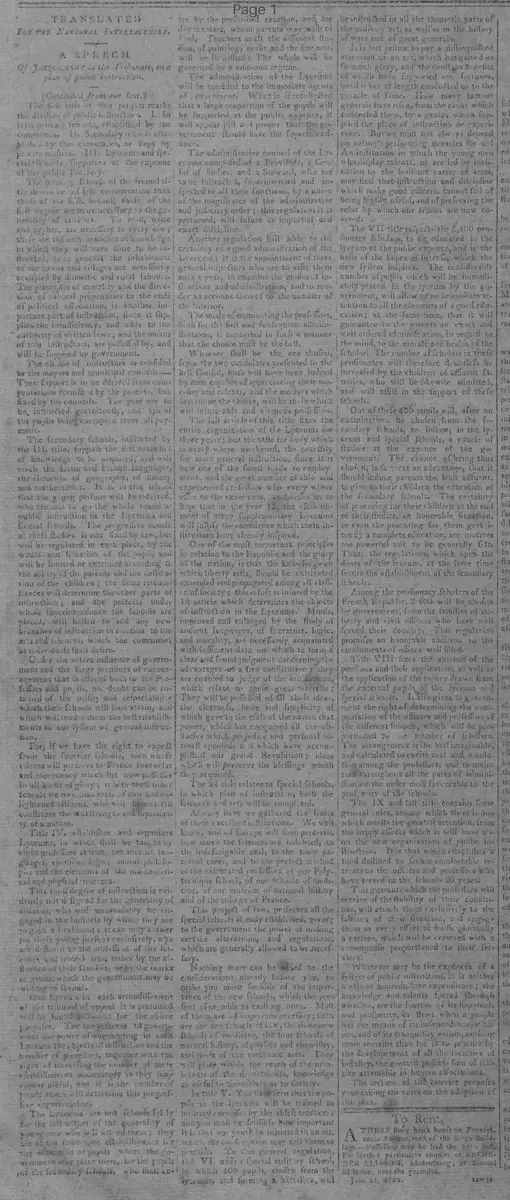
The first title of this project marks the division of public instruction. I. In primary ten schools, established by the commons. II. Secondary schools established by the communes, or kept by private masters. III. Lyceums and special schools supported at the expense of the public treasury.
The primary schools of the second title should be of less consideration than those of the first, because those of the first degree are more necessary to the generality of citizens. To read, write and cipher, are necessary to every one; these are the only branches of knowledge in which they will have time to be instructed, as in general the inhabitants of the towns and villages are necessarily occupied by domestic and rural labours.
The principles of morality and the direction of natural propensities to the ends of political association, is another important part of instruction, since it supplies the insufficiency, and adds to the authority of written laws; and the means of this instruction, are possessed by, and will be supplied by government.
The choice of instructors is confided to the mayors and municipal councils. Their support is to be derived from contributions furnished by the parents, but fixed by the councils. The poor are to be instructed gratuitously, one sixth of the pupils being exempted from all payment.
The secondary schools, instituted by the III. title, suppose the first branches of knowledge to be acquired, and will teach the Latin and French languages, the elements of geography, of history and mathematics. It is in this school that the young persons will be received, who are not to go the whole round of public instruction in the Lyceums and special schools. The progressive course of these studies is not fixed by law, but will be regulated in each place, by the wants and situation of the pupil, and will be limited or extended according to the ability of the parents and the destination of the children; the same circumstances will determine the other parts of instruction; and the prefects under whose superintendence the schools are placed, will hasten to add any new branches of instruction in relation to the arts and sciences, which the communes or individuals shall desire.
Under the active influence of government and the large premiums of encouragement that is offered both to the professors and pupils, no doubt can be entertained of the utility and respectability which these schools will soon attain, and which will render them the best establishments in our system of general instruction.
For, if we have the right to expect from the superior schools, men whose talents will preserve to France that eclat and ascendency which she now possesses in all kinds of glory; it is to these office schools we owe that mass of able and enlightened citizens, who will henceforth constitute the real strength and superiority of a nation.
Title IV. establishes and organizes Lyceums, in which shall be taught, at least by eight professors, the ancient languages, rhetoric, logic, moral philosophy and the elements of the mathematical and physical sciences.
This third degree of instruction is evidently not designed for the generality of citizens, who will unavoidably be engaged in the business by which they are to gain a livelihood; it can only answer for those young persons exclusively, who are destined to the profession of the sciences and liberal arts either by the affluence of their families, or by the works of genius which the government may be willing to favour.
One Lyceum in each arrondissement of the tribunal of appeal it is presumed will be found sufficient for the above purposes. The law reserves to government the power of augmenting in each Lyceum the objects of instruction and the number of professors, together with the right of increasing the number of these establishments accordingly as they may appear useful, and it is the number of pupils which will determine this progressive augmentation.
The Lyceums are not schools only for the instruction of the generality of young men who will attend them; they are at the same time establishments for the education of pupils whom the government may place there, for the pupils of the secondary schools, who shall enter by the prescribed rotation, and for scholars, whom parents may will to send.
Teachers in all the different studies, of painting, music and the fine arts, will be furnished: The whole will be governed by a common regime.
The administration of the Lyceums will be confided to the immediate agents of government. When it is recollected that a large proportion of the pupils will be supported at the public expense, it will appear just and proper that the government should have the superintendence.
The administrative council of the Lyceums composed of a Provost, a Censor of studies, and a Steward, who are to be instructed, superintended and inspected in all their functions, by a union of the magistrates of the administrative and judiciary order; this regulation it is presumed, will insure an impartial and exact discipline.
Another regulation still adds to the certainty of a good administration of the Lyceums; it is the appointment of three general inspectors who are to visit them once a year, to examine the modes of instruction and administration, and to render an account thereof to the minister of the interior.
The mode of nominating the professors, both for the first and subsequent administrations, is concerted in such a manner that the choice must be the best. Whoever shall be the one chosen, from the two candidates presented to the first Consul, both will have been judged by men capable of appreciating their morality and talents, and the motives which determine the choice, will be those which will insure able and virtuous professors.
The last article of this title fixes the entire organization of the Lyceums for three years; but the taste for study which is every where awakened, the necessity for more general instruction, since it is now one of the surest roads to employment, and the great number of able and experienced professors who every where offer to the examiners, authorizes us to hope that in the year 13, the establishment of many supplementary Lyceums will justify the confidence which these institutions have already inspired.
One of the most important principles in relation to the Republic and the glory of the nation, is that the knowledge on which liberty rests, should be cultivated, extended and propagated among all classes of society; this result is insured by the first article which determines the objects of instruction in the Lyceums. Minds improved and enlarged by the study of ancient languages, of literature, logic and morality, are necessarily acquainted with sufficient data on which to form a clear and sound judgment concerning the advantages of a free constitution; they are enabled to judge of the institutions, which relate to these great interests.
They will be possessed of all those ideas, the clearness, force and simplicity of which gave to the masses of the nation that power, which has conquered all the obstacles which prejudice and personal interest opposed, and which have accomplished our grand Revolution; ideas which will preserve the blessings which thus acquired.
The 2d title relates to special schools, in which plan of instruction, both the sciences and arts will be completed. Already have we gathered the fruits of these excellent institutions. We well know, and all Europe will soon perceive, how much the sciences are indebted, to the indefatigable zeal, to the truly paternal cares, and to the perfect method of the celebrated professors of our Polytechnic school, of our schools of medicine, of our museum of national history and of the college of France.
This project of law, preserves all the special schools already established, giving to the government the power of making certain alterations, and regulations, which are generally allowed to be necessary.
Nothing more can be added to the considerations already before you, to make you more sensible of the importance of the new schools, which the present plan adds to existing ones. Most of them are of imperious necessity; Such are the ten schools of law, the thirteen new schools of medicine, the four schools of natural history, of physics and chemistry, and those of the mechanic arts. They will place within the reach of the inhabitants of the departments, knowledge as useful to themselves as to society.
In title V. You have seen that the pupils in the lyceums will be trained to military exercise, by the ablest teachers: and you must be sensible how important it is, that our youth be initiated in an art, which the constitution may call them to practice. To this general regulation, title VI. adds a special military school, in which 500 pupils, chosen from the lyceums, and forming a battalion, will be instructed in all the theoretic parts of the military art, as well as in the history of wars and of great generals.
It is but justice to pay a distinguished attention to an art, which has gained us so much glory, and the constant benefits of which have supported our fortunes, until it has at length conducted us to the pinnacle of fame. How many famous generals have risen, from the ranks which concealed them, by a genius which supplied the place of instruction or experience. But we must not always depend on nature's performing miracles for us.
An institution in which the young men who display talents, or are led by inclination to the brilliant career of arms, may find that instruction and discipline which make good officers, cannot fail of being highly useful, and of preserving the eclat by which our armies are now covered.
The VII title recalls the 400 pensionary scholars, to be educated in the lyceum at the public expense, and is the basis of the hopes of success, which the new system inspires. The considerable number of pupils which will be immediately placed in the lyceum by the government, will allow of an immediate attention to all the elements of a good education; at the same time, that it will guarantee to the parents an exact and well ordered administration, in regard to the mind, to the morals and health of the scholar.
The number of scholars in these pensionates will therefore doubtless be increased by the children of affluent families, who will be likewise admitted, and will assist in the support of these schools.
Out of these 400 pupils will, after an examination, be chosen from the secondary schools, to follow, in the lyceum and special schools, a course of studies at the expense of the government. The chance of being thus chosen, is so great an advantage, that it should induce parents the least affluent, to give to their children the education of the secondary schools. The certainty of procuring for their children at the end of their studies, an honorable situation, or even the procuring for them gratuitously a complete education, are motives too powerful not to be generally felt.
Thus, the regulations, which open the doors of the lyceum, at the same time secure the establishment of the secondary schools.
Among the pensionary scholars of the French Republic, 2400 will be chosen by government, from the families of military and civil officers who have well served their country. This regulation promises an honorable addition to the emoluments of offices well filled.
Title VIII fixes the amount of the pensions and their application, as well as the application of the money drawn from the external pupils of the lyceum and special schools. It also gives to government the right of determining the compensation of the officers and professors of the different schools, which will be proportioned to the number of scholars.
The arrangement is the best imaginable, and calculated to excite zeal and emulation among the professors, and to maintain throughout all the parts of administration the order most favourable to the prosperity of the schools.
The IX and last title contains some general rules, among which there is one which merits the greatest attention, from the happy effects which it will have upon the new organization of public instruction. It is that which establishes a fund destined to secure comfortable retreats to the officers and professors who have served in the schools 10 years.
This guaranty which the professors will receive of the stability of their conditions, will attach them exclusively to the labours of their situation, and engage them to every effort to finish gloriously a career, which will be crowned with a recompense proportioned to their services.
Whatever may be the expenses of a system of public instruction, it is neither a vain or unproductive expenditure; the knowledge and talents spread through a nation, are the sources of its happiness and prosperity, in short when a people has the means of its independence without, and of its tranquility within, nothing more remains than for it to procure by the development of all the faculties of industry, the greatest possible sum of felicity attainable in human associations.
The section of the interior proposes your taking the votes on the adoption of this plan.
What sub-type of article is it?
What keywords are associated?
What entities or persons were involved?
Where did it happen?
Foreign News Details
Primary Location
France
Key Persons
Event Details
Jacques Von's report in the Tribunate outlines a plan for public instruction in France, dividing into primary town schools for basic literacy and morality, secondary schools for languages and basic sciences, lyceums for advanced studies in humanities and sciences, and special schools for arts and military training, with government oversight, funding for the poor, and pensions for educators.