Thank you for visiting SNEWPapers!
Sign up free
Editorial
June 18, 1833
The New Hampshire Gazette
Portsmouth, Rockingham County, New Hampshire
What is this article about?
Editorial tribute to Rev. Hosea Ballou's natural oratorical talents and influence as a Universalist preacher, copied from N.H. Patriot, with commentary criticizing idolizers of Daniel Webster and describing Ballou's recent sermon at a Unitarian church attended by legislators.
Clipping
OCR Quality
95%
Excellent
Full Text
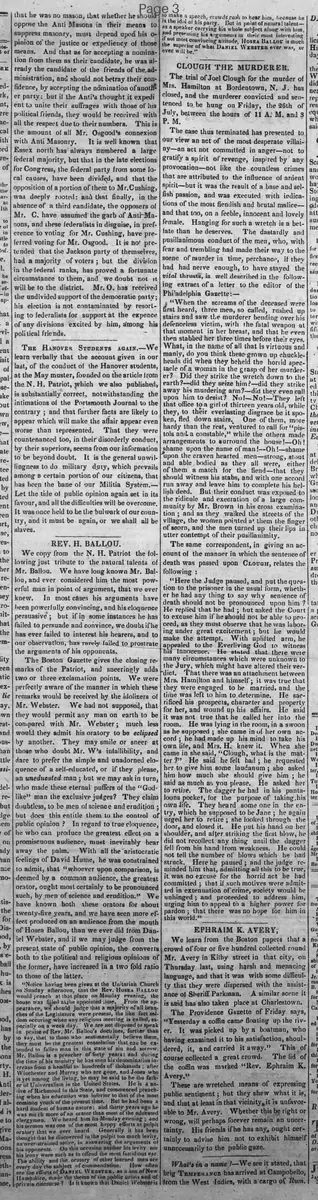
REV. H. BALLOU.
We copy from the N. H. Patriot the following just tribute to the natural talents of Mr. Ballou. We have long known Mr. Ballou, and ever considered him the most powerful man in point of argument, that we ever knew. In most cases his arguments have been powerfully convincing, and his eloquence persuasive; but if in some instances he has failed to persuade and convince, we doubt if he has ever failed to interest his hearers, and to our observation, has rarely failed to prostrate the arguments of his opponents.
The Boston Gazette gives the closing remarks of the Patriot, and sneeringly adds two or three exclamation points. We were perfectly aware of the manner in which these remarks would be received by the idolizers of Mr. Webster. We had not supposed, that they would permit any man on earth to be compared with Mr. Webster; much less would they admit his oratory to be eclipsed by another. They may smile or sneer at those who doubt Mr. W's infallibility, and dare to prefer the simple and unadorned eloquence of a self-educated, or if they please, an uneducated man; but we may ask in turn, who made these eternal 'puffers' of the "God-like" man the exclusive judges? They claim doubtless, to be men of science and erudition; but does this entitle them to the control of public opinion? In regard to true eloquence, he who can produce the greatest effect on a promiscuous audience, must inevitably bear away the palm. With all the aristocratic feelings of David Hume, he was constrained to admit, that "whoever upon comparison, is deemed by a common audience, the greatest orator, ought most certainly to be pronounced such, by men of science and erudition." We have known both these orators for about twenty-five years, and we have seen more effect produced on an audience from the mouth of Hosea Ballou, than we ever did from Daniel Webster, and if we may judge from the present state of public opinion, the converts both to the political and religious opinions of the former, have increased in a two fold ratio to those of the latter.
"Notice having been given at the Unitarian Church on Sunday afternoon, that the Rev. Hosea Ballou would preach at that place on Monday evening, the house was filled at the appointed time. From the appearance, we should judge that a majority of all branches of the Legislature were present, the like act seldom occurring when any religious meeting is called, especially on a week day. We are not disposed to speak in praise of Rev. Mr. Ballou's doctrines, further than to say, that to those who sentimentally believe them, they must be the greatest consolation that can be extended to fallen man in this state of sin and sorrow. Mr. Ballou is a preacher of forty years: and during the time of his ministry he has seen his denomination increase from a handful to hundreds of thousands; after Winchester and Murray who are gone, and Jones who is yet among the living, he may be said to be the father of Universalism in the United States. He is a native of Richmond in this State, and commenced preaching when his education was inferior to that of the most common youth of the present time. But he had been a hard student of human nature: and thirty years ago he was much more of an orator than most of the educated clergymen. We heard him on Monday evening: and his sermon was one of the most happy efforts at pulpit oratory that we ever heard. Generally it has been thought that he discovered in the pulpit too much levity, over-strained satire, in answering the arguments of his opponents. On this occasion neither his levity nor his irony were such as to offend the most fastidious ear. The ability and the oratory of other learned men are the efforts of Daniel Webster, as a son of New Hampshire, made the theme of the public prints and of private discourse? Is it known that Daniel Webster is to make a speech, crowds rush to hear him, because he is the idol of his party. But in point of natural talent—as a speaker carrying his whole subject along with him, and presenting his arguments in their most interesting if not most convincing attitude, Hosea Ballou is much the superior of what Daniel Webster ever was, or ever will be."
We copy from the N. H. Patriot the following just tribute to the natural talents of Mr. Ballou. We have long known Mr. Ballou, and ever considered him the most powerful man in point of argument, that we ever knew. In most cases his arguments have been powerfully convincing, and his eloquence persuasive; but if in some instances he has failed to persuade and convince, we doubt if he has ever failed to interest his hearers, and to our observation, has rarely failed to prostrate the arguments of his opponents.
The Boston Gazette gives the closing remarks of the Patriot, and sneeringly adds two or three exclamation points. We were perfectly aware of the manner in which these remarks would be received by the idolizers of Mr. Webster. We had not supposed, that they would permit any man on earth to be compared with Mr. Webster; much less would they admit his oratory to be eclipsed by another. They may smile or sneer at those who doubt Mr. W's infallibility, and dare to prefer the simple and unadorned eloquence of a self-educated, or if they please, an uneducated man; but we may ask in turn, who made these eternal 'puffers' of the "God-like" man the exclusive judges? They claim doubtless, to be men of science and erudition; but does this entitle them to the control of public opinion? In regard to true eloquence, he who can produce the greatest effect on a promiscuous audience, must inevitably bear away the palm. With all the aristocratic feelings of David Hume, he was constrained to admit, that "whoever upon comparison, is deemed by a common audience, the greatest orator, ought most certainly to be pronounced such, by men of science and erudition." We have known both these orators for about twenty-five years, and we have seen more effect produced on an audience from the mouth of Hosea Ballou, than we ever did from Daniel Webster, and if we may judge from the present state of public opinion, the converts both to the political and religious opinions of the former, have increased in a two fold ratio to those of the latter.
"Notice having been given at the Unitarian Church on Sunday afternoon, that the Rev. Hosea Ballou would preach at that place on Monday evening, the house was filled at the appointed time. From the appearance, we should judge that a majority of all branches of the Legislature were present, the like act seldom occurring when any religious meeting is called, especially on a week day. We are not disposed to speak in praise of Rev. Mr. Ballou's doctrines, further than to say, that to those who sentimentally believe them, they must be the greatest consolation that can be extended to fallen man in this state of sin and sorrow. Mr. Ballou is a preacher of forty years: and during the time of his ministry he has seen his denomination increase from a handful to hundreds of thousands; after Winchester and Murray who are gone, and Jones who is yet among the living, he may be said to be the father of Universalism in the United States. He is a native of Richmond in this State, and commenced preaching when his education was inferior to that of the most common youth of the present time. But he had been a hard student of human nature: and thirty years ago he was much more of an orator than most of the educated clergymen. We heard him on Monday evening: and his sermon was one of the most happy efforts at pulpit oratory that we ever heard. Generally it has been thought that he discovered in the pulpit too much levity, over-strained satire, in answering the arguments of his opponents. On this occasion neither his levity nor his irony were such as to offend the most fastidious ear. The ability and the oratory of other learned men are the efforts of Daniel Webster, as a son of New Hampshire, made the theme of the public prints and of private discourse? Is it known that Daniel Webster is to make a speech, crowds rush to hear him, because he is the idol of his party. But in point of natural talent—as a speaker carrying his whole subject along with him, and presenting his arguments in their most interesting if not most convincing attitude, Hosea Ballou is much the superior of what Daniel Webster ever was, or ever will be."
What sub-type of article is it?
Moral Or Religious
Partisan Politics
What keywords are associated?
Hosea Ballou
Daniel Webster
Universalism
Oratory
Preaching
New Hampshire
What entities or persons were involved?
Rev. H. Ballou
Daniel Webster
N. H. Patriot
Boston Gazette
David Hume
Editorial Details
Primary Topic
Praise For Rev. Hosea Ballou's Oratory And Universalist Influence
Stance / Tone
Strongly Supportive Of Ballou, Critical Of Webster Idolizers
Key Figures
Rev. H. Ballou
Daniel Webster
N. H. Patriot
Boston Gazette
David Hume
Key Arguments
Ballou Is The Most Powerful Arguer Known
Ballou's Eloquence Interests And Convinces Audiences More Than Webster's
True Eloquence Judged By Audience Effect, Not Erudition
Universalism Grew From Handful To Hundreds Of Thousands Under Ballou
Ballou Superior In Natural Talent And Pulpit Oratory To Webster