Thank you for visiting SNEWPapers!
Sign up free
The Bluffton News
Bluffton, Allen County, Hancock County, Ohio
What is this article about?
The Galapagos Islands' history: discovered 1535, haunt of pirates and whalers for tortoise provisions, unique post office, Darwin's 1835 visit shaping evolution theory, now US air bases for Panama Canal defense via Ecuador.
Clipping
OCR Quality
Full Text
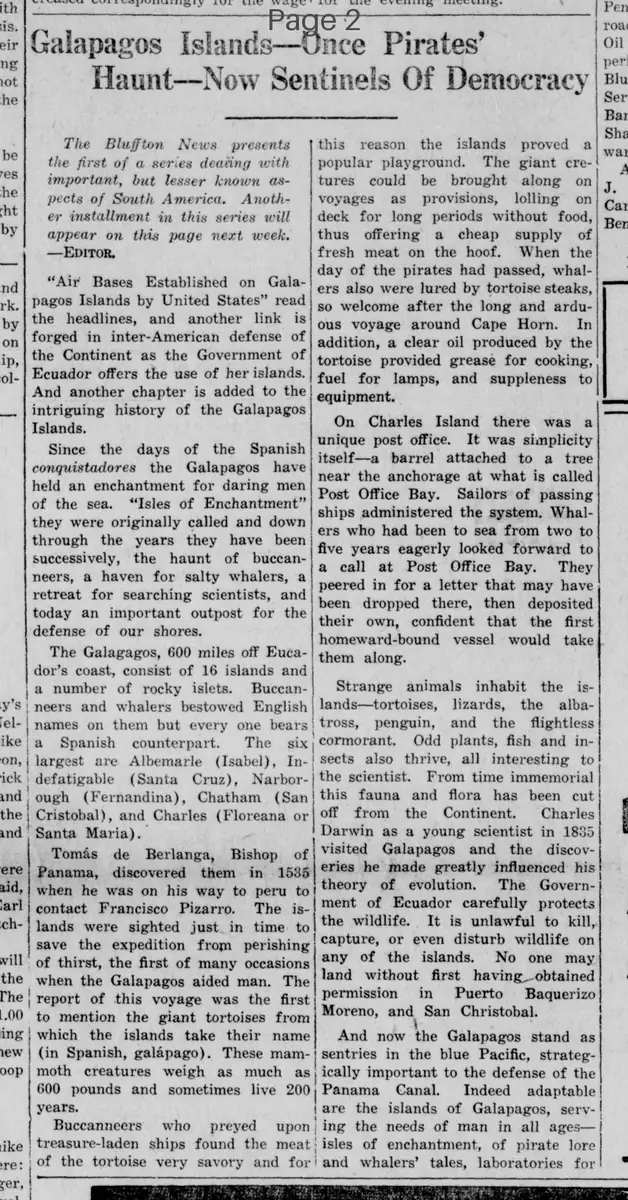
Haunt--Now Sentinels Of Democracy
The Bluffton News presents the first of a series dealing with important, but lesser known aspects of South America. Another installment in this series will appear on this page next week.
-EDITOR.
"Air Bases Established on Galapagos Islands by United States" read the headlines, and another link is forged in inter-American defense of the Continent as the Government of Ecuador offers the use of her islands.
And another chapter is added to the intriguing history of the Galapagos Islands.
Since the days of the Spanish conquistadores the Galapagos have held an enchantment for daring men of the sea. "Isles of Enchantment" they were originally called and down through the years they have been successively, the haunt of buccaneers. a haven for salty whalers, a retreat for searching scientists, and today an important outpost for the defense of our shores.
The Galapagos. 600 miles off Ecuador's coast, consist of 16 islands and a number of rocky islets. Buccaneers and whalers bestowed English names on them but every one bears a Spanish counterpart. The six largest are Albemarle (Isabel), Indefatigable (Santa Cruz). Narborough (Fernandina), Chatham (San Cristobal). and Charles (Floreana or Santa Maria).
Tomás de Berlanga, Bishop of Panama, discovered them in 1535 when he was on his way to peru to contact Francisco Pizarro. The islands were sighted just in time to save the expedition from perishing of thirst, the first of many occasions when the Galapagos aided man. The report of this voyage was the first to mention the giant tortoises from which the islands take their name (in Spanish, galápago). These mammoth creatures weigh as much as 600 pounds and sometimes live 200 years.
Buccanneers who preyed upon treasure-laden ships found the meat of the tortoise very savory and for this reason the islands proved a popular playground. The giant creatures could be brought along on voyages as provisions, lolling on deck for long periods without food, thus offering a cheap supply of fresh meat on the hoof. When the day of the pirates had passed. whalers also were lured by tortoise steaks, so welcome after the long and arduous voyage around Cape Horn. In addition, a clear oil produced by the tortoise provided grease for cooking, fuel for lamps, and suppleness to equipment.
On Charles Island there was a unique post office. It was simplicity itself--a barrel attached to a tree near the anchorage at what is called Post Office Bay. Sailors of passing ships administered the system, Whalers who had been to sea from two to five years eagerly looked forward to a call at Post Office Bay. They peered in for a letter that may have been dropped there, then deposited their own, confident that the first homeward-bound vessel would take them along.
Strange animals inhabit the islands-tortoises, lizards, the albatross, penguin, and the flightless cormorant. Odd plants, fish and insects also thrive, all interesting to the scientist. From time immemorial this fauna and flora has been cut off from the Continent. Charles Darwin as a young scientist in 1835 visited Galapagos and the discoveries he made greatly influenced his theory of evolution. The Government of Ecuador carefully protects the wildlife. It is unlawful to kill, capture, or even disturb wildlife on any of the islands. No one may land without first having obtained permission in Puerto Baquerizo Moreno, and San Christobal.
And now the Galapagos stand as sentries in the blue Pacific, strategically important to the defense of the Panama Canal. Indeed adaptable are the islands of Galapagos, serving the needs of man in all ages isles of enchantment, of pirate lore and whalers' tales, laboratories for science and sentinels of democracy.
What sub-type of article is it?
What themes does it cover?
What keywords are associated?
What entities or persons were involved?
Where did it happen?
Story Details
Key Persons
Location
Galapagos Islands, 600 Miles Off Ecuador's Coast
Event Date
1535
Story Details
The Galapagos Islands, discovered in 1535 by Tomás de Berlanga, served as a haunt for buccaneers and whalers due to giant tortoises used as provisions. They featured a unique barrel post office on Charles Island. Visited by Charles Darwin in 1835, influencing his evolution theory. Protected wildlife. Now, Ecuador offers them to the US for air bases in defense of the Panama Canal.