Thank you for visiting SNEWPapers!
Sign up free
The Farmer And Mechanic
Raleigh, Wake County, North Carolina
What is this article about?
The Southern Planter provides March farming advice for Southern U.S. regions affected by abnormal hard freezing weather and snow, delaying work from February. Recommends replanting killed wheat and oats with rust-proof oats, forage crops like peas and soy beans, or grasses and clovers; emphasizes soil preparation, fertilizers, and timely seeding of various crops including cotton, tobacco, potatoes, and strawberries.
Merged-components note: These components are parts of the same continuous agricultural instructional article titled 'Work for the Month' from The Southern Planter, spanning across pages 1 and 2. The text flows directly from one to the next, indicating a single logical unit focused on farming advice.
Clippings
1 of 2
OCR Quality
Full Text
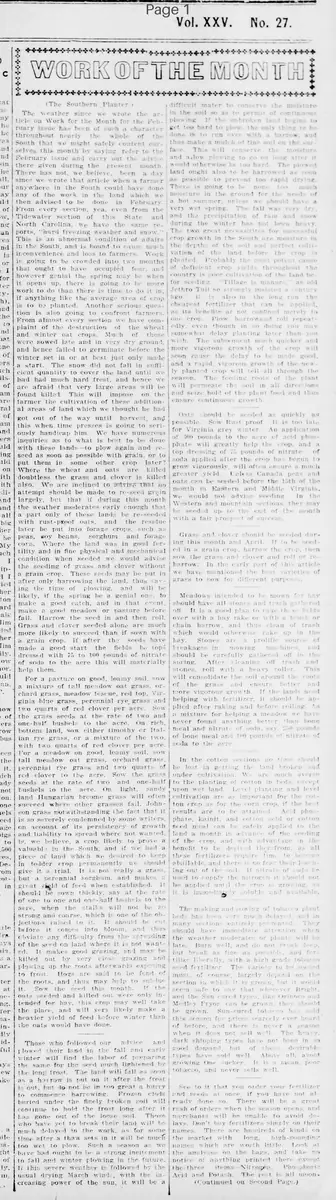
The weather since we wrote the article on Work for the Month for the February issue has been of such a character throughout nearly the whole of the South that we might safely content ourselves this month by saying, refer to the February issue and carry out the advice there given during the present month. There has not, we believe, been a day since we wrote that article when a farmer anywhere in the South could have done any of the work in the land which we then advised to be done in February. From every section, yea, even from the Tidewater section of this State and North Carolina, we have the same reports, "hard freezing weather and snow." This is an abnormal condition of affairs in the South, and is bound to cause much inconvenience and loss to farmers. Work is going to be crowded into two months that ought to have occupied four, and however genial the spring may be when it opens up, there is going to be more work to do than there is time to do it in, if anything like the average area of crops is to be planted. Another serious question is also going to confront farmers. From almost every section we have complaint of the destruction of the wheat and winter oat crops. Much of these were sowed late and in very dry ground, and hence failed to germinate before the winter set in or at best just only made a start. The snow did not fall in sufficient quantity to cover the land until we had had much hard frost, and hence we are afraid that very large areas will be found killed. This will impose on the farmer the cultivation of these additional areas of land which we thought he had got out of the way until harvest, and this when time presses is going to seriously handicap him. We have numerous inquiries as to what is best to be done with these lands—to plow again and re-seed as soon as possible with grain, or to put them in some other crop later?
Where the wheat and oats are killed doubtless the grass and clover is killed also. We are inclined to advise that no attempt should be made to re-seed grain largely, but that if during this month the weather moderates early enough that a part only of these lands be re-seeded with rust-proof oats, and the residue later be put into forage crops, such as peas, soy beans, sorghum and forage corn. Where the land was in good fertility and in fine physical and mechanical condition when seeded we would advise the seeding of grass and clover without a grain crop. These seeds may be put in after only harrowing the land, thus saving the time of plowing, and will be likely, if the spring be a genial one, to make a good catch, and in that event, make a good meadow or pasture before fall. Harrow the seed in and then roll. Grass and clover seeded alone are much more likely to succeed than if sown with a grain crop. If after the seeds have made a good start the fields be top-dressed with 75 to 100 pounds of nitrate of soda to the acre this will materially help them.
For a pasture on good, loamy soil, sow a mixture of tall meadow oat grass, orchard grass, meadow fescue, red top, Virginia blue grass, perennial rye grass and two quarts of red clover per acre. Sow the grass seeds at the rate of two and one-half bushels to the acre. On rich, bottom land, sow either timothy or Italian rye grass, or a mixture of the two, with two quarts of red clover per acre. For a meadow on good, loamy soil, sow tall meadow oat grass, orchard grass, perennial rye grass and two quarts of red clover to the acre. Sow the grass seeds at the rate of two and one-half bushels to the acre. On light, sandy land Hungarian broom corn grass will often succeed where other grasses fail. Johnson grass notwithstanding the fact that it is so severely condemned by some writers, on account of its persistency of growth and liability to spread where not wanted, is, we believe, a crop likely to prove a valuable one in the South, and if we had a piece of land which we desired to keep in fodder crop permanently we should give it a trial. It is not really a grass, but a perennial sorghum, and makes a great yield of feed when established. It should be sown thickly, say at the rate of one to one and one-half bushels to the acre, when the stalks will not be so strong and coarse, which is one of the objections raised to it. It should be cut before it comes into bloom, and thus obviate any difficulty from the spreading of the seed on land where it is not wanted. It makes good grazing, and may be killed out by very close grazing and plowing up the roots afterwards exposing to frost. Hogs are said to be fond of the roots, and thus may help to subdue it. Sow the seed this month. If the oats seeded and killed out were only intended for hay, this crop may well take the place, and will very likely make a heavier yield of feed before winter than the oats would have done.
Those who followed our advice and plowed their land in the fall and early winter will find the labor of preparing the same for the seed much lightened by the long frost. The land will fall as soon as a harrow is put on it after the frost is out, but do not be in too great a hurry to commence harrowing. Frozen clods buried under the finely broken soil will continue to hold the frost long after it has gone out of the loose soil. Those who have yet to break their land will be much delayed in the work, as for some time after a thaw sets in it will be much too wet to plow. Such a season as we have had ought to be a strong incitement to fall and winter plowing in the future. If this severe weather is followed by the usual drying March wind, with the increasing power of the sun, it will be a
Vol. XXV. No. 27.
WORK FOR THE MONTH
difficult matter to conserve the moisture in the soil so as to permit of continuous plowing. If the unbroken land begins to get too hard to plow, the only thing to be done is to run over with a harrow, and thus make a mulch of fine soil on the surface. This will conserve the moisture and allow plowing to go on longer after it would otherwise be too hard. The plowed land ought also to be harrowed as soon as possible to prevent too rapid drying. There is going to be none too much moisture in the ground for the need of a hot summer, unless we should have a very wet spring. The fall was very dry, and the precipitation of rain and snow during the winter has not been heavy. The two great necessities for successful crop growth in the South are moisture in the depth of the soil and perfect cultivation of the land before the crop is planted. Probably the most potent cause of deficient crop yields throughout the country is poor cultivation of the land before seeding. Tillage is manure, as old Jethro Tull so strongly insisted a century ago. It is also in the long run the cheapest fertilizer that can be applied, as its benefits are not confined merely to one crop. Plow, harrow and roll repeatedly, even though in so doing you may somewhat delay planting later than you wish. The subsequent much quicker and more vigorous growth of the crop will soon cause the delay to be made good, and a rapid, vigorous growth of the newly planted crop will tell all through the season. The feeding roots of the plant will permeate the soil in all directions and seize hold of the plant food and thus ensure continuous growth.
Oats should be seeded as quickly as possible. Sow Rust proof. It is too late for Virginia grey winter. An application of 300 pounds to the acre of acid phosphate will greatly help the crop, and a top dressing of 200 pounds of nitrate of soda applied after the crop has begun to grow vigorously will often ensure a much greater yield. Unless Canada peas and oats can be seeded before the 15th of the month in Eastern and Middle Virginia, we would not advise seeding. In the Western and mountain sections, they may be seeded up to the end of the month with a fair prospect of success.
Grass and clover should be seeded during this month and April. If to be seeded in a grain crop, harrow the crop, then sow the grass and clover and roll or re-harrow. In the early part of this article we have mentioned the best varieties of grass to sow for different purposes. Meadows intended to be mown for hay should have all stones and trash gathered off. It is a good plan to rake these fields over with a hay rake or with a brush or chain harrow, and thus clean off trash which would otherwise make up in the hay. Stones are a prolific source of breakages in mowing machines, and should be carefully gathered off in the spring. After cleaning off trash and stones, roll with a heavy roller. This will consolidate the soil around the roots of the grass and ensure better and more vigorous growth. If the land needs helping with fertilizer, it should be applied after raking and before rolling. As a mixture for helping a meadow we have never found anything better than bone meal and nitrate of soda say 200 pounds of bone meal and 200 pounds of nitrate of soda to the acre.
In the cotton sections no time should be lost in getting the land frozen and under cultivation. We are much against the planting of cotton in fields except upon wet land. Less planting and less cultivation are as important for the cotton crop as for the corn crop, if the best results are to be attained. Acid phosphate, kainit, and cotton seed or cotton seed meal can be safely applied to the land a month in advance of the seeding of the crop, and with advantage, the benefit to be derived therefrom, as all these fertilizers require time to become available, and there is no fear their leaching out of the soil. If nitrate of soda is used to supply the nitrogen it should not be applied until the crop is growing as it is immediately soluble and available.
The making and sowing of tobacco plant bed has been very much delayed and in many sections entirely prevented. They should have immediate attention when the weather moderates or plants will be late. Burn well, and do not break deep, but break as fine as possible, and fertilize liberally, with a high grade nitrogen seed fertilizer. The variety to be raised must, of course, largely depend on the section in which it is grown. It would seem safe to say that wherever Bright and the Sun cured types like Orinoco and Medley Pryor, can be grown, they should be grown. Sun-cured tobacco has sold this season for prices scarcely ever before equaled, and there is never a season when it does not sell well. The heavy, dark shipping types have not been in good demand, but of these, desirable types have sold well. Above all, avoid growing one sucker. It is a lanky inferior tobacco, and never sells well.
See to it that you order your fertilizer and seeds at once, if you have not already done so. There will be a great rush of orders when the season opens and merchants will be unable to avoid delays. Don't buy fertilizers simply on their names. There are hundreds of kinds on the market with long, high sounding names which are worth little. Look at the analyses on the tags, and take no notice of anything printed there except the three items—Nitrogen, Phosphoric Acid and Potash. The rest is all moon-
(Continued on Second Page.)
shine. Study the requirements of the crop and soil, and meet these as nearly as possible.
The work which we laid out in our February issue to be done in that month having been wholly impossible of accomplishment by reason of the severe weather, we would refer our readers to that issue for work to be done this month.
This adding of one month's work to the next at this season of the year is going to make March a very busy month if the weather should become genial and spring-like, because not only will the earliest crops require to be planted, but the land be got ready for the planting of the main crops of all vegetables. Do not, however, be in too great haste to plow and cultivate your land until it is dry enough to work freely. Land plowed and worked when too wet in the spring never becomes in good crop condition the whole season. Instead of devoting time to plowing and cultivating, give attention to the getting of the manure and fertilizers on to the land and to the spreading of the same. This may be done with farm yard manure and the mineral fertilizers, phosphates and potash, without fear of loss from leaching. They can then be plowed and worked in when the land is dry enough. Do not economize on manure and fertilizers for the garden. Most vegetable crops are gross feeders, and all require to be grown quickly if to be really fine, and this cannot be accomplished without plenty of manure and fertilizer.
Irish potatoes and English peas should be planted as soon as possible, and kale, spinach and early salad crops may be sown later in the month. The great reduction in the production of Irish potatoes last year has made them scarce and high in price all winter, and the market is now being largely supplied with imported ones. This will no doubt induce the planting of a much larger area this year, and for those who are so situate as to be able to produce the early crop, and to get it cheaply on the markets of the North, there is likely to be profit in the crop. Those who are not so situate should not increase the area of the crop materially, as prices will no doubt fall later from a more general production throughout the country. Use a good special potato fertilizer for planting the crop, or make your own mixture, using 300 pounds of nitrate of soda, 600 pounds of cotton seed meal or fish scrap, 800 pounds of acid phosphate, and 300 pounds of muriate of potash. A series of experiments made over seven years in Canada has shown that Irish potatoes planted as soon as they are cut will make a heavier yield than those which are not planted until after they have been cut from four to six days, therefore cut your sets as you plant.
Fall planted cabbages should be encouraged to grow by cultivating them as soon as the ground is dry enough, and after they have started a top dressing of 100 pounds to the acre of nitrate of soda will greatly help them to make up time lost in the hard winter.
Strawberries should be cultivated as soon as the ground is dry enough, and if not looking thrifty, should have some potash, phosphate and a little nitrate of soda worked in. After this is done, mulch the ground with pine straw or marsh hay to keep the berries clean.
The Soil Action of Soil Phosphate.
Acid phosphate is very often sold as a complete fertilizer, at least it is used as such in many parts of the country. A very short time, however, suffices to reach a point where it no longer acts to advantage, and fertilizers are consequently very thoroughly condemned. The fertilizer manufacturer will do well to keep this matter in mind also, for he loses a good trade simply for a few years of easy business!
Acid phosphate is the product of the treatment of phosphate rock with hot sulphuric acid, the object being to make soluble phosphoric acid. To do this, the lime to which the phosphoric acid is combined must be removed. Sulphuric acid being a stronger acid than phosphoric, displaces the latter. Acid phosphate, as it is called, is simply a mixture of acid lime phosphate and sulphate of lime: the latter is better known to farmers as "land plaster" or "gypsum." When acid phosphate is applied to the soil, we are always at the same time applying gypsum.
There is an old saying, and a very true one, too, that gypsum enriches the father at the expense of the son—meaning that it hastens the exhaustion of the soil, and this it certainly does. Sulphate of lime has the power of acting on the soil silicates insoluble in water; it breaks them up and liberates such plant food as they contain, usually largely potash. This is by no means an evil of itself, as this potash might just as well be used, but the trouble is that farmers learn to depend on it.
Gypsum is used, in the form of acid phosphate, and crops do well. The acid phosphate supplies the phosphoric acid, the gypsum it contains liberates potash, and the two together keep the clover going, which supplies the nitrogen. This is a very comprehensive system; the phosphoric acid is supplied, and it supplies the other two elements. Unfortunately, this potash within reach of the gypsum is easily exhausted. When it gives out, the whole system drops. The eggs are all in one basket.
The potash taken up by the plants is only a small part of the quantity set free, and the excess is usually lost by drainage. This, of course, cannot be helped so long as acid phosphate is so lavishly used. We cannot hope to put any check on the use of acid phosphate, so long as it apparently pays to use it, but we can answer the questions of the farmer when he finds it begins to fail—and this we have answered. It is probable that the average fertilizer manufacturer is acting in ignorance in using acid phosphate largely as the whole art of chemical manuring, but it is likely to prove an expensive ignorance in the long run.
Though as a rule potash is the plant food ingredient most used by plants, it is the one least supplied in quantity in the fertilizers of commerce. Nitrogen is supplied more or less by legumes, but it comes from the exhaustless supplies in the air: potash has no endless source of supply, yet it is most neglected.
What sub-type of article is it?
What themes does it cover?
What keywords are associated?
Where did it happen?
Story Details
Location
The South, Tidewater Section Of Virginia And North Carolina, Eastern And Middle Virginia, Western And Mountain Sections, Cotton Sections
Event Date
March
Story Details
Due to abnormal hard freezing weather and snow delaying February farming work, advice is given to replant killed wheat and oats with rust-proof oats, forage crops like peas, soy beans, sorghum, or grasses and clovers without grain; prepare soil through plowing, harrowing, and rolling; apply fertilizers timely; seed oats, peas, grass, clover, cotton, tobacco, potatoes, peas, vegetables; discusses soil action of acid phosphate and importance of potash.