Thank you for visiting SNEWPapers!
Sign up free
Fowle's New Hampshire Gazette And General Advertiser
Portsmouth, Rockingham County, New Hampshire
What is this article about?
Extract of letter from New-York, May 29, 1785, lamenting U.S. resentment toward Britain over post-independence trade restrictions, especially exclusion from British West-India islands. Advises British merchants to halt credit shipments, impose duties on U.S. goods, and prohibit tobacco in American ships to counter American retaliatory port policies and protect British interests amid U.S. anarchy.
Clipping
OCR Quality
Full Text
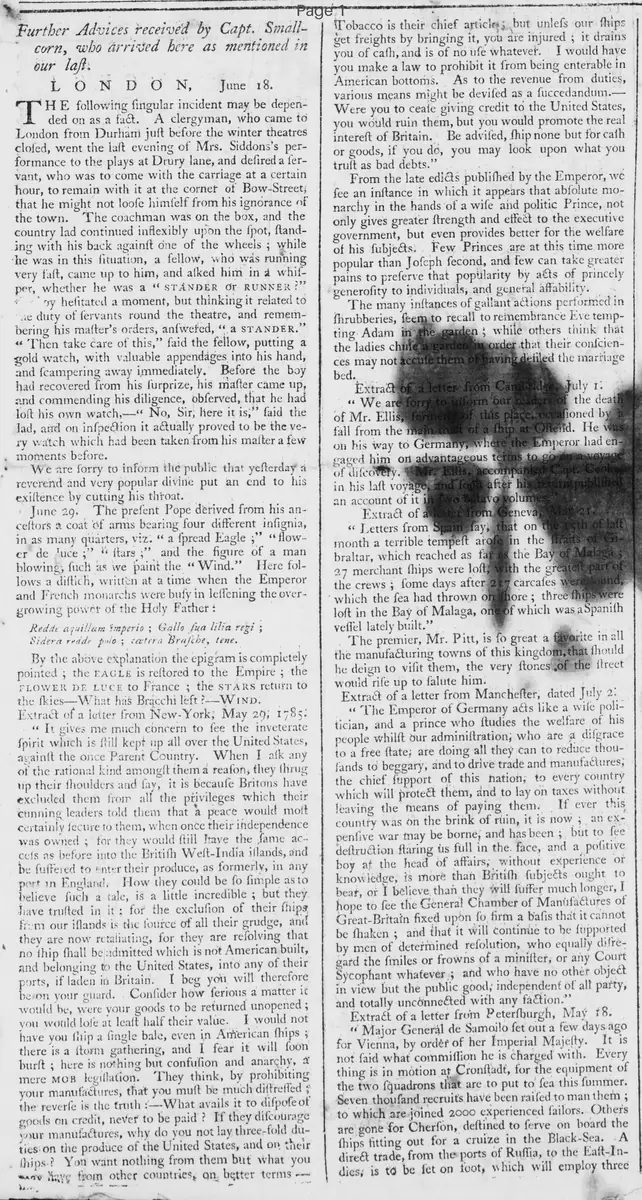
"It gives me much concern to see the inveterate Spirit which is still kept up all over the United States, against the once Parent Country. When I ask any of the rational kind amongst them a reason, they shrug up their shoulders and say, it is because Britons have excluded them from all the privileges which their cunning leaders told them that a peace would most certainly secure to them, when once their independence was owned; for they would still have the same access as before into the British West-India islands, and be suffered to enter their produce, as formerly, in any port in England. How they could be so simple as to believe such a tale, is a little incredible; but they have trusted in it: for the exclusion of their ships from our islands is the source of all their grudge, and they are now retaliating, for they are resolving that no ship shall be admitted which is not American built, and belonging to the United States, into any of their ports, if laden in Britain. I beg you will therefore be on your guard. Consider how serious a matter it would be, were your goods to be returned unopened; you would lose at least half their value. I would not have you ship a single bale, even in American ships; there is a storm gathering, and I fear it will soon burst; here is nothing but confusion and anarchy, a mere mob legislation. They think, by prohibiting your manufactures, that you must be much distressed: the reverse is the truth:--What avails it to dispose of goods on credit, never to be paid? If they discourage your manufactures, why do you not lay three-fold duties on the produce of the United States, and on their ships.? You want nothing from them but what you may have from other countries, on better terms.
Tobacco is their chief article: but unless our ships get freights by bringing it, you are injured; it drains you of cash, and is of no use whatever. I would have you make a law to prohibit it from being enterable in American bottoms. As to the revenue from duties, various means might be devised as a succedaneum.-- Were you to cease giving credit to the United States, you would ruin them, but you would promote the real interest of Britain. Be advised, ship none but for cash or goods, if you do, you may look upon what you trust as bad debts."
What sub-type of article is it?
What keywords are associated?
Where did it happen?
Domestic News Details
Primary Location
New York
Event Date
May 29, 1785
Outcome
ongoing grudge against britain leading to resolutions prohibiting non-american built ships laden in britain from entering u.s. ports; advice to britain to impose duties on u.s. produce and ships, prohibit tobacco in american bottoms, and cease giving credit to ruin u.s. economy.
Event Details
Letter expresses concern over persistent anti-British sentiment in the U.S. due to exclusion from British West-India islands and English ports post-independence. Americans believed false promises of continued access. They retaliate by resolving to admit only American-built ships not laden in Britain. Advises British merchants to avoid shipping goods to U.S., especially on credit, as it risks losses amid confusion and mob legislation. Suggests Britain impose threefold duties on U.S. produce and ships, prohibit tobacco imports in American vessels, and trade only for cash or goods to promote British interests.