Thank you for visiting SNEWPapers!
Sign up free
Story
January 31, 1891
Frostburg Mining Journal
Frostburg, Allegany County, Maryland
What is this article about?
Professor Koch of Berlin developed a method to cure consumption inspired by observing pure bacteria cultures on cooked potatoes, as recounted by Dr. Emmerich of Munich. This led to his successful bacteriologic investigations and potential tuberculosis remedy.
Clipping
OCR Quality
95%
Excellent
Full Text
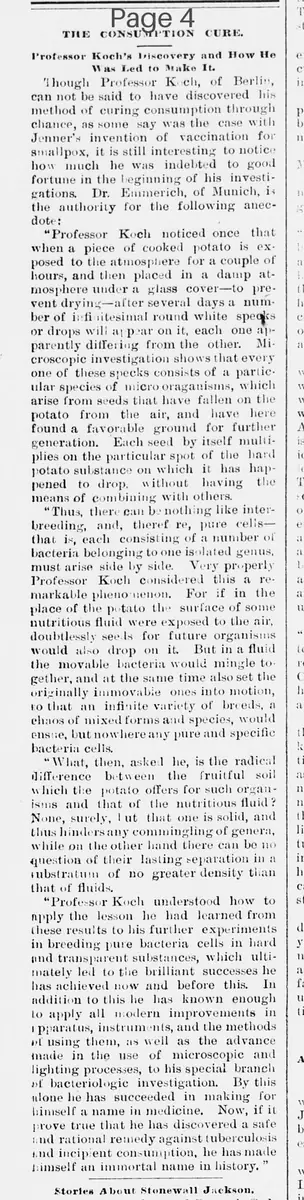
THE
CONSUMPTION
CURE
Professor Koch's Discovery and How He
Was Led to Make It.
Though Professor Koch, of Berlin,
can not be said to have discovered his
method of curing consumption through
chance, as some say was the case with
Jenner's invention of vaccination for
smallpox, it is still interesting to notice
how much he was indebted to good
fortune in the beginning of his investi-
gations. Dr. Emmerich, of Munich, is
the authority for the following anec-
dote:
"Professor Koch noticed once that
when a piece of cooked potato is ex-
posed to the atmosphere for a couple of
hours, and then placed in a damp at-
mosphere under a glass cover to pre-
vent drying, after several days a num-
ber of infinitesimal round white specks
or drops will appear on it, each one ap-
parently differing from the other. Mi-
croscopic investigation shows that every
one of these specks consists of a partic-
ular species of micro organisms, which
arise from seeds that have fallen on the
potato from the air, and have here
found a favorable ground for further
generation. Each seed by itself multi-
plies on the particular spot of the hard
potato substance on which it has hap-
pened to drop, without having the
means of combining with others.
"Thus, there can be nothing like inter
breeding, and, therefore, pure cells-
that is, each consisting of a number of
bacteria belonging to one isolated genus,
must arise side by side. Very properly
Professor Koch considered this a re-
markable phenomenon. For if in the
place of the potato the surface of some
nutritious fluid were exposed to the air.
doubtlessly seeds for future organisms
would also drop on it. But in a fluid
the movable bacteria would mingle to-
gether, and at the same time also set the
originally immovable ones into motion,
so that an infinite variety of breeds, a
chaos of mixed forms and species. would
ensue, but nowhere any pure and specific
bacteria cells.
"What, then, asked he, is the radical
difference between the fruitful soil
which the potato offers for such organ-
isms and that of the nutritious fluid?
None, surely, but that one is solid, and
thus hinders any commingling of genera,
while on the other hand there can be no
question of their lasting separation in a
substratum of no greater density than
that of fluids.
"Professor Koch understood how to
apply the lesson he had learned from
these results to his further experiments
in breeding pure bacteria cells in hard
and transparent substances, which ulti-
mately led to the brilliant successes he
has achieved now and before this. In
addition to this he has known enough
to apply all modern improvements in
apparatus, instruments, and the methods
of using them, as well as the advance
made in the use of microscopic and
lighting processes, to his special branch
of bacteriologic investigation. By this
alone he has succeeded in making for
himself a name in medicine. Now, if it
prove true that he has discovered a safe
and rational remedy against tuberculosis
and incipient consumption, he has made
himself an immortal name in history.
CONSUMPTION
CURE
Professor Koch's Discovery and How He
Was Led to Make It.
Though Professor Koch, of Berlin,
can not be said to have discovered his
method of curing consumption through
chance, as some say was the case with
Jenner's invention of vaccination for
smallpox, it is still interesting to notice
how much he was indebted to good
fortune in the beginning of his investi-
gations. Dr. Emmerich, of Munich, is
the authority for the following anec-
dote:
"Professor Koch noticed once that
when a piece of cooked potato is ex-
posed to the atmosphere for a couple of
hours, and then placed in a damp at-
mosphere under a glass cover to pre-
vent drying, after several days a num-
ber of infinitesimal round white specks
or drops will appear on it, each one ap-
parently differing from the other. Mi-
croscopic investigation shows that every
one of these specks consists of a partic-
ular species of micro organisms, which
arise from seeds that have fallen on the
potato from the air, and have here
found a favorable ground for further
generation. Each seed by itself multi-
plies on the particular spot of the hard
potato substance on which it has hap-
pened to drop, without having the
means of combining with others.
"Thus, there can be nothing like inter
breeding, and, therefore, pure cells-
that is, each consisting of a number of
bacteria belonging to one isolated genus,
must arise side by side. Very properly
Professor Koch considered this a re-
markable phenomenon. For if in the
place of the potato the surface of some
nutritious fluid were exposed to the air.
doubtlessly seeds for future organisms
would also drop on it. But in a fluid
the movable bacteria would mingle to-
gether, and at the same time also set the
originally immovable ones into motion,
so that an infinite variety of breeds, a
chaos of mixed forms and species. would
ensue, but nowhere any pure and specific
bacteria cells.
"What, then, asked he, is the radical
difference between the fruitful soil
which the potato offers for such organ-
isms and that of the nutritious fluid?
None, surely, but that one is solid, and
thus hinders any commingling of genera,
while on the other hand there can be no
question of their lasting separation in a
substratum of no greater density than
that of fluids.
"Professor Koch understood how to
apply the lesson he had learned from
these results to his further experiments
in breeding pure bacteria cells in hard
and transparent substances, which ulti-
mately led to the brilliant successes he
has achieved now and before this. In
addition to this he has known enough
to apply all modern improvements in
apparatus, instruments, and the methods
of using them, as well as the advance
made in the use of microscopic and
lighting processes, to his special branch
of bacteriologic investigation. By this
alone he has succeeded in making for
himself a name in medicine. Now, if it
prove true that he has discovered a safe
and rational remedy against tuberculosis
and incipient consumption, he has made
himself an immortal name in history.
What sub-type of article is it?
Biography
Historical Event
Medical Curiosity
What themes does it cover?
Triumph
Exploration
Recovery
What keywords are associated?
Koch Discovery
Bacteria Culture
Potato Experiment
Tuberculosis Cure
Consumption Remedy
What entities or persons were involved?
Professor Koch
Dr. Emmerich
Jenner
Where did it happen?
Berlin
Story Details
Key Persons
Professor Koch
Dr. Emmerich
Jenner
Location
Berlin
Story Details
Professor Koch observed pure bacteria cultures forming separately on cooked potato exposed to air, unlike in fluids where they mix. This insight led him to develop methods for breeding pure bacteria, resulting in his successes in bacteriologic investigation and a potential cure for tuberculosis and consumption.