Thank you for visiting SNEWPapers!
Sign up free
Story
June 17, 1879
The Daily Gazette
Wilmington, New Castle County, Delaware
What is this article about?
In Washington on June 16, Democrats highlight Republican surrender on Army bill's sixth section prohibiting troops at polls. Republicans, after initial support bundled with appropriations, vote unanimously against it as a standalone bill, revealing their true opposition and possibly prompting President Hayes to veto the full measure.
Clipping
OCR Quality
95%
Excellent
Full Text
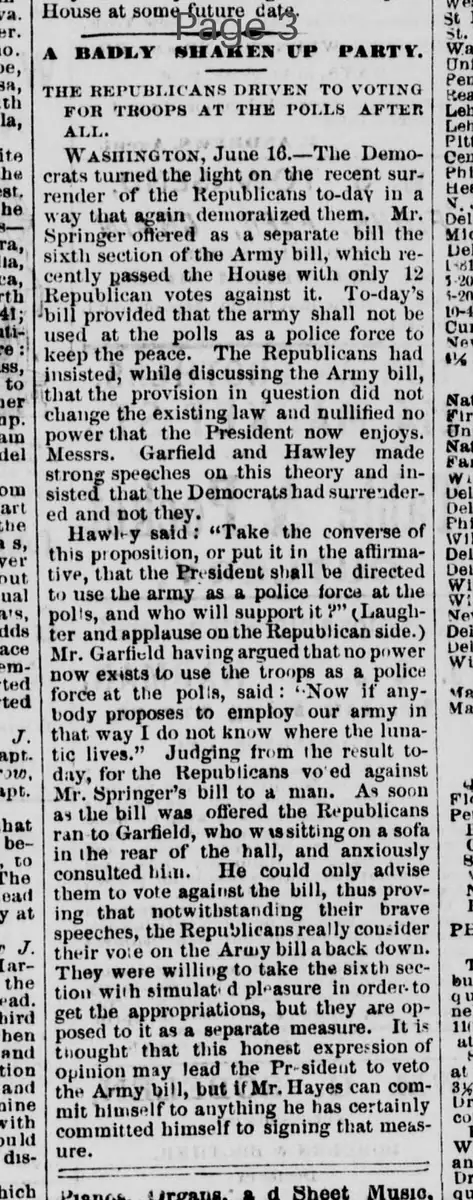
A BADLY SHAKEN UP PARTY.
THE REPUBLICANS DRIVEN TO VOTING FOR TROOPS AT THE POLLS AFTER ALL.
WASHINGTON, June 16.—The Democrats turned the light on the recent surrender of the Republicans to-day in a way that again demoralized them. Mr. Springer offered as a separate bill the sixth section of the Army bill, which recently passed the House with only 12 Republican votes against it. To-day's bill provided that the army shall not be used at the polls as a police force to keep the peace. The Republicans had insisted, while discussing the Army bill, that the provision in question did not change the existing law and nullified no power that the President now enjoys. Messrs. Garfield and Hawley made strong speeches on this theory and insisted that the Democrats had surrendered and not they.
Hawley said: "Take the converse of this proposition, or put it in the affirmative, that the President shall be directed to use the army as a police force at the polls, and who will support it?" (Laughter and applause on the Republican side.)
Mr. Garfield having argued that no power now exists to use the troops as a police force at the polls, said: Now if anybody proposes to employ our army in that way I do not know where the lunatic lives. Judging from the result to-day, for the Republicans voted against Mr. Springer's bill to a man. As soon as the bill was offered the Republicans ran to Garfield, who was sitting on a sofa in the rear of the hall, and anxiously consulted him. He could only advise them to vote against the bill, thus proving that notwithstanding their brave speeches, the Republicans really consider their vote on the Army bill a back down. They were willing to take the sixth section with simulated pleasure in order to get the appropriations, but they are opposed to it as a separate measure. It is thought that this honest expression of opinion may lead the President to veto the Army bill, but if Mr. Hayes can commit himself to anything he has certainly committed himself to signing that measure.
THE REPUBLICANS DRIVEN TO VOTING FOR TROOPS AT THE POLLS AFTER ALL.
WASHINGTON, June 16.—The Democrats turned the light on the recent surrender of the Republicans to-day in a way that again demoralized them. Mr. Springer offered as a separate bill the sixth section of the Army bill, which recently passed the House with only 12 Republican votes against it. To-day's bill provided that the army shall not be used at the polls as a police force to keep the peace. The Republicans had insisted, while discussing the Army bill, that the provision in question did not change the existing law and nullified no power that the President now enjoys. Messrs. Garfield and Hawley made strong speeches on this theory and insisted that the Democrats had surrendered and not they.
Hawley said: "Take the converse of this proposition, or put it in the affirmative, that the President shall be directed to use the army as a police force at the polls, and who will support it?" (Laughter and applause on the Republican side.)
Mr. Garfield having argued that no power now exists to use the troops as a police force at the polls, said: Now if anybody proposes to employ our army in that way I do not know where the lunatic lives. Judging from the result to-day, for the Republicans voted against Mr. Springer's bill to a man. As soon as the bill was offered the Republicans ran to Garfield, who was sitting on a sofa in the rear of the hall, and anxiously consulted him. He could only advise them to vote against the bill, thus proving that notwithstanding their brave speeches, the Republicans really consider their vote on the Army bill a back down. They were willing to take the sixth section with simulated pleasure in order to get the appropriations, but they are opposed to it as a separate measure. It is thought that this honest expression of opinion may lead the President to veto the Army bill, but if Mr. Hayes can commit himself to anything he has certainly committed himself to signing that measure.
What sub-type of article is it?
Historical Event
What themes does it cover?
Deception
What keywords are associated?
Republicans
Democrats
Army Bill
Troops At Polls
Congressional Vote
Political Backdown
What entities or persons were involved?
Mr. Springer
Mr. Garfield
Mr. Hawley
Mr. Hayes
Where did it happen?
Washington
Story Details
Key Persons
Mr. Springer
Mr. Garfield
Mr. Hawley
Mr. Hayes
Location
Washington
Event Date
June 16
Story Details
Democrats force Republicans to vote against standalone bill prohibiting army use at polls, exposing their earlier bundled support as a backdown to secure appropriations, potentially influencing President Hayes' decision on the Army bill.