Thank you for visiting SNEWPapers!
Sign up free
The National Intelligencer And Washington Advertiser
Washington, District Of Columbia
What is this article about?
Emperor Francis I of Austria declares war on Napoleonic France in a proclamation from Vienna on April 9, 1809, citing failed peace efforts and threats to independence. Archduke Charles addresses the German nation for support in self-defense. French Marshal Davoust issues a counter-proclamation to his Rhine army on April 12, justifying the conflict and predicting victory.
Merged-components note: These components cover the Austrian declaration of war and the French proclamation in response, forming a coherent unit on the outbreak of the Austro-French war. Sequential reading order and direct topical connection.
Clipping
OCR Quality
Full Text
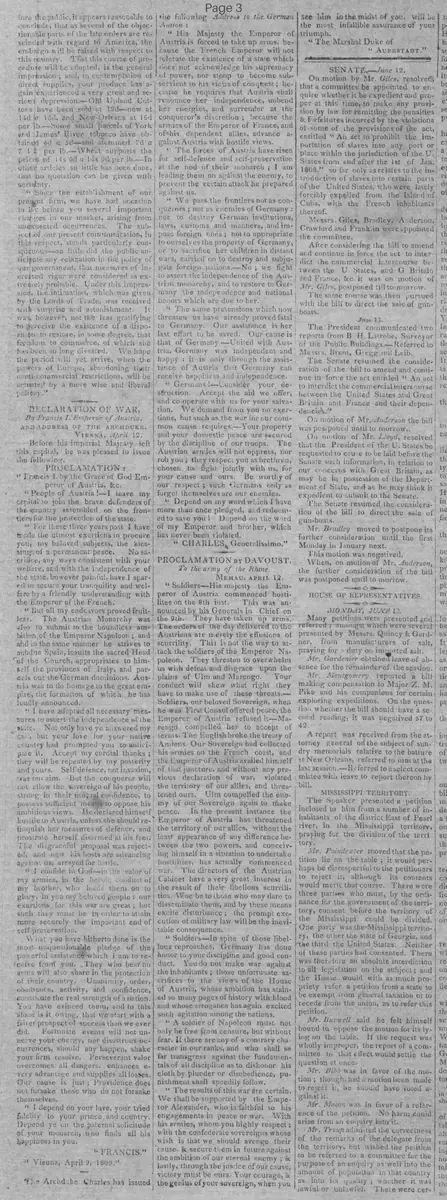
By Francis I. Emperor of Austria.
AND ADDRESS OF THE ARCHDUKE.
VIENNA, April 12.
Before his imperial Majesty left this capital, he was pleased to issue the following.
PROCLAMATION:
"Francis I. by the Grace of God Emperor of Austria, &c.
"People of Austria!—I leave my capital to join the brave defenders of the country assembled on the frontiers for the protection of the state.
"For these three years past I have made the utmost exertions to procure you, my beloved subjects, the blessings of a permanent peace. No sacrifice, any ways consistent with your welfare, and with the independence of the state, however painful, have I spared to secure your tranquility and welfare by a friendly understanding with the Emperor of the French.
"But all my endeavors proved fruitless. The Austrian Monarchy was also to submit to the boundless ambition of the Emperor Napoleon; and in the same manner he strives to subdue Spain, insults the sacred Head of the Church, appropriates to himself the provinces of Italy, and parcels out the German dominions. Austria was to do homage to the great empire, the formation of which he has loudly announced.
"I have adopted all necessary measures to assert the independence of the state. Not only have ye answered my call, but your love for your native country had prompted you to anticipate it. Accept my cordial thanks; they will be repeated by my posterity and yours. Self defence, not invasion, was our aim. But the conqueror will not allow the Sovereign of his people, strong in their mutual confidence, to possess sufficient means to oppose his ambitious views. He declared himself hostile to Austria, unless she should relinquish her measures of defence, and prostrate herself disarmed at his feet. The disgraceful proposal was rejected, and now his hosts are advancing against us, arrayed for battle.
"I confide in God, in the valor of my armies, in the heroic conduct of my brother, who leads them on to glory, in you my beloved people: our exertions for this war are great; but such they must be in order to attain more securely the important end of self-preservation.
What you have hitherto done is the most unquestionable pledge of the powerful assistance which I am to receive from you. They who bear no arms will also share in the protection of their country. Unanimity, order, obedience, activity, and confidence, constitute the real strength of a nation. You have evinced them, and to this alone is it owing, that we start with a fairer prospect of success than we ever did. Fortunate events will not unnerve your energy, nor disastrous occurrences, should any happen, shake your firm resolve. Perseverant valor overcomes all dangers, enhances every advantage and supplies all losses. Our cause is just; Providence does not forsake those who do not forsake themselves.
"I depend on your love, your tried fidelity to your prince and country. Depend ye on the paternal solicitude of your monarch, who finds all his happiness in you."
FRANCIS.
Vienna, April 9, 1809.
The Archduke Charles has issued the following Address to the German Nation:
"His Majesty the Emperor of Austria is forced to take up arms, because the French Emperor will not tolerate the existence of a state which does not acknowledge his supremacy of power, nor stoop to become subservient to his views of conquest; because he requires that Austria shall renounce her independence, unbend her energies, and surrender at the conqueror's discretion; because the armies of the Emperor of France, and of his dependent allies, advance against Austria with hostile views.
"The forces of Austria have risen for self-defence and self-preservation at the nod of their monarch; I am leading them on against the enemy, to prevent the certain attack he prepared against us.
"We pass the frontiers not as conquerors; not as enemies of Germany: nor to destroy German institutions, laws, customs and manners, and impose foreign ones; not to appropriate to ourselves the property of Germany, or to sacrifice her children in distant wars, carried on to destroy and subjugate foreign nations. No; we fight to assert the independence of the Austrian monarchy, and to restore to Germany the independence and national honors which are due to her.
"The same pretensions which now threaten us have already proved fatal to Germany. Our assistance is her last effort to be saved. Our cause is that of Germany—United with Austria, Germany was independent and happy: it is only through the assistance of Austria that Germany can receive happiness and independence.
"Germans! Consider your destruction. Accept the aid we offer, and co-operate with us for your salvation. We demand from you no exertions, but such as the war for our common cause requires. Your property and your domestic peace are secured by the discipline of our troops. The Austrian armies will not oppress, nor rob you; they respect you as brethren, chosen to fight jointly with us, for your cause and ours. Be worthy of our respect; such Germans only as forget themselves are our enemies.
"Depend on my word which I have more than once pledged, and redeemed to save you! Depend on the word of my Emperor and brother, which has never been violated."
CHARLES, Generalissimo.
PROCLAMATION By DAVOUST.
To the army of the Rhine
MEMAU, APRIL 12.
"Soldiers—His majesty the Emperor of Austria commenced hostilities on the 8th inst. This was announced by his Generals in Chief on the 9th. They have taken up arms. The orders of the day delivered to the Austrians are merely the effusions of scurrility. This is not the way to attack the soldiers of the Emperor Napoleon. They threaten to overwhelm us with defeat and disgrace upon the plains of Ulm and Marengo. Your conduct will shew what right they have to make use of these threats.
Soldiers, our beloved Sovereign, when he was First Consul offered peace, the Emperor of Austria refused it—Marengo compelled her to accept of terms. The English broke the treaty of Amiens. Our Sovereign had collected his armies on the French coast, and the Emperor of Austria availed himself of that juncture, and without any previous declaration of war, violated the territory of our allies, and threatened ours. Ulm compelled the enemy of our Sovereign again to make peace. In the present instance the Emperor of Austria has threatened the territory of our allies, without the least appearance of any difference between the two powers, and conceiving himself in a situation to undertake hostilities, has actually commenced war. The directors of the Austrian Cabinet have a very great interest in the result of their libellous scurrilities. Woe be to those who may dare to disseminate them, and by these means excite disturbance; the prompt execution of military law will be the inevitable consequence.
"Soldiers—In spite of those libellous reproaches, Germany has done honor to your discipline and good conduct. You do not make war against the inhabitants; those unfortunate sacrifices to the views of the House of Austria, whose ambition has stained so many pages of history with blood and whose arrogance has again excited such agitation among the nations.
"A soldier of Napoleon must not only be free from censure, but without fear. If there are any of a contrary character in our ranks, and who shall so far transgress against the fundamentals of all discipline as to dishonor his cloth by plunder or disobedience, punishment shall speedily follow.
"The results of this war are certain. We shall be supported by the Emperor Alexander, who is faithful to his engagements in peace or war. With his armies, whom you highly respect; with the confederate sovereigns whose wish is that we should avenge their cause, & secure them in future against the ambition of our eternal enemy; & lastly, through the justice of our cause. Victory must be ours. Your courage, & the genius of your sovereign, when you see him in the midst of you, will be the most infallible assurance of your triumph."
The Marshal Duke of
AUERSTADT.
What sub-type of article is it?
What keywords are associated?
What entities or persons were involved?
Where did it happen?
Foreign News Details
Primary Location
Vienna
Event Date
April 9, 1809
Key Persons
Outcome
austria rejects french demands and declares war; french forces advance in response, with predictions of victory on both sides.
Event Details
Emperor Francis I proclaims war on France, citing Napoleon's ambition and failed peace efforts, calling on Austrians for self-defense. Archduke Charles addresses Germans for support to restore independence. Marshal Davoust proclaims to French troops that Austria initiated hostilities and assures victory with allies.