Thank you for visiting SNEWPapers!
Sign up free
Story
February 9, 1884
St. Tammany Farmer
Covington, Saint Tammany County, Louisiana
What is this article about?
Educational article by Richard A. Proctor describing the sun's immense size, distance from Earth, gravitational power, light and heat output, chemical composition, rotation, and sunspots, presenting scientific facts as wonders.
Clipping
OCR Quality
98%
Excellent
Full Text
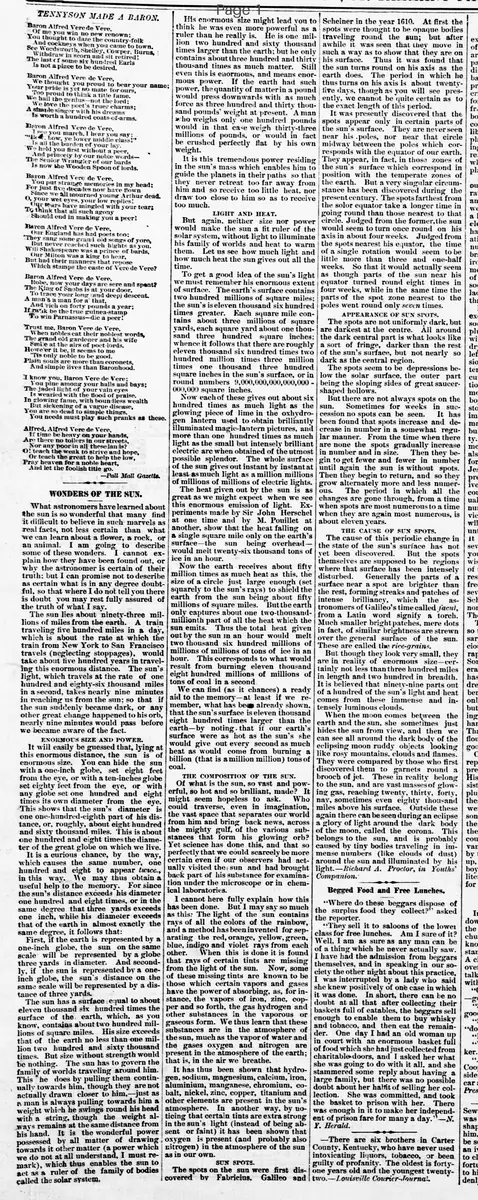
WONDERS OF THE SUN.
What astronomers have learned about the sun is so wonderful that many find it difficult to believe in such marvels as real facts, not less certain than what we can learn about a flower, a rock, or an animal. I am going to describe some of these wonders. I cannot explain how they have been found out, or why the astronomer is certain of their truth; but I can promise not to describe as certain what is in any degree doubtful, so that where I do not tell you there is doubt you may rest fully assured of the truth of what I say.
The sun lies about ninety-three millions of miles from the earth. A train traveling five hundred miles in a day, which is about the rate at which the train from New York to San Francisco travels (neglecting stoppages), would take about five hundred years in traveling this enormous distance. The sun's light, which travels at the rate of one hundred and eighty-six thousand miles in a second, takes nearly nine minutes in reaching us from the sun; so that if the sun suddenly became dark, or any other great change happened to his orb, nearly nine minutes would pass before we became aware of the fact.
ENORMOUS SIZE AND POWER.
It will easily be guessed that, lying at this enormous distance, the sun is of enormous size. You can hide the sun with a one-inch globe, set eight feet from the eye, or with a ten-inch globe set eighty feet from the eye, or with any globe set one hundred and eight times its own diameter from the eye. This shows that the sun's diameter is one one-hundred-and-eighth part of his distance, or, roughly, about eight hundred and sixty thousand miles. This is about one hundred and eight times the diameter of the great globe on which we live. It is a curious chance, by the way, which causes the same number, one hundred and eight, to appear twice in this way. We may thus obtain a useful help to the memory. For since the sun's distance exceeds his diameter one hundred and eight times, or in the same degree that three yards exceeds one inch, while his diameter exceeds that of the earth in almost exactly the same degree, it follows that:
First, if the earth is represented by a one-inch globe, the sun on the same scale will be represented by a globe three yards in diameter. And secondly, if the sun is represented by a one-inch globe, the sun's distance on the same scale will be represented by a distance of three yards.
The sun has a surface equal to about eleven thousand six hundred times the surface of the earth, which, as you know, contains about two hundred millions of square miles. His size exceeds that of the earth no less than one million two hundred and sixty thousand times. But size without strength would be nothing. The sun has to govern the family of worlds traveling around him. This he does by pulling them continually towards him, though they are not actually drawn closer to him—just as a man is always pulling towards him a weight which he swings round his head with a string, though the weight always remains at the same distance from his hand. It is the wonderful power possessed by all matter of drawing towards it other matter (a power which we do not at all understand, I must remark), which thus enables the sun to act as a ruler of the family of bodies called the solar system.
His enormous size might lead you to think he was even more powerful as a ruler than he really is. He is one million two hundred and sixty thousand times larger than the earth; but he only contains about three hundred and thirty thousand times as much matter. Still even this is enormous, and means enormous power. If the earth had such power, the quantity of matter in a pound would press downwards with as much force as three hundred and thirty thousand pounds' weight at present. A man who weighs only one hundred pounds would in that case weigh thirty-three millions of pounds, or would in fact be crushed perfectly flat by his own weight.
It is this tremendous power residing in the sun's mass which enables him to guide the planets in their paths so that they never recede too far away from him and so receive too little heat, nor draw too close to him so as to receive too much.
LIGHT AND HEAT.
But again, neither size nor power would make the sun a fit ruler of the solar system, without light to illuminate his family of worlds and heat to warm them. Let us see how much light and how much heat the sun gives out all the time.
To get a good idea of the sun's light we must remember his enormous extent of surface. The earth's surface contains two hundred millions of square miles; the sun's is eleven thousand six hundred times greater. Each square mile contains about three millions of square yards, each square yard about one thousand three hundred square inches; whence it follows that there are roughly eleven thousand six hundred times two hundred million times three million times one thousand three hundred square inches in the sun's surface, or in round numbers 9,000,000,000,000,000,000,000 square inches.
Now each of these gives out about six hundred times as much light as the glowing piece of lime in the oxyhydrogen lantern used to obtain brilliantly illuminated magic-lantern pictures, and more than one hundred times as much light as the small but intensely brilliant electric arc when obtained of the utmost possible splendor. The whole surface of the sun gives out instant by instant at least as much light as a million millions of millions of millions of electric lights.
The heat given out by the sun is as great as we might expect when we see this enormous emission of light. Experiments made by Sir John Herschel at one time and by M. Pouillet at another, show that the heat falling on a single square mile only on the earth's surface—the sun being overhead—would melt twenty-six thousand tons of ice in an hour.
Now the earth receives about fifty million times as much heat as this, the size of a circle just large enough (set squarely to the sun's rays) to shield the earth from the sun being about fifty millions of square miles. But the earth only captures about one two-millionth part of all the heat which the sun emits.
Thus the total heat given out by the sun in an hour would melt two thousand six hundred millions of millions of millions of tons of ice in an hour. This corresponds to what would result from burning eleven thousand eight hundred millions of millions of tons of coal in a second.
We can find (as it chances) a ready aid to the memory—at least if we remember what has been already shown, that the sun's surface is eleven thousand eight hundred times larger than the earth—by noting that if our earth's surface were as hot as the sun's she would give out every second as much heat as would come from burning a billion (that is a million million) tons of coal.
Of what is the sun, so vast and powerful, so hot and so brilliant, made? It might seem hopeless to ask. Who could traverse, even in imagination, the vast space that separates our world from him and bring back news, across the mighty gulf, of the various substances that form his glowing orb?
Yet science has done this, and that so perfectly that we could scarcely be more certain even if our observers had actually visited the sun and had brought back part of his substance for examination under the microscope or in chemical laboratories.
I cannot here fully explain how this has been done. But I may say so much as this: The light of the sun contains rays of all the colors of the rainbow, and a method has been invented for separating the red, orange, yellow, green, blue, indigo and violet rays from each other.
When this is done it is found that rays of certain tints are missing from the light of the sun. Now, some of these missing tints are known to be those which certain vapors and gases have the power of absorbing, as, for instance, the vapors of iron, zinc, copper and so forth, the gas hydrogen and other substances in the vaporous or gaseous form. We thus learn that these substances are in the atmosphere of the sun, much as the vapor of water and the gases oxygen and nitrogen are present in the atmosphere of the earth; that is, in the air we breathe.
It has thus been shown that hydrogen, sodium, magnesium, calcium, iron, aluminium, manganese, chromium, cobalt, nickel, zinc, copper, titanium and other elements are present in the sun's atmosphere. In another way, by noticing that certain tints are extra strong in the sun's light (instead of being absent or faint) it has been shown that oxygen is present (and probably also nitrogen) in the atmosphere of the sun as in our own.
SUN SPOTS.
The spots on the sun were first discovered by Fabricius, Galileo and Scheiner in the year 1610. At first the spots were thought to be opaque bodies traveling round the sun; but after awhile it was seen that they move in such a way as to show that they are on his surface. Thus it was found that the sun turns round on his axis as the earth does. The period in which he thus turns on his axis is about twenty-five days, though as you will see presently, we cannot be quite certain as to the exact length of this period.
It was presently discovered that the spots appear only in certain parts of the sun's surface. They are never seen near his poles, nor near that circle midway between the poles which corresponds with the equator of our earth. They appear, in fact, in those zones of the sun's surface which correspond in position with the temperate zones of the earth. But a very singular circumstance has been discovered during the present century. The spots farthest from the solar equator take a longer time in going round than those nearest to that circle. Judged from the former, the sun would seem to turn once round on his axis in about four weeks. Judged from the spots nearest his equator, the time of a single rotation would seem to be little more than three and one-half weeks. So that it would actually seem as though parts of the sun near his equator turned round eight times in four weeks, while in the same time the parts of the spot zone nearest to the poles went round only seven times.
APPEARANCE OF SUN SPOTS.
The spots are not uniformly dark, but are darkest at the centre. All around the dark central part is what looks like a sort of fringe, darker than the rest of the sun's surface, but not nearly so dark as the central region. The spots seem to be depressions below the solar surface, the outer part being the sloping sides of great saucer-shaped hollows.
But there are not always spots on the sun. Sometimes for weeks in succession no spots can be seen. It has been found that spots increase and decrease in number in a somewhat regular manner. From the time when there are none the spots gradually increase in number and in size. Then they begin to get fewer and fewer in number until again the sun is without spots. Then they begin to return, and so they grow alternately more and less numerous.
The period in which all the changes are gone through, from a time when spots are most numerous to a time when they are again most numerous, is about eleven years.
THE CAUSE OF SUN SPOTS.
The cause of this periodic change in the state of the sun's surface has not yet been discovered. But the spots themselves are supposed to be regions where that surface has been intensely disturbed. Generally the parts of a surface near a spot are brighter than the rest, forming streaks and patches of intense brilliancy, which the astronomers of Galileo's time called faculae, from a Latin word signifying a torch.
Much smaller bright patches, mere dots in fact, of similar brightness are strewn over the general surface of the sun. These are called the rice-grains. But though they look very small, they are in reality of enormous size—certainly not less than three hundred miles in length and two hundred in breadth.
It is believed that ninety-nine parts out of a hundred of the sun's light and heat comes from these immense and intensely luminous clouds.
When the moon comes between the earth and the sun, she sometimes just hides the sun from view, and then we can see all around the dark body of the eclipsing moon ruddy objects looking like rosy mountains, clouds and flames. They were compared by those who first discovered them to garnets round a brooch of jet. These in reality belong to the sun, and are vast masses of glowing gas, reaching twenty, thirty, forty, nay, sometimes even eighty thousand miles above his surface. "Outside these again there can be seen during an eclipse a glory of light around the dark body of the moon, called the corona. This belongs to the sun, and is probably caused by tiny bodies traveling in immense numbers (like clouds of dust) around the sun and illuminated by his light."—Richard A. Proctor, in Youth's Companion.
What astronomers have learned about the sun is so wonderful that many find it difficult to believe in such marvels as real facts, not less certain than what we can learn about a flower, a rock, or an animal. I am going to describe some of these wonders. I cannot explain how they have been found out, or why the astronomer is certain of their truth; but I can promise not to describe as certain what is in any degree doubtful, so that where I do not tell you there is doubt you may rest fully assured of the truth of what I say.
The sun lies about ninety-three millions of miles from the earth. A train traveling five hundred miles in a day, which is about the rate at which the train from New York to San Francisco travels (neglecting stoppages), would take about five hundred years in traveling this enormous distance. The sun's light, which travels at the rate of one hundred and eighty-six thousand miles in a second, takes nearly nine minutes in reaching us from the sun; so that if the sun suddenly became dark, or any other great change happened to his orb, nearly nine minutes would pass before we became aware of the fact.
ENORMOUS SIZE AND POWER.
It will easily be guessed that, lying at this enormous distance, the sun is of enormous size. You can hide the sun with a one-inch globe, set eight feet from the eye, or with a ten-inch globe set eighty feet from the eye, or with any globe set one hundred and eight times its own diameter from the eye. This shows that the sun's diameter is one one-hundred-and-eighth part of his distance, or, roughly, about eight hundred and sixty thousand miles. This is about one hundred and eight times the diameter of the great globe on which we live. It is a curious chance, by the way, which causes the same number, one hundred and eight, to appear twice in this way. We may thus obtain a useful help to the memory. For since the sun's distance exceeds his diameter one hundred and eight times, or in the same degree that three yards exceeds one inch, while his diameter exceeds that of the earth in almost exactly the same degree, it follows that:
First, if the earth is represented by a one-inch globe, the sun on the same scale will be represented by a globe three yards in diameter. And secondly, if the sun is represented by a one-inch globe, the sun's distance on the same scale will be represented by a distance of three yards.
The sun has a surface equal to about eleven thousand six hundred times the surface of the earth, which, as you know, contains about two hundred millions of square miles. His size exceeds that of the earth no less than one million two hundred and sixty thousand times. But size without strength would be nothing. The sun has to govern the family of worlds traveling around him. This he does by pulling them continually towards him, though they are not actually drawn closer to him—just as a man is always pulling towards him a weight which he swings round his head with a string, though the weight always remains at the same distance from his hand. It is the wonderful power possessed by all matter of drawing towards it other matter (a power which we do not at all understand, I must remark), which thus enables the sun to act as a ruler of the family of bodies called the solar system.
His enormous size might lead you to think he was even more powerful as a ruler than he really is. He is one million two hundred and sixty thousand times larger than the earth; but he only contains about three hundred and thirty thousand times as much matter. Still even this is enormous, and means enormous power. If the earth had such power, the quantity of matter in a pound would press downwards with as much force as three hundred and thirty thousand pounds' weight at present. A man who weighs only one hundred pounds would in that case weigh thirty-three millions of pounds, or would in fact be crushed perfectly flat by his own weight.
It is this tremendous power residing in the sun's mass which enables him to guide the planets in their paths so that they never recede too far away from him and so receive too little heat, nor draw too close to him so as to receive too much.
LIGHT AND HEAT.
But again, neither size nor power would make the sun a fit ruler of the solar system, without light to illuminate his family of worlds and heat to warm them. Let us see how much light and how much heat the sun gives out all the time.
To get a good idea of the sun's light we must remember his enormous extent of surface. The earth's surface contains two hundred millions of square miles; the sun's is eleven thousand six hundred times greater. Each square mile contains about three millions of square yards, each square yard about one thousand three hundred square inches; whence it follows that there are roughly eleven thousand six hundred times two hundred million times three million times one thousand three hundred square inches in the sun's surface, or in round numbers 9,000,000,000,000,000,000,000 square inches.
Now each of these gives out about six hundred times as much light as the glowing piece of lime in the oxyhydrogen lantern used to obtain brilliantly illuminated magic-lantern pictures, and more than one hundred times as much light as the small but intensely brilliant electric arc when obtained of the utmost possible splendor. The whole surface of the sun gives out instant by instant at least as much light as a million millions of millions of millions of electric lights.
The heat given out by the sun is as great as we might expect when we see this enormous emission of light. Experiments made by Sir John Herschel at one time and by M. Pouillet at another, show that the heat falling on a single square mile only on the earth's surface—the sun being overhead—would melt twenty-six thousand tons of ice in an hour.
Now the earth receives about fifty million times as much heat as this, the size of a circle just large enough (set squarely to the sun's rays) to shield the earth from the sun being about fifty millions of square miles. But the earth only captures about one two-millionth part of all the heat which the sun emits.
Thus the total heat given out by the sun in an hour would melt two thousand six hundred millions of millions of millions of tons of ice in an hour. This corresponds to what would result from burning eleven thousand eight hundred millions of millions of tons of coal in a second.
We can find (as it chances) a ready aid to the memory—at least if we remember what has been already shown, that the sun's surface is eleven thousand eight hundred times larger than the earth—by noting that if our earth's surface were as hot as the sun's she would give out every second as much heat as would come from burning a billion (that is a million million) tons of coal.
Of what is the sun, so vast and powerful, so hot and so brilliant, made? It might seem hopeless to ask. Who could traverse, even in imagination, the vast space that separates our world from him and bring back news, across the mighty gulf, of the various substances that form his glowing orb?
Yet science has done this, and that so perfectly that we could scarcely be more certain even if our observers had actually visited the sun and had brought back part of his substance for examination under the microscope or in chemical laboratories.
I cannot here fully explain how this has been done. But I may say so much as this: The light of the sun contains rays of all the colors of the rainbow, and a method has been invented for separating the red, orange, yellow, green, blue, indigo and violet rays from each other.
When this is done it is found that rays of certain tints are missing from the light of the sun. Now, some of these missing tints are known to be those which certain vapors and gases have the power of absorbing, as, for instance, the vapors of iron, zinc, copper and so forth, the gas hydrogen and other substances in the vaporous or gaseous form. We thus learn that these substances are in the atmosphere of the sun, much as the vapor of water and the gases oxygen and nitrogen are present in the atmosphere of the earth; that is, in the air we breathe.
It has thus been shown that hydrogen, sodium, magnesium, calcium, iron, aluminium, manganese, chromium, cobalt, nickel, zinc, copper, titanium and other elements are present in the sun's atmosphere. In another way, by noticing that certain tints are extra strong in the sun's light (instead of being absent or faint) it has been shown that oxygen is present (and probably also nitrogen) in the atmosphere of the sun as in our own.
SUN SPOTS.
The spots on the sun were first discovered by Fabricius, Galileo and Scheiner in the year 1610. At first the spots were thought to be opaque bodies traveling round the sun; but after awhile it was seen that they move in such a way as to show that they are on his surface. Thus it was found that the sun turns round on his axis as the earth does. The period in which he thus turns on his axis is about twenty-five days, though as you will see presently, we cannot be quite certain as to the exact length of this period.
It was presently discovered that the spots appear only in certain parts of the sun's surface. They are never seen near his poles, nor near that circle midway between the poles which corresponds with the equator of our earth. They appear, in fact, in those zones of the sun's surface which correspond in position with the temperate zones of the earth. But a very singular circumstance has been discovered during the present century. The spots farthest from the solar equator take a longer time in going round than those nearest to that circle. Judged from the former, the sun would seem to turn once round on his axis in about four weeks. Judged from the spots nearest his equator, the time of a single rotation would seem to be little more than three and one-half weeks. So that it would actually seem as though parts of the sun near his equator turned round eight times in four weeks, while in the same time the parts of the spot zone nearest to the poles went round only seven times.
APPEARANCE OF SUN SPOTS.
The spots are not uniformly dark, but are darkest at the centre. All around the dark central part is what looks like a sort of fringe, darker than the rest of the sun's surface, but not nearly so dark as the central region. The spots seem to be depressions below the solar surface, the outer part being the sloping sides of great saucer-shaped hollows.
But there are not always spots on the sun. Sometimes for weeks in succession no spots can be seen. It has been found that spots increase and decrease in number in a somewhat regular manner. From the time when there are none the spots gradually increase in number and in size. Then they begin to get fewer and fewer in number until again the sun is without spots. Then they begin to return, and so they grow alternately more and less numerous.
The period in which all the changes are gone through, from a time when spots are most numerous to a time when they are again most numerous, is about eleven years.
THE CAUSE OF SUN SPOTS.
The cause of this periodic change in the state of the sun's surface has not yet been discovered. But the spots themselves are supposed to be regions where that surface has been intensely disturbed. Generally the parts of a surface near a spot are brighter than the rest, forming streaks and patches of intense brilliancy, which the astronomers of Galileo's time called faculae, from a Latin word signifying a torch.
Much smaller bright patches, mere dots in fact, of similar brightness are strewn over the general surface of the sun. These are called the rice-grains. But though they look very small, they are in reality of enormous size—certainly not less than three hundred miles in length and two hundred in breadth.
It is believed that ninety-nine parts out of a hundred of the sun's light and heat comes from these immense and intensely luminous clouds.
When the moon comes between the earth and the sun, she sometimes just hides the sun from view, and then we can see all around the dark body of the eclipsing moon ruddy objects looking like rosy mountains, clouds and flames. They were compared by those who first discovered them to garnets round a brooch of jet. These in reality belong to the sun, and are vast masses of glowing gas, reaching twenty, thirty, forty, nay, sometimes even eighty thousand miles above his surface. "Outside these again there can be seen during an eclipse a glory of light around the dark body of the moon, called the corona. This belongs to the sun, and is probably caused by tiny bodies traveling in immense numbers (like clouds of dust) around the sun and illuminated by his light."—Richard A. Proctor, in Youth's Companion.
What sub-type of article is it?
Curiosity
Extraordinary Event
What themes does it cover?
Nature
What keywords are associated?
Sun Wonders
Astronomy Facts
Sun Size
Sunspots
Solar Heat
Solar Composition
Solar Rotation
What entities or persons were involved?
Richard A. Proctor
Fabricius
Galileo
Scheiner
Sir John Herschel
M. Pouillet
Where did it happen?
The Sun
Story Details
Key Persons
Richard A. Proctor
Fabricius
Galileo
Scheiner
Sir John Herschel
M. Pouillet
Location
The Sun
Event Date
1610
Story Details
Article explains sun's distance, size, gravitational power, light and heat emission, chemical composition via spectroscopy, rotation period, sunspots' appearance, periodicity, and solar phenomena like prominences and corona.