Thank you for visiting SNEWPapers!
Sign up free
The National Intelligencer And Washington Advertiser
Washington, District Of Columbia
What is this article about?
Report of William Pitt's speech in the House of Commons on May 23, 1803, justifying war with France due to violations of the Treaty of Amiens, hostile actions like the Sebastiani mission to Egypt, demands over Malta, and interference in British affairs. Pitt urges vigorous defense preparations.
Merged-components note: Continuation of the report on Mr. Pitt's speech in the House of Commons, split across page boundary on page 4; sequential reading order and topic coherence indicate single foreign news article.
Clipping
OCR Quality
Full Text
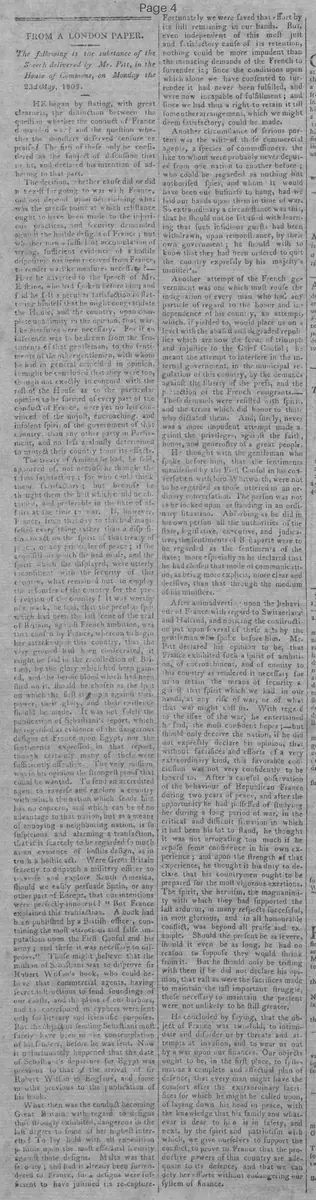
The following is the substance of the Speech delivered by Mr. Pitt, in the House of Commons, on Monday the 23d May, 1803.
HE began by stating, with great clearness, the distinction between the question whether the conduct of France demanded war? and the question whether the ministers deserved censure or praise? The first of these only he considered as the subject of discussion that night, and declared his intention of adhering to that part.
The decision, whether cause did or did not exist for going to war with France, did not depend upon determining what was the precise point at which resistance ought to have been made to the injurious practices, and security demanded against the hostile designs of France; but whether now a sufficient accumulation of wrong, sufficient evidence of a hostile disposition has been received from France, to render warlike measures necessary?
Here he alluded to the speech of Mr. Erskine, who had spoken before him; and said he felt a peculiar satisfaction in flattering himself that he might congratulate the House, and the country, upon complete unanimity in the opinion, that warlike measures were necessary. For if an inference was to be drawn from the sentiments of that gentleman, to the sentiments of the other gentlemen, with whom he had in general coincided in opinion, it might be concluded that they were too, though not exactly in concord with the rest of the House as to the particular opinion to be formed of every part of the conduct of France, were yet no less convinced of the unjust, encroaching, and insolent spirit of the government of that Country, than any other party in Parliament, and no less zealously determined to protect their country from its effects.
The treaty of Amiens he had, he said, approved of, not because he thought the terms satisfactory; for who could think them satisfactory: but because he thought them the best which could be obtained, and preferable in the state of affairs at the time by war. He, however, France, from that day to this had manifested every thing rather than a disposition to act on the spirit of that treaty of peace, or any principles of peace; if the acquisitions which they had made, and the spirit which they displayed, were utterly inconsistent with the security of this country, what remained but to employ the resources of the country for the preservation of the Country? It was worthy of remark, he said, that the peculiar spot which had been the last scene of the zeal of Britain, against French ambition, was the spot chosen by France, whereon to begin her attacks upon this country, that the very ground had been consecrated, it might be said in the recollection of Britons, by the glory which had been gained, and the heroic blood which had been shed on it, should be chosen as the spot on which the first attempts against their power, their glory, and their existence should be made. It was not solely the publication of Sebastiani's report, which he regarded as evidence of the dangerous designs of France upon Egypt, nor the sentiments expressed in that report, though certainly many of these were sufficiently offensive The very mission was in his opinion the strongest proof that could be wanted. To send an accredited agent to traverse and explore a country with which the nation which sends him has no concern, and which can be of no advantage to that nation, but as a means of annoying a neighboring nation, is so suspicious and alarming a transaction, that it is scarcely to be regarded so much as an evidence of hostile design, as in truth a hostile act. Were Great Britain secretly to dispatch a military officer to traverse and explore South America, Should we easily persuade Spain, or any other part of Europe, that our intentions were perfectly innocent? But France explained this transaction. A book had been published by a British officer, containing the most atrocious and false imputations upon the First Consul and his army; and these it was necessary to disprove. Those might believe that the mission of Sebastiani was to disprove it Robert Wilson's book, who could believe that commercial agents, having secret instructions to soundings of our coasts, and the plans of our harbors, and to correspond in cyphers were sent only for literary and scientific purposes. But the object of sending Sebastiani must surely have been in the contemplation of his senders, before he was sent. Now it unfortunately happened that the date of Sebastiani's departure for Egypt was previous to that of the arrival of Sir Robert Wilson in England, and some months previous to the publication of his book.
What then was the conduct becoming Great Britain with regard to designs thus strongly exhibited, dangerous in the last degree to one of her highest interest? To lay hold with all expedition possible upon the most effectual security against those designs. Malta was that security; and had it already been surrendered to France, such designs were sufficient to have justified its re-capture. Fortunately we were saved that effort by its still remaining in our hands. But, even independent of this most just and satisfactory cause of its retention, nothing could be more impudent than the menacing demands of the French to surrender it; since the Conditions upon which alone we have consented to surrender it had never been fulfilled, and were now incapable of fulfillment: and since we had thus a right to retain it till some other arrangement, which we might deem satisfactory, could be made.
Another circumstance of serious import was the visit of those commercial agents, a species of commissioners the like to whom were probably never deputed from one nation to another before; who could be regarded as nothing but authorized spies, and whom it would have been our business to hang, had we laid our hands upon them in time of war. So extraordinary a circumstance was this, that he should not be satisfied with learning that such insidious guests had been withdrawn, upon remonstrance, by their own government; he should wish to know that they had been ordered to quit the country expressly by his majesty's ministers.
Another attempt of the French government was one which must rouse the indignation of every man who has any particle of regard to the honor and independence of his country, an attempt, which, if yielded to, would place us on a level with the abased and degraded republics which are now the scene of triumph and injustice to the Chief Consul; he meant the attempt to interfere in the internal government, in the municipal regulation of this country, by the demands against the liberty of the press, and the protection of the French emigrants. The demands were resisted with spirit, and the terms which did honor to those who dictated them. And, surely, never was a more impudent attempt made against the privileges, against the faith, honor, and generosity of a great people.
He thought with the gentleman who spoke before him, that the sentiments manifested by the First Consul in his conversation with lord Whitworth, were not to be regarded as those uttered in an ordinary conversation. The person was not to be looked upon as standing in an ordinary situation. Absorbing as he did in his own person all the authorities of the state, legislative, executive, and judiciary, the sentiments of Bonaparte were to be regarded as the sentiments of the state; more especially as he declared that he had chosen that mode of communication, as being more explicit, more clear and decisive, than that through the medium of his ministers.
After animadverting upon the behavior of France with regard to Switzerland and Holland, and noticing the construction put upon several of these acts by the gentleman who spoke before him. Mr. Pitt declared his opinion to be, that France exhibited such a spirit of ambition, of encroachment, and of enmity to this Country as rendered it necessary for us to retain the means of security against that spirit which we had in our hands, at any risk of war, or of what that war might cost us. With regard to the issue of the war, he entertained he said, the most confident hopes;—but should only deceive the nation, if he did not expressly declare his opinion, that without sacrifices and efforts of a very extraordinary kind, this favorable conclusion was not very confidently to be looked to. After a careful observation of the behaviour of Republican France during two years of peace, and after the opportunity he had possessed of studying her during a long period of war, in the critical and difficult situation in which it had been his lot to stand, he thought it was not arrogating too much if he reposed some confidence in his own experience; and upon the strength of that experience, he thought it his duty to declare that his countrymen ought to be prepared for the most vigorous exertions. The spirit, the heroism, the magnanimity with which they had supported the last arduous, in many respects successful, in most glorious, and in all honourable conflict, was beyond all praise and example. Should the present be as severe, should it even be as long, he had no reason to suppose they would shrink from it. But he should only be trifling with them if he did not declare his opinion, that vast as were the sacrifices made to maintain the last important struggle, those necessary to maintain the present were not unlikely to be still greater.
He concluded by saying, that the object of France was two-fold, to intimidate and disorder us by threats and attempts at invasion, and to wear us out by a war upon our finances. Our objects ought to be, in the first place, to systematize a complete and effectual plan of defence, that every man might have the comfort after the extraordinary sacrifices for which he might be called upon, of laying down his head in peace, with the knowledge that his family and whatever is dear to him is in safety, and next, by the spirit and patriotism with which, we give ourselves to support the conflict, to prove to France that the productive powers of this country are adequate to its defence, and that we can deny her efforts without endangering our system of finance.
What sub-type of article is it?
What keywords are associated?
What entities or persons were involved?
Where did it happen?
Foreign News Details
Primary Location
France
Event Date
23 May 1803
Key Persons
Outcome
justification for war with france; retention of malta; resistance to french demands on press liberty and emigrants; call for vigorous national defense and sacrifices.
Event Details
Mr. Pitt's speech in the House of Commons distinguishes the debate on whether France's conduct demands war, emphasizing violations of the Treaty of Amiens, the suspicious mission of Sebastiani to Egypt as a hostile act, impudent demands for Malta's surrender, deployment of commercial agents as spies, interference in British internal affairs, and aggressive sentiments from the First Consul. He approves the treaty reluctantly but sees France's actions as requiring warlike measures and retention of security like Malta. Pitt urges preparation for extraordinary efforts in the impending conflict.