Thank you for visiting SNEWPapers!
Sign up free
Editorial
October 12, 1786
Fowle's New Hampshire Gazette And General Advertiser
Portsmouth, Rockingham County, New Hampshire
What is this article about?
An editorial by 'The Examiner' defends a proposed plan for emitting paper money in New-Hampshire to relieve economic distress, fund debts via taxation, and reduce need for hard currency. It refutes objections on circulation, appreciation of securities, trade impacts, and historical depreciations, arguing the plan will promote industry and stability.
Clipping
OCR Quality
98%
Excellent
Full Text
To the FREEMEN of New-Hampshire,
Gentlemen,
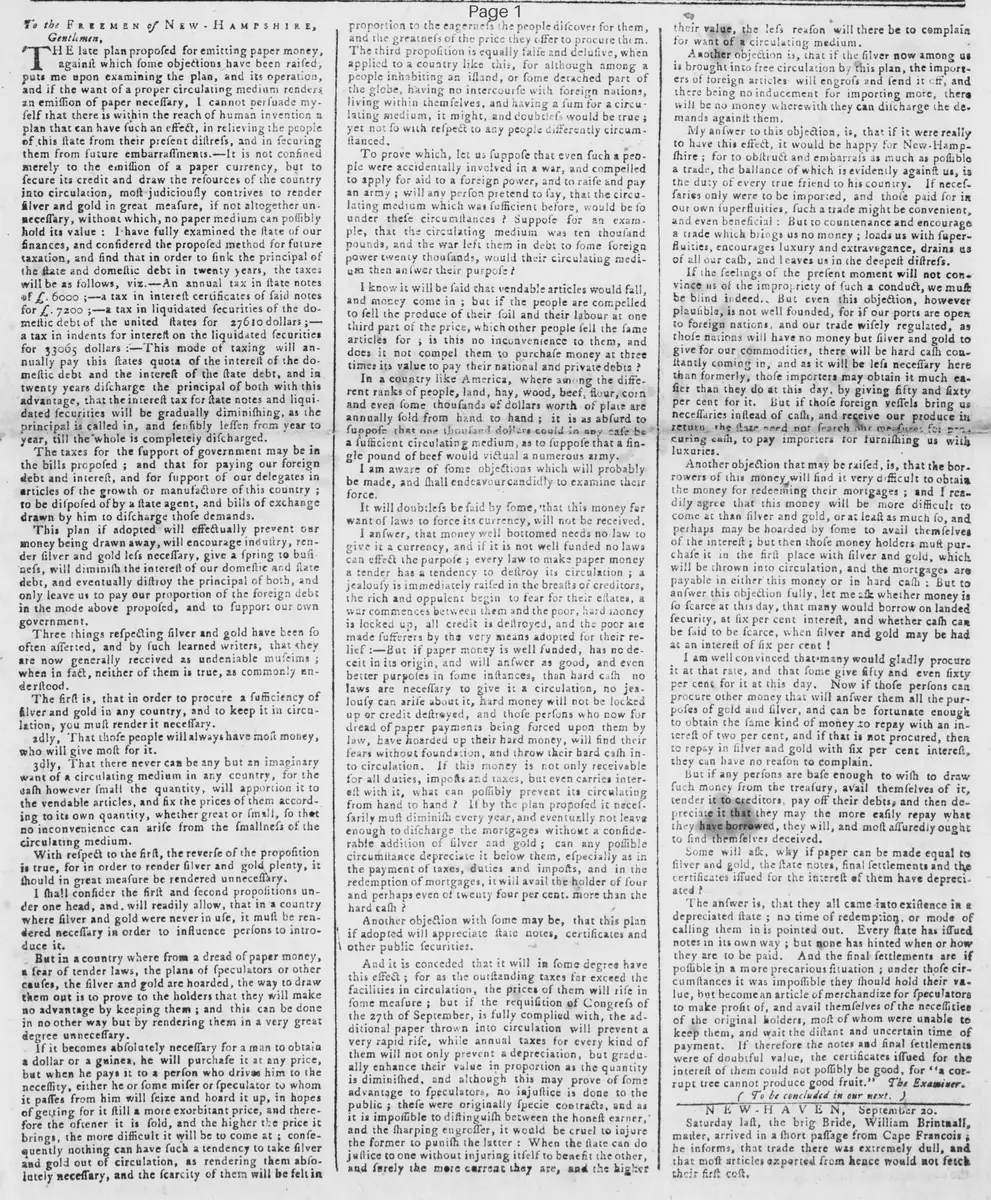
The late plan proposed for emitting paper money, against which some objections have been raised, puts me upon examining the plan, and its operation, and if the want of a proper circulating medium renders an emission of paper necessary, I cannot persuade myself that there is within the reach of human invention a plan that can have such an effect, in relieving the people of this state from their present distresses, and in securing them from future embarrassments. --It is not confined merely to the emission of a paper currency, but to secure its credit and draw the resources of the country into circulation, most judiciously contrives to render silver and gold in great measure, if not altogether unnecessary, without which, no paper medium can possibly hold its value: I have fully examined the state of our finances, and considered the proposed method for future taxation, and find that in order to sink the principal of the state and domestic debt in twenty years, the taxes will be as follows, viz. --An annual tax in state notes of £6000; --a tax in interest certificates of said notes for £7200; --a tax in liquidated securities of the domestic debt of the United States for $27600 dollars; -- a tax in indents for interest on the liquidated securities for $33005 dollars: --This mode of taxing will annually pay this state's quota of the interest of the domestic debt and the interest of the state debt, and in twenty years discharge the principal of both with this advantage, that the interest tax for state notes and liquidated securities will be gradually diminishing, as the principal is called in, and sensibly seen from year to year, till the whole is completely discharged.
The taxes for the support of government may be in the bills proposed; and that for paying our foreign debt and interest, and for support of our delegates in articles of the growth or manufacture of this country; to be disposed of by a state agent, and bills of exchange drawn by him to discharge those demands.
This plan if adopted will effectually prevent our money being drawn away, will encourage industry, render silver and gold less necessary, give a spring to business, will diminish the interest of our domestic and state debt, and eventually destroy the principal of both, and only leave us to pay our proportion of the foreign debt in the mode above proposed, and to support our own government.
Three things respecting silver and gold have been so often asserted, and by such learned writers, that they are now generally received as undeniable maxims; when in fact, neither of them is true, as commonly understood.
The first is, that in order to procure a sufficiency of silver and gold in any country, and to keep it in circulation, you must render it necessary.
2dly, That those people will always have most money, who will give most for it.
3dly, That there never can be any but an imaginary want of a circulating medium in any country, for the cash however small the quantity, will apportion it to the vendable articles, and fix the prices of them according to its own quantity, whether great or small, so that no inconvenience can arise from the smallness of the circulating medium.
With respect to the first, the reverse of the proposition is true, for in order to render silver and gold plenty, it should in great measure be rendered unnecessary.
I shall consider the first and second propositions under one head, and, will readily allow, that in a country where silver and gold were never in use, it must be rendered necessary in order to influence persons to introduce it.
But in a country where from a dread of paper money, a fear of tender laws, the plans of speculators or other causes, the silver and gold are hoarded, the way to draw them out is to prove to the holders that they will make no advantage by keeping them: and this can be done in no other way but by rendering them in a very great degree unnecessary.
If it becomes absolutely necessary for a man to obtain a dollar or a guinea, he will purchase it at any price, but when he pays it to a person who drives him into the necessity, either he or some miser or speculator to whom it passes from him will seize and hoard it up, in hopes of getting for it still a more exorbitant price, and therefore the oftener it is sold, and the higher the price it brings, the more difficult it will be to come at: consequently nothing can have such a tendency to take silver and gold out of circulation, as rendering them absolutely necessary, and the scarcity of them will be felt in proportion to the eagerness the people discover for them, and the greatness of the price they offer to procure them.
The third proposition is equally false and delusive, when applied to a country like this, for although among a people inhabiting an island, or some detached part of the globe, having no intercourse with foreign nations, living within themselves, and having a sum for a circulating medium, it might, and doubtless would be true; yet not so with respect to any people differently circumstanced.
To prove which, let us suppose that even such a people were accidentally involved in a war, and compelled to apply for aid to a foreign power, and to raise and pay an army; will any person pretend to say, that the circulating medium which was sufficient before, would be so under these circumstances? Suppose for an example, that the circulating medium was ten thousand pounds, and the war left them in debt to some foreign power twenty thousands, would their circulating medium then answer their purpose?
I know it will be said that vendable articles would fall, and money come in; but if the people are compelled to sell the produce of their soil and their labour at one third part of the price, which other people sell the same articles for; is this no inconvenience to them, and does it not compel them to purchase money at three times its value to pay their national and private debts?
In a country like America, where among the different ranks of people, land, hay, wood, beef, flour, corn and even some thousands of dollars worth of plate are annually sold from hand to hand; it is as absurd to suppose that one thousand dollars could in any case be a sufficient circulating medium, as to suppose that a single pound of beef would victual a numerous army.
I am aware of some objections which will probably be made, and shall endeavour candidly to examine their force.
It will doubtless be said by some, 'that this money for want of laws to force its currency, will not be received.' I answer, that money well bottomed needs no law to give it a currency, and if it is not well funded no laws can effect the purpose; every law to make paper money a tender has a tendency to destroy its circulation; a jealousy is immediately raised in the breasts of creditors, the rich and opulent begin to fear for their estates, a war commences between them and the poor, hard money is locked up, all credit is destroyed, and the poor are made sufferers by this very means adopted for their relief: --But if paper money is well funded, has no deceit in its origin, and will answer as good, and even better purposes in some instances, than hard cash no laws are necessary to give it a circulation, no jealousy can arise about it, hard money will not be locked up or credit destroyed, and those persons who now for dread of paper payments being forced upon them by law, have hoarded up their hard money, will find their fears without foundation, and throw their hard cash into circulation. If this money is not only receivable for all duties, imposts and taxes, but even carries interest with it, what can possibly prevent its circulating from hand to hand? If by the plan proposed it necessarily must diminish every year, and eventually not leave enough to discharge the mortgages without a considerable addition of silver and gold; can any possible circumstance depreciate it below them, especially as in the payment of taxes, duties and imposts, and in the redemption of mortgages, it will avail the holder of four and perhaps even of twenty four per cent. more than the hard cash?
Another objection with some may be, that this plan if adopted will appreciate state notes, certificates and other public securities.
And it is conceded that it will in some degree have this effect; for as the outstanding taxes far exceed the facilities in circulation, the prices of them will rise in some measure; but if the requisition of Congress of the 27th of September, is fully complied with, the additional paper thrown into circulation will prevent a very rapid rise, while annual taxes for every kind of them will not only prevent a depreciation, but gradually enhance their value in proportion as the quantity is diminished, and although this may prove of some advantage to speculators, no injustice is done to the public; these were originally specie contracts, and as it is impossible to distinguish between the honest earner, and the sharping engrosser, it would be cruel to injure the former to punish the latter: When the state can do justice to one without injuring itself to benefit the other, and surely the more current they are, and the higher their value, the less reason will there be to complain for want of a circulating medium.
Another objection is, that if the silver now among us is brought into free circulation by this plan, the importers of foreign articles will engross and send it off, and there being no inducement for importing more, there will be no money wherewith they can discharge the demands against them.
My answer to this objection, is, that if it were really to have this effect, it would be happy for New-Hampshire; for to obstruct and embarrass as much as possible a trade, the balance of which is evidently against us, is the duty of every true friend to his country. If necessaries only were to be imported, and those paid for in our own superfluities, such a trade might be convenient, and even beneficial: But to countenance and encourage a trade which brings us no money; loads us with superfluities, encourages luxury and extravagance, drains us of all our cash, and leaves us in the deepest distress.
If the feelings of the present moment will not convince us of the impropriety of such a conduct, we must be blind indeed. But even this objection, however plausible, is not well founded, for if our ports are open to foreign nations, and our trade wisely regulated, as those nations will have no money but silver and gold to give for our commodities, there will be hard cash constantly coming in, and as it will be less necessary here than formerly, those importers may obtain it much easier than they do at this day, by giving fifty and sixty per cent for it. But if those foreign vessels bring us necessaries instead of cash, and receive our produce in return, the state need not search out means for procuring cash, to pay importers for furnishing us with luxuries.
Another objection that may be raised, is, that the borrowers of this money will find it very difficult to obtain the money for redeeming their mortgages; and I readily agree that this money will be more difficult to come at than silver and gold, or at least as much so, and perhaps may be hoarded by some to avail themselves of the interest; but then those money holders must purchase it in the first place with silver and gold, which will be thrown into circulation, and the mortgages are payable in either this money or in hard cash: But to answer this objection fully, let me ask whether money is so scarce at this day, that many would borrow on landed security, at six per cent interest, and whether cash can be said to be scarce, when silver and gold may be had at an interest of six per cent!
I am well convinced that many would gladly procure it at that rate, and that some give fifty and even sixty per cent for it at this day. Now if those persons can procure other money that will answer them all the purposes of gold and silver, and can be fortunate enough to obtain the same kind of money to repay with an interest of two per cent, and if that is not procured, then to repay in silver and gold with six per cent interest, they can have no reason to complain.
But if any persons are base enough to wish to draw such money from the treasury, avail themselves of it, tender it to creditors, pay off their debts, and then depreciate it that they may the more easily repay what they have borrowed, they will, and most assuredly ought to find themselves deceived.
Some will ask, why if paper can be made equal to silver and gold, the state notes, final settlements and the certificates issued for the interest of them have depreciated?
The answer is, that they all came into existence in a depreciated state; no time of redemption, or mode of calling them in is pointed out. Every state has issued notes in its own way; but none has hinted when or how they are to be paid. And the final settlements are if possible in a more precarious situation; under those circumstances it was impossible they should hold their value, but become an article of merchandise for speculators to make profit of, and avail themselves of the necessities of the original holders, most of whom were unable to keep them, and wait the distant and uncertain time of payment. If therefore the notes and final settlements were of doubtful value, the certificates issued for the interest of them could not possibly be good, for "a corrupt tree cannot produce good fruit." The Examiner.
(To be concluded in our next.)
Gentlemen,
The late plan proposed for emitting paper money, against which some objections have been raised, puts me upon examining the plan, and its operation, and if the want of a proper circulating medium renders an emission of paper necessary, I cannot persuade myself that there is within the reach of human invention a plan that can have such an effect, in relieving the people of this state from their present distresses, and in securing them from future embarrassments. --It is not confined merely to the emission of a paper currency, but to secure its credit and draw the resources of the country into circulation, most judiciously contrives to render silver and gold in great measure, if not altogether unnecessary, without which, no paper medium can possibly hold its value: I have fully examined the state of our finances, and considered the proposed method for future taxation, and find that in order to sink the principal of the state and domestic debt in twenty years, the taxes will be as follows, viz. --An annual tax in state notes of £6000; --a tax in interest certificates of said notes for £7200; --a tax in liquidated securities of the domestic debt of the United States for $27600 dollars; -- a tax in indents for interest on the liquidated securities for $33005 dollars: --This mode of taxing will annually pay this state's quota of the interest of the domestic debt and the interest of the state debt, and in twenty years discharge the principal of both with this advantage, that the interest tax for state notes and liquidated securities will be gradually diminishing, as the principal is called in, and sensibly seen from year to year, till the whole is completely discharged.
The taxes for the support of government may be in the bills proposed; and that for paying our foreign debt and interest, and for support of our delegates in articles of the growth or manufacture of this country; to be disposed of by a state agent, and bills of exchange drawn by him to discharge those demands.
This plan if adopted will effectually prevent our money being drawn away, will encourage industry, render silver and gold less necessary, give a spring to business, will diminish the interest of our domestic and state debt, and eventually destroy the principal of both, and only leave us to pay our proportion of the foreign debt in the mode above proposed, and to support our own government.
Three things respecting silver and gold have been so often asserted, and by such learned writers, that they are now generally received as undeniable maxims; when in fact, neither of them is true, as commonly understood.
The first is, that in order to procure a sufficiency of silver and gold in any country, and to keep it in circulation, you must render it necessary.
2dly, That those people will always have most money, who will give most for it.
3dly, That there never can be any but an imaginary want of a circulating medium in any country, for the cash however small the quantity, will apportion it to the vendable articles, and fix the prices of them according to its own quantity, whether great or small, so that no inconvenience can arise from the smallness of the circulating medium.
With respect to the first, the reverse of the proposition is true, for in order to render silver and gold plenty, it should in great measure be rendered unnecessary.
I shall consider the first and second propositions under one head, and, will readily allow, that in a country where silver and gold were never in use, it must be rendered necessary in order to influence persons to introduce it.
But in a country where from a dread of paper money, a fear of tender laws, the plans of speculators or other causes, the silver and gold are hoarded, the way to draw them out is to prove to the holders that they will make no advantage by keeping them: and this can be done in no other way but by rendering them in a very great degree unnecessary.
If it becomes absolutely necessary for a man to obtain a dollar or a guinea, he will purchase it at any price, but when he pays it to a person who drives him into the necessity, either he or some miser or speculator to whom it passes from him will seize and hoard it up, in hopes of getting for it still a more exorbitant price, and therefore the oftener it is sold, and the higher the price it brings, the more difficult it will be to come at: consequently nothing can have such a tendency to take silver and gold out of circulation, as rendering them absolutely necessary, and the scarcity of them will be felt in proportion to the eagerness the people discover for them, and the greatness of the price they offer to procure them.
The third proposition is equally false and delusive, when applied to a country like this, for although among a people inhabiting an island, or some detached part of the globe, having no intercourse with foreign nations, living within themselves, and having a sum for a circulating medium, it might, and doubtless would be true; yet not so with respect to any people differently circumstanced.
To prove which, let us suppose that even such a people were accidentally involved in a war, and compelled to apply for aid to a foreign power, and to raise and pay an army; will any person pretend to say, that the circulating medium which was sufficient before, would be so under these circumstances? Suppose for an example, that the circulating medium was ten thousand pounds, and the war left them in debt to some foreign power twenty thousands, would their circulating medium then answer their purpose?
I know it will be said that vendable articles would fall, and money come in; but if the people are compelled to sell the produce of their soil and their labour at one third part of the price, which other people sell the same articles for; is this no inconvenience to them, and does it not compel them to purchase money at three times its value to pay their national and private debts?
In a country like America, where among the different ranks of people, land, hay, wood, beef, flour, corn and even some thousands of dollars worth of plate are annually sold from hand to hand; it is as absurd to suppose that one thousand dollars could in any case be a sufficient circulating medium, as to suppose that a single pound of beef would victual a numerous army.
I am aware of some objections which will probably be made, and shall endeavour candidly to examine their force.
It will doubtless be said by some, 'that this money for want of laws to force its currency, will not be received.' I answer, that money well bottomed needs no law to give it a currency, and if it is not well funded no laws can effect the purpose; every law to make paper money a tender has a tendency to destroy its circulation; a jealousy is immediately raised in the breasts of creditors, the rich and opulent begin to fear for their estates, a war commences between them and the poor, hard money is locked up, all credit is destroyed, and the poor are made sufferers by this very means adopted for their relief: --But if paper money is well funded, has no deceit in its origin, and will answer as good, and even better purposes in some instances, than hard cash no laws are necessary to give it a circulation, no jealousy can arise about it, hard money will not be locked up or credit destroyed, and those persons who now for dread of paper payments being forced upon them by law, have hoarded up their hard money, will find their fears without foundation, and throw their hard cash into circulation. If this money is not only receivable for all duties, imposts and taxes, but even carries interest with it, what can possibly prevent its circulating from hand to hand? If by the plan proposed it necessarily must diminish every year, and eventually not leave enough to discharge the mortgages without a considerable addition of silver and gold; can any possible circumstance depreciate it below them, especially as in the payment of taxes, duties and imposts, and in the redemption of mortgages, it will avail the holder of four and perhaps even of twenty four per cent. more than the hard cash?
Another objection with some may be, that this plan if adopted will appreciate state notes, certificates and other public securities.
And it is conceded that it will in some degree have this effect; for as the outstanding taxes far exceed the facilities in circulation, the prices of them will rise in some measure; but if the requisition of Congress of the 27th of September, is fully complied with, the additional paper thrown into circulation will prevent a very rapid rise, while annual taxes for every kind of them will not only prevent a depreciation, but gradually enhance their value in proportion as the quantity is diminished, and although this may prove of some advantage to speculators, no injustice is done to the public; these were originally specie contracts, and as it is impossible to distinguish between the honest earner, and the sharping engrosser, it would be cruel to injure the former to punish the latter: When the state can do justice to one without injuring itself to benefit the other, and surely the more current they are, and the higher their value, the less reason will there be to complain for want of a circulating medium.
Another objection is, that if the silver now among us is brought into free circulation by this plan, the importers of foreign articles will engross and send it off, and there being no inducement for importing more, there will be no money wherewith they can discharge the demands against them.
My answer to this objection, is, that if it were really to have this effect, it would be happy for New-Hampshire; for to obstruct and embarrass as much as possible a trade, the balance of which is evidently against us, is the duty of every true friend to his country. If necessaries only were to be imported, and those paid for in our own superfluities, such a trade might be convenient, and even beneficial: But to countenance and encourage a trade which brings us no money; loads us with superfluities, encourages luxury and extravagance, drains us of all our cash, and leaves us in the deepest distress.
If the feelings of the present moment will not convince us of the impropriety of such a conduct, we must be blind indeed. But even this objection, however plausible, is not well founded, for if our ports are open to foreign nations, and our trade wisely regulated, as those nations will have no money but silver and gold to give for our commodities, there will be hard cash constantly coming in, and as it will be less necessary here than formerly, those importers may obtain it much easier than they do at this day, by giving fifty and sixty per cent for it. But if those foreign vessels bring us necessaries instead of cash, and receive our produce in return, the state need not search out means for procuring cash, to pay importers for furnishing us with luxuries.
Another objection that may be raised, is, that the borrowers of this money will find it very difficult to obtain the money for redeeming their mortgages; and I readily agree that this money will be more difficult to come at than silver and gold, or at least as much so, and perhaps may be hoarded by some to avail themselves of the interest; but then those money holders must purchase it in the first place with silver and gold, which will be thrown into circulation, and the mortgages are payable in either this money or in hard cash: But to answer this objection fully, let me ask whether money is so scarce at this day, that many would borrow on landed security, at six per cent interest, and whether cash can be said to be scarce, when silver and gold may be had at an interest of six per cent!
I am well convinced that many would gladly procure it at that rate, and that some give fifty and even sixty per cent for it at this day. Now if those persons can procure other money that will answer them all the purposes of gold and silver, and can be fortunate enough to obtain the same kind of money to repay with an interest of two per cent, and if that is not procured, then to repay in silver and gold with six per cent interest, they can have no reason to complain.
But if any persons are base enough to wish to draw such money from the treasury, avail themselves of it, tender it to creditors, pay off their debts, and then depreciate it that they may the more easily repay what they have borrowed, they will, and most assuredly ought to find themselves deceived.
Some will ask, why if paper can be made equal to silver and gold, the state notes, final settlements and the certificates issued for the interest of them have depreciated?
The answer is, that they all came into existence in a depreciated state; no time of redemption, or mode of calling them in is pointed out. Every state has issued notes in its own way; but none has hinted when or how they are to be paid. And the final settlements are if possible in a more precarious situation; under those circumstances it was impossible they should hold their value, but become an article of merchandise for speculators to make profit of, and avail themselves of the necessities of the original holders, most of whom were unable to keep them, and wait the distant and uncertain time of payment. If therefore the notes and final settlements were of doubtful value, the certificates issued for the interest of them could not possibly be good, for "a corrupt tree cannot produce good fruit." The Examiner.
(To be concluded in our next.)
What sub-type of article is it?
Economic Policy
Taxation
Trade Or Commerce
What keywords are associated?
Paper Money
Circulating Medium
State Debt
Taxation Plan
Hard Currency
Trade Balance
Public Securities
Economic Relief
What entities or persons were involved?
New Hampshire
Congress
The Examiner
Editorial Details
Primary Topic
Defense Of Paper Money Emission Plan For New Hampshire
Stance / Tone
Strongly Supportive Of The Plan, Refuting Objections
Key Figures
New Hampshire
Congress
The Examiner
Key Arguments
Plan Relieves Distress By Issuing Well Funded Paper Money Backed By Taxation To Sink Debts In 20 Years.
Reduces Need For Silver And Gold, Drawing Them Into Circulation By Making Them Less Necessary.
Refutes Maxims On Hard Currency Necessity And Sufficiency Of Small Circulating Medium In Open Economies.
Well Funded Paper Needs No Tender Laws; Interest Bearing And Tax Receivable Ensures Circulation.
Appreciation Of Securities Benefits Honest Holders Without Injustice.
Limits Harmful Imports, Promotes Beneficial Trade, Eases Hard Money Acquisition.
Borrowers Benefit From Low Interest Paper; Historical Depreciations Due To Poor Funding, Not Inherent Flaws.