Thank you for visiting SNEWPapers!
Sign up free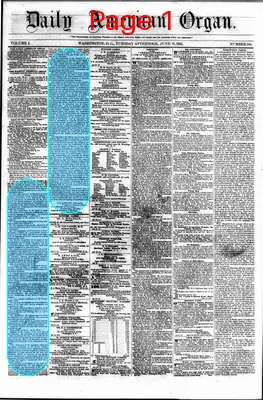
Editorial
June 19, 1855
Daily American Organ
Washington, District Of Columbia
What is this article about?
The platform of the American Party, adopted by its National Council, outlines 14 principles emphasizing acknowledgment of divine providence, American nationalism, union preservation, constitutional obedience, immigration and naturalization reforms, anti-party corruption, resistance to Catholic influence, legislative reform, executive restraint, non-denominational public education with Bible inclusion, non-interference in slavery, just foreign policy, and open avowal of the Order's principles. Signed by council officers.
Clipping
OCR Quality
95%
Excellent
Full Text
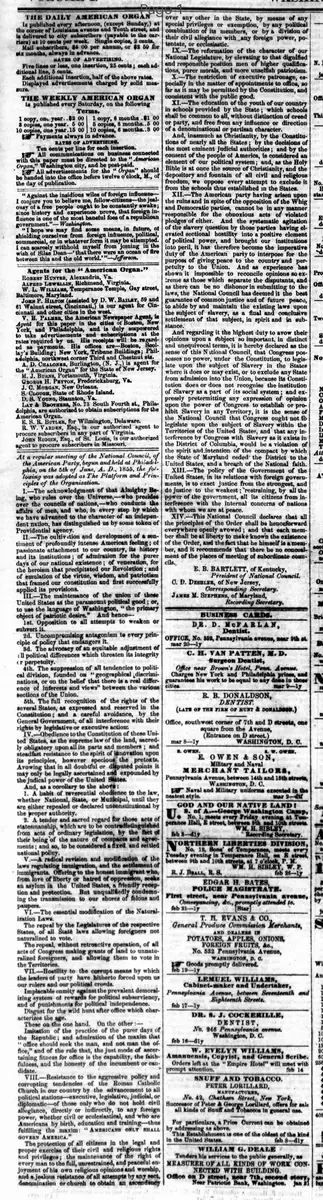
I. -The acknowledgment of that Almighty Being, who rules over the Universe,--who presides over the councils of nations,—who conducts the affairs of men, and who, in every step by which we have advanced to the character of an independent nation, has distinguished us by some token of Providential agency.
II.-The cultivation and development of a sentiment of profoundly intense American feeling; of passionate attachment to our country, its history and its institutions; of admiration for the purer days of our national existence; of veneration, for the heroism that precipitated our Revolution; and of emulation of the virtue, wisdom, and patriotism that framed our constitution and first successfully applied its provisions.
III. The maintenance of the union of these United States as the paramount political good; or, to use the language of Washington, "the primary object of patriotic desire." And hence
1st. Opposition to all attempts to weaken or subvert it.
2d. Uncompromising antagonism to every principle of policy that endangers it.
3d. The advocacy of an equitable adjustment of all political differences which threaten its integrity or perpetuity.
4th. The suppression of all tendencies to political division, founded on "geographical discriminations, or on the belief that there is a real difference of interests and views" between the various sections of the Union.
5th. The full recognition of the rights of the several States, as expressed and reserved in the Constitution; and a careful avoidance, by the General Government, of all interference with their rights by legislative or executive action:
IV.--Obedience to the Constitution of these United States, as the supreme law of the land, sacredly obligatory upon all its parts and members; and steadfast resistance to the spirit of innovation upon its principles, however specious the pretexts,
Avowing that in all doubtful or disputed points it may only be legally ascertained and expounded by the judicial power of the United States.
And, as a corollary to the above:
1. A habit of reverential obedience to the law, whether National, State, or Municipal, until they are either repealed or declared unconstitutional by the proper authority.
2. A tender and sacred regard for those acts of statesmanship. which are to be contradistinguished from acts of ordinary legislation, by the fact of their being of the nature of compacts and agreements; and so, to be considered a fixed and settled national policy.
V.-A radical revision and modification of the laws regulating immigration, and the settlement of immigrants. Offering to the honest immigrant who, from love of liberty or hatred of oppression, seeks an asylum in the United States, a friendly reception and protection. But unqualifiedly condemning the transmission to our shores of felons and paupers.
VI.-The essential modification of the Naturalization Laws. The repeal by the Legislatures of the respective States. of all State laws allowing foreigners not naturalized to vote. The repeal, without retroactive operation, of all acts of Congress making grants of land to unnaturalized foreigners, and allowing them to vote in the Territories.
VII.-Hostility to the corrupt means by which the leaders of party have hitherto forced upon us our rulers and our political creeds. Implacable enmity against the prevalent demoralizing system of rewards for political subserviency, and of punishments for political independence. Disgust for the wild hunt after office which characterizes the age.
These on the one hand. On the other:—
Imitation of the practice of the purer days of the Republic; and admiration of the maxim that "office should seek the man, and not man the office." and of the rule that, the just mode of ascertaining fitness for office is the capability, the faithfulness, and the honesty of the incumbent or candidate.
VIII.-Resistance to the aggressive policy and corrupting tendencies of the Roman Catholic Church in our country by the advancement to all political stations—executive, legislative, judicial, or diplomatic—of those only who do not hold civil allegiance, directly or indirectly, to any foreign power, whether civil or ecclesiastical, and who are Americans by birth, education and training—thus fulfilling the maxim: "AMERICANS ONLY SHALL Govern America."
The protection of all citizens in the legal and proper exercise of their civil and religious rights and privileges; the maintenance of the right of every man to the full, unrestrained, and peaceful enjoyment of his own religious opinions and worship, and a jealous resistance of all attempts by any sect, denomination or church to obtain an ascendency over any other in the State, by means of any special privileges or exemption, by any political combination of its members, or by a division of their civil allegiance with any foreign power, potentate, or ecclesiastic.
IX.-The reformation of the character of our National Legislature, by elevating to that dignified and responsible position men of higher qualifications, purer morals, and more unselfish patriotism.
X.-The restriction of executive patronage, especially in the matter of appointments to office, so far as it may be permitted by the Constitution, and consistent with the public good.
XI.-The education of the youth of our country in schools provided by the State; which schools shall be common to all, without distinction of creed or party, and free from any influence or direction of a denominational or partisan character.
And, inasmuch as Christianity, by the Constitutions of nearly all the States; by the decisions of the most eminent judicial authorities; and by the consent of the people of America, is considered an element of our political system; and, as the Holy Bible is at once the source of Christianity, and the depository and fountain of all civil and religious freedom, we oppose every attempt to exclude it from the schools thus established in the States.
XII.-The American party having arisen upon the ruins and in spite of the opposition of the Whig and Democratic parties, cannot be in any manner responsible for the obnoxious acts of violated pledges of either. And the systematic agitation of the slavery question by those parties having elevated sectional hostility into a positive element of political power, and brought our institutions into peril, it has therefore become the imperative duty of the American party to interpose for the purpose of giving peace to the country and perpetuity to the Union. And as experience has shown it impossible to reconcile opinions so extreme as those which separate the disputants, and as there can be no dishonor in submitting to the laws, the National Council has deemed it the best guarantee of common justice and of future peace, to abide by and maintain the existing laws upon the subject of slavery, as a final and conclusive settlement of that subject, in spirit and in substance.
And regarding it the highest duty to avow their opinions upon a subject so important, in distinct and unequivocal terms, it is hereby declared as the sense of this National Council, that Congress possesses no power, under the Constitution, to legislate upon the subject of Slavery in the States where it does or may exist, or to exclude any State from admission into the Union, because its Constitution does or does not recognise the institution of Slavery as a part of its social system; and expressly pretermitting any expression of opinion upon the power of Congress to establish or prohibit Slavery in any Territory, it is the sense of the National Council that Congress ought not to legislate upon the subject of Slavery within the Territories of the United States, and that any interference by Congress with Slavery as it exists in the District of Columbia, would be a violation of the spirit and intention of the compact by which the State of Maryland ceded the District to the United States, and a breach of the National faith.
XIII.-The policy of the Government of the United States, in its relations with foreign governments, is to exact justice from the strongest, and do justice to the weakest; restraining, by all the power of the government, all its citizens from interference with the internal concerns of nations with whom we are at peace.
XIV.-This National Council declares that all the principles of the Order shall be henceforward everywhere openly avowed; and that each member shall be at liberty to make known the existence of the Order, and the fact that he himself is a member, and it recommends that there be no concealment of the places of meeting of subordinate councils.
E. B. BARTLETT, of Kentucky.
President of National Council.
C. D. DESHLER, of New Jersey,
Corresponding Secretary.
JAMES M. STEPHENS, of Maryland,
Recording Secretary.
II.-The cultivation and development of a sentiment of profoundly intense American feeling; of passionate attachment to our country, its history and its institutions; of admiration for the purer days of our national existence; of veneration, for the heroism that precipitated our Revolution; and of emulation of the virtue, wisdom, and patriotism that framed our constitution and first successfully applied its provisions.
III. The maintenance of the union of these United States as the paramount political good; or, to use the language of Washington, "the primary object of patriotic desire." And hence
1st. Opposition to all attempts to weaken or subvert it.
2d. Uncompromising antagonism to every principle of policy that endangers it.
3d. The advocacy of an equitable adjustment of all political differences which threaten its integrity or perpetuity.
4th. The suppression of all tendencies to political division, founded on "geographical discriminations, or on the belief that there is a real difference of interests and views" between the various sections of the Union.
5th. The full recognition of the rights of the several States, as expressed and reserved in the Constitution; and a careful avoidance, by the General Government, of all interference with their rights by legislative or executive action:
IV.--Obedience to the Constitution of these United States, as the supreme law of the land, sacredly obligatory upon all its parts and members; and steadfast resistance to the spirit of innovation upon its principles, however specious the pretexts,
Avowing that in all doubtful or disputed points it may only be legally ascertained and expounded by the judicial power of the United States.
And, as a corollary to the above:
1. A habit of reverential obedience to the law, whether National, State, or Municipal, until they are either repealed or declared unconstitutional by the proper authority.
2. A tender and sacred regard for those acts of statesmanship. which are to be contradistinguished from acts of ordinary legislation, by the fact of their being of the nature of compacts and agreements; and so, to be considered a fixed and settled national policy.
V.-A radical revision and modification of the laws regulating immigration, and the settlement of immigrants. Offering to the honest immigrant who, from love of liberty or hatred of oppression, seeks an asylum in the United States, a friendly reception and protection. But unqualifiedly condemning the transmission to our shores of felons and paupers.
VI.-The essential modification of the Naturalization Laws. The repeal by the Legislatures of the respective States. of all State laws allowing foreigners not naturalized to vote. The repeal, without retroactive operation, of all acts of Congress making grants of land to unnaturalized foreigners, and allowing them to vote in the Territories.
VII.-Hostility to the corrupt means by which the leaders of party have hitherto forced upon us our rulers and our political creeds. Implacable enmity against the prevalent demoralizing system of rewards for political subserviency, and of punishments for political independence. Disgust for the wild hunt after office which characterizes the age.
These on the one hand. On the other:—
Imitation of the practice of the purer days of the Republic; and admiration of the maxim that "office should seek the man, and not man the office." and of the rule that, the just mode of ascertaining fitness for office is the capability, the faithfulness, and the honesty of the incumbent or candidate.
VIII.-Resistance to the aggressive policy and corrupting tendencies of the Roman Catholic Church in our country by the advancement to all political stations—executive, legislative, judicial, or diplomatic—of those only who do not hold civil allegiance, directly or indirectly, to any foreign power, whether civil or ecclesiastical, and who are Americans by birth, education and training—thus fulfilling the maxim: "AMERICANS ONLY SHALL Govern America."
The protection of all citizens in the legal and proper exercise of their civil and religious rights and privileges; the maintenance of the right of every man to the full, unrestrained, and peaceful enjoyment of his own religious opinions and worship, and a jealous resistance of all attempts by any sect, denomination or church to obtain an ascendency over any other in the State, by means of any special privileges or exemption, by any political combination of its members, or by a division of their civil allegiance with any foreign power, potentate, or ecclesiastic.
IX.-The reformation of the character of our National Legislature, by elevating to that dignified and responsible position men of higher qualifications, purer morals, and more unselfish patriotism.
X.-The restriction of executive patronage, especially in the matter of appointments to office, so far as it may be permitted by the Constitution, and consistent with the public good.
XI.-The education of the youth of our country in schools provided by the State; which schools shall be common to all, without distinction of creed or party, and free from any influence or direction of a denominational or partisan character.
And, inasmuch as Christianity, by the Constitutions of nearly all the States; by the decisions of the most eminent judicial authorities; and by the consent of the people of America, is considered an element of our political system; and, as the Holy Bible is at once the source of Christianity, and the depository and fountain of all civil and religious freedom, we oppose every attempt to exclude it from the schools thus established in the States.
XII.-The American party having arisen upon the ruins and in spite of the opposition of the Whig and Democratic parties, cannot be in any manner responsible for the obnoxious acts of violated pledges of either. And the systematic agitation of the slavery question by those parties having elevated sectional hostility into a positive element of political power, and brought our institutions into peril, it has therefore become the imperative duty of the American party to interpose for the purpose of giving peace to the country and perpetuity to the Union. And as experience has shown it impossible to reconcile opinions so extreme as those which separate the disputants, and as there can be no dishonor in submitting to the laws, the National Council has deemed it the best guarantee of common justice and of future peace, to abide by and maintain the existing laws upon the subject of slavery, as a final and conclusive settlement of that subject, in spirit and in substance.
And regarding it the highest duty to avow their opinions upon a subject so important, in distinct and unequivocal terms, it is hereby declared as the sense of this National Council, that Congress possesses no power, under the Constitution, to legislate upon the subject of Slavery in the States where it does or may exist, or to exclude any State from admission into the Union, because its Constitution does or does not recognise the institution of Slavery as a part of its social system; and expressly pretermitting any expression of opinion upon the power of Congress to establish or prohibit Slavery in any Territory, it is the sense of the National Council that Congress ought not to legislate upon the subject of Slavery within the Territories of the United States, and that any interference by Congress with Slavery as it exists in the District of Columbia, would be a violation of the spirit and intention of the compact by which the State of Maryland ceded the District to the United States, and a breach of the National faith.
XIII.-The policy of the Government of the United States, in its relations with foreign governments, is to exact justice from the strongest, and do justice to the weakest; restraining, by all the power of the government, all its citizens from interference with the internal concerns of nations with whom we are at peace.
XIV.-This National Council declares that all the principles of the Order shall be henceforward everywhere openly avowed; and that each member shall be at liberty to make known the existence of the Order, and the fact that he himself is a member, and it recommends that there be no concealment of the places of meeting of subordinate councils.
E. B. BARTLETT, of Kentucky.
President of National Council.
C. D. DESHLER, of New Jersey,
Corresponding Secretary.
JAMES M. STEPHENS, of Maryland,
Recording Secretary.
What sub-type of article is it?
Immigration
Partisan Politics
Moral Or Religious
What keywords are associated?
American Party
Nativism
Immigration Reform
Anti Catholic
Union Preservation
Slavery Compromise
Constitutional Obedience
Public Education
What entities or persons were involved?
American Party
National Council
Washington
Roman Catholic Church
Whig Party
Democratic Party
Editorial Details
Primary Topic
American Party Platform Principles
Stance / Tone
Nativist And Unionist Advocacy
Key Figures
American Party
National Council
Washington
Roman Catholic Church
Whig Party
Democratic Party
Key Arguments
Acknowledge Divine Providence In National History
Cultivate Intense American Nationalism And Veneration For Revolution And Constitution
Maintain Union As Paramount Good, Oppose Divisions
Obey Constitution And Resist Innovations
Revise Immigration Laws To Exclude Felons And Paupers
Modify Naturalization Laws And Restrict Foreign Voting
Oppose Party Corruption And Office Seeking
Resist Catholic Influence, Promote Native Born Americans In Government
Reform Legislature With Higher Qualifications
Restrict Executive Patronage
Support State Provided Non Denominational Education Including Bible
Maintain Existing Slavery Laws Without Congressional Interference
Pursue Just Foreign Policy Without Interference
Openly Avow Order's Principles