Thank you for visiting SNEWPapers!
Sign up free
Editorial
November 12, 1791
Gazette Of The United States
New York, New York County, New York
What is this article about?
Editorial argues for using newspapers and the Post-Office to inform citizens about government actions, emphasizing education on rights, self-governance over force, and the dangers of withholding information from the public.
Clipping
OCR Quality
97%
Excellent
Full Text
COMMUNICATIONS.
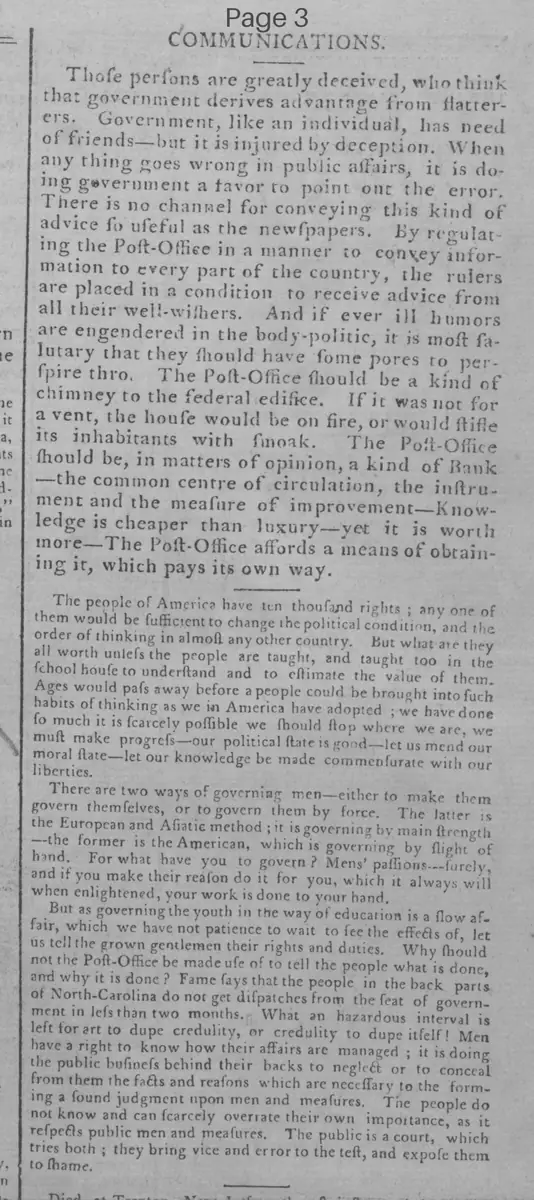
Those persons are greatly deceived, who think that government derives advantage from flatterers. Government, like an individual, has need of friends—but it is injured by deception. When any thing goes wrong in public affairs, it is doing government a favor to point out the error. There is no channel for conveying this kind of advice so useful as the newspapers. By regulating the Post-Office in a manner to convey information to every part of the country, the rulers are placed in a condition to receive advice from all their well-wishers. And if ever ill humors are engendered in the body-politic, it is most salutary that they should have some pores to perspire thro'. The Post-Office should be a kind of chimney to the federal edifice. If it was not for a vent, the house would be on fire, or would stifle its inhabitants with smoke. The Post-Office should be, in matters of opinion, a kind of Bank—the common centre of circulation, the instrument and the measure of improvement—Knowledge is cheaper than luxury—yet it is worth more—The Post-Office affords a means of obtaining it, which pays its own way.
The people of America have ten thousand rights; any one of them would be sufficient to change the political condition, and the order of thinking in almost any other country. But what are they all worth unless the people are taught, and taught too in the school house to understand and to estimate the value of them. Ages would pass away before a people could be brought into such habits of thinking as we in America have adopted; we have done so much it is scarcely possible we should stop where we are, we must make progress—our political state is good—let us mend our moral state—let our knowledge be made commensurate with our liberties.
There are two ways of governing men—either to make them govern themselves, or to govern them by force. The latter is the European and Asiatic method; it is governing by main strength—the former is the American, which is governing by sleight of hand. For what have you to govern? Mens' passions—and if you make their reason do it for you, which it always will when enlightened, your work is done to your hand.
But as governing the youth in the way of education is a slow affair, which we have not patience to wait to see the effects of, let us tell the grown gentlemen their rights and duties. Why should not the Post-Office be made use of to tell the people what is done, and why it is done? Fame says that the people in the back parts of North-Carolina do not get dispatches from the seat of government in less than two months. What an hazardous interval is left for art to dupe credulity, or credulity to dupe itself! Men have a right to know how their affairs are managed; it is doing the public business behind their backs to neglect or to conceal from them the facts and reasons which are necessary to the forming a sound judgment upon men and measures. The people do not know and can scarcely overrate their own importance, as it respects public men and measures. The public is a court, which tries both; they bring vice and error to the test, and expose them to shame.
Those persons are greatly deceived, who think that government derives advantage from flatterers. Government, like an individual, has need of friends—but it is injured by deception. When any thing goes wrong in public affairs, it is doing government a favor to point out the error. There is no channel for conveying this kind of advice so useful as the newspapers. By regulating the Post-Office in a manner to convey information to every part of the country, the rulers are placed in a condition to receive advice from all their well-wishers. And if ever ill humors are engendered in the body-politic, it is most salutary that they should have some pores to perspire thro'. The Post-Office should be a kind of chimney to the federal edifice. If it was not for a vent, the house would be on fire, or would stifle its inhabitants with smoke. The Post-Office should be, in matters of opinion, a kind of Bank—the common centre of circulation, the instrument and the measure of improvement—Knowledge is cheaper than luxury—yet it is worth more—The Post-Office affords a means of obtaining it, which pays its own way.
The people of America have ten thousand rights; any one of them would be sufficient to change the political condition, and the order of thinking in almost any other country. But what are they all worth unless the people are taught, and taught too in the school house to understand and to estimate the value of them. Ages would pass away before a people could be brought into such habits of thinking as we in America have adopted; we have done so much it is scarcely possible we should stop where we are, we must make progress—our political state is good—let us mend our moral state—let our knowledge be made commensurate with our liberties.
There are two ways of governing men—either to make them govern themselves, or to govern them by force. The latter is the European and Asiatic method; it is governing by main strength—the former is the American, which is governing by sleight of hand. For what have you to govern? Mens' passions—and if you make their reason do it for you, which it always will when enlightened, your work is done to your hand.
But as governing the youth in the way of education is a slow affair, which we have not patience to wait to see the effects of, let us tell the grown gentlemen their rights and duties. Why should not the Post-Office be made use of to tell the people what is done, and why it is done? Fame says that the people in the back parts of North-Carolina do not get dispatches from the seat of government in less than two months. What an hazardous interval is left for art to dupe credulity, or credulity to dupe itself! Men have a right to know how their affairs are managed; it is doing the public business behind their backs to neglect or to conceal from them the facts and reasons which are necessary to the forming a sound judgment upon men and measures. The people do not know and can scarcely overrate their own importance, as it respects public men and measures. The public is a court, which tries both; they bring vice and error to the test, and expose them to shame.
What sub-type of article is it?
Press Freedom
Education
Constitutional
What keywords are associated?
Post Office
Newspapers
Public Information
American Rights
Education
Self Governance
Enlightenment
What entities or persons were involved?
Government
Post Office
People Of America
Rulers
Editorial Details
Primary Topic
Role Of Newspapers And Post Office In Informing The Public And Promoting Education On Rights
Stance / Tone
Advocacy For Public Access To Information And Self Governance Through Enlightenment
Key Figures
Government
Post Office
People Of America
Rulers
Key Arguments
Government Benefits From Honest Advice Via Newspapers Rather Than Flattery.
Post Office Should Circulate Information And Opinions To Prevent Public Discontent.
American Rights Require Education To Be Valued And Sustained.
Self Governance Through Reason Is Superior To Force.
Public Must Be Informed Of Government Actions To Judge Men And Measures.