Thank you for visiting SNEWPapers!
Sign up free
Constitutional Whig
Richmond, Virginia
What is this article about?
Correspondence in June-July 1825 between Georgia Gov. George M. Troup and U.S. War Department over surveying Creek Indian ceded lands before treaty removal deadline. Federal government warns Georgia assumes all risks; Troup insists on proceeding. Gen. Gaines responds defending federal protection of Indians.
Clipping
OCR Quality
Full Text
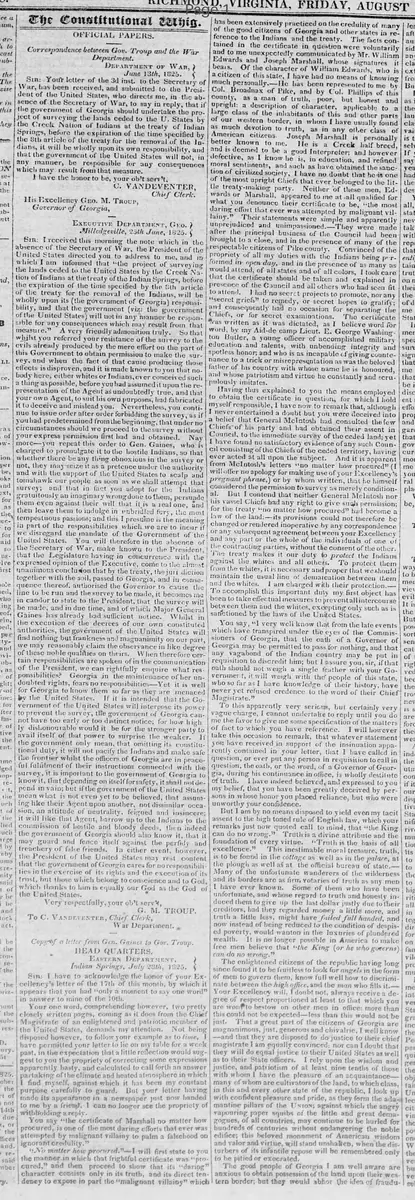
OFFICIAL PAPERS.
Correspondence between Gov. Troup and the War Department.
DEPARTMENT OF WAR,
June 13th, 1825.
Sir: Your letter of the 3d inst. to the Secretary of War, has been received, and submitted to the President of the United States, who directs me, in the absence of the Secretary of War, to say in reply, that if the government of Georgia should undertake the project of surveying the lands ceded to the U. States by the Creek Nation of Indians at the treaty of Indian Springs, before the expiration of the time specified by the 5th article of the treaty for the removal of the Indians, it will be wholly upon its own responsibility, and that the government of the United States will not, in any manner, be responsible for any consequences which may result from that measure.
I have the honor to be, your ob't serv't.
C. VANDEVENTER,
Chief Clerk.
His Excellency Geo. M. Troup,
Governor of Georgia.
Executive Department, Geo.
Milledgeville, 25th June, 1825.
Sir: I received this morning the note which in the absence of the Secretary of War, the President of the United States directed you to address to me, and in which I am informed that "the project of surveying the lands ceded to the United States by the Creek Nation of Indians at the treaty of the Indian Springs, before the expiration of the time specified by the 5th article of the treaty for the removal of the Indians, will be wholly upon its (the government of Georgia) responsibility, and that the government (viz: the government of the United States) will not in any manner be responsible for any consequences which may result from that measure." A very friendly admonition truly. So that whilst you referred your resistance of the survey to the evils already produced by the mere effort on the part of this Government to obtain permission to make the survey, and when the fact of that cause producing those effects is disproven, and it is made known to you that nobody here, either whites or Indians, ever conceived such a thing as possible, before you had assumed it upon the representation of the Agent as undoubtedly true, and that your own Agent, to suit his own purposes, had fabricated it to deceive and mislead you. Nevertheless, you continue to issue order after order forbidding the survey, as if you had predetermined from the beginning, that under no circumstances should we proceed to the survey without your express permission first had and obtained. Nay more—you repeat this order to Gen. Gaines, who is charged to promulgate it to the hostile Indians, so that whether there be any thing obnoxious in the survey or not, they may seize it as a pretence under the authority and with the support of the United States to scalp and tomahawk our people as soon as we shall attempt that survey; and that in fact you adopt for the Indians gratuitously an imaginary wrong done to them, persuade them even against their will that it is a real one, and then leave them to indulge in unbridled fury, the most tempestuous passions; and this I presume is the meaning in part of the responsibilities which we are to incur if we disregard the mandate of the Government of the United States. You will therefore in the absence of the Secretary of War, make known to the President, that the Legislature having in concurrence with the expressed opinion of the Executive, come to the almost unanimous conclusion that by the treaty, the jurisdiction together with the soil, passed to Georgia, and in consequence thereof, authorised the Governor to cause the line to be run and the survey to be made, it becomes incumbent in candor to state to the President, that the survey will be made, and in due time, and of which Major General Gaines has already had sufficient notice. Whilst in the execution of the decrees of our own constituted authorities, the government of the United States will find nothing but frankness and magnanimity on our part, we may reasonably claim the observance in like degree of these noble qualities on theirs. When therefore certain responsibilities are spoken of in the communication of the President, we can rightfully enquire what responsibilities? Georgia in the maintenance of her undoubted rights, fears no responsibilities—Yet it is well for Georgia to know them so far as they are menaced by the United States. If it is intended that the Government of the United States will interpose its power to prevent the survey, the government of Georgia cannot have too early or too distinct notice; for how highly dishonourable would it be for the stronger party to avail itself of that power to surprise the weaker. If the government only mean, that omitting its constitutional duty, it will not pacify the Indians and make safe the frontier whilst the officers of Georgia are in peaceful fulfilment of their instructions connected with the survey, it is important to the government of Georgia to know it, that depending on itself for safety, it shall not depend in vain; but if the government of the United States mean what is not even yet to be believed, that assuming like their Agent upon another, not dissimilar occasion, an attitude of neutrality, feigned and insincere; it will like that Agent, harrow up to the Indians to the commission of hostile and bloody deeds, then indeed the government of Georgia should also know it, that it may guard and fence itself against the perfidy and treachery of false friends. In either event, however, the President of the United States may rest content that the government of Georgia cares for no responsibilities in the exercise of its rights and the execution of its trust, but those which belong to conscience and to God, which thanks to him is equally our God as the God of the United States.
G. M. TROUP.
To C. VANDEVENTER, Chief Clerk,
War Department.
Copy of a letter from Gen. Gaines to Gov. Troup.
HEAD QUARTERS.
Eastern Department,
Indian Springs, July 28th, 1825.
Sir: I have to acknowledge the honor of your Excellency's letter of the 17th of this month, by which it appears that you had "only a moment to say one word" in answer to mine of the 10th.
Your one word, comprehending however, two pretty closely written pages, coming as it does from the Chief Magistrate of an enlightened and patriotic member of the United States, demands my attention. Not being disposed however, to follow your example as to time, I have permitted your letter to lie on my table for a week past, in the expectation that a little reflection would suggest to you the propriety of correcting some expressions apparently hasty, and calculated to call forth an answer partaking of the climate and heated atmosphere in which I find myself, against which it has been my constant purpose carefully to guard. But your letter having made its appearance in a newspaper just now handed to me by a friend, I can no longer see the propriety of withholding a reply.
You say "the certificate of Marshall no matter how procured, is one of the most daring efforts that ever was attempted by malignant villainy to palm a falsehood on ignorant credulity."
"No matter how procured."—I will first state to you the manner in which that frightful certificate was "procured," and then proceed to show that its "daring" character consists only in its truth, and its direct tendency to expose in part the "malignant villainy" which has been extensively practiced on the credulity of many of the good citizens of Georgia and other states in reference to the Indians and the treaty. The facts contained in the certificate in question were voluntarily and to me unexpectedly communicated by Mr. William Edwards and Joseph Marshall, whose signatures it bears. Of the character of William Edwards, who is a citizen of this state, I have had no means of knowing much personally.—He has been represented to me by Col. Broadnax of Pike, and by Col. Phillips of this county, as a man of truth, poor, but honest and upright: a description of character, applicable to a large class of the inhabitants of this and other parts of our western border, in whom I have usually found as much devotion to truth, as in any other class of American citizens. Joseph Marshall is personally better known to me. He is a Creek half breed, and is deemed to be a good Interpreter; and however defective, as I know he is, in education, and refined moral sentiments, and such as have obtained the sanction of civilized society. I have no doubt that he is one of the most upright Chiefs that ever belonged to the little treaty-making party. Neither of these men, Edwards or Marshall, appeared to me at all qualified for what you denounce their certificate to be, "the most daring effort that ever was attempted by malignant villainy." Their statements were simple and apparently unprejudiced and unimpassioned.—They were made after the principal business of the Council had been brought to a close, and in the presence of many of the respectable citizens of Pike county. Convinced of the propriety of all my duties with the Indians being performed in open day, and in the presence of as many as would attend, of all states and of all colors, I took care that the certificate should be taken and explained in presence of the Council and all others who had seen fit to attend. I had no secret projects to promote, nor any "secret griefs" to remedy, or secret hopes to gratify; and consequently had no occasion for separating the Chiefs, or for secret examinations. The certificate was written as it was dictated, as I believe word for word, by my Aid-de camp Lieut. E. George Washington Butler, a young officer of accomplished military education and talents, with unbending integrity and spotless honor; and who is as incapable of giving countenance to a trick or misrepresentation as was the beloved father of his country with whose name he is honoured, and whose patriotism and virtue he constantly and scrupulously imitates.
Having thus explained to you the means employed to obtain the certificate in question, for which I hold myself responsible, I have now to remark that, although I never entertained a doubt but you were deceived into a belief that General McIntosh had consulted the few Chiefs of his party and had obtained their assent in Council, to the immediate survey of the ceded land; yet I have found no satisfactory evidence of any such Council consisting of the Chiefs of the ceded territory, having ever acted at all upon the subject. And it is apparent from McIntosh's letters "no matter how procured" (I will offer no apology for making use of your Excellency's pregnant phrase,) or by whom written, that he himself considered the permission to survey as merely conditional. But I contend that neither General McIntosh nor his vassal Chiefs had any right to give such permission; for the treaty "no matter how procured" had become a law of the land:—its provisions could not therefore be changed or rendered inoperative by any correspondence or any subsequent agreement between your Excellency and any part or the whole of the individuals of one of the contracting parties, without the consent of the other. The treaty makes it our duty to protect the Indians against the whites and all others." To protect them from the whites, it is necessary and proper that we should maintain the usual line of demarcation between them and the whites. I am charged with their protection.— To accomplish this important duty my first object has been to take effectual measures to prevent all intercourse between them and the whites, excepting only such as is sanctioned by the laws of the United States.
You say, "I very well know that from the late events which have transpired under the eyes of the Commissioners of Georgia, that the oaths of a Governor of Georgia may be permitted to pass for nothing, and that any vagabond of the Indian country may be put in requisition to discredit him; but I assure you, sir, if that oath should not weigh a single feather with your Government, it will weigh with the people of this state, who so far as I have knowledge of their history, have never yet refused credence to the word of their Chief Magistrate."
To this apparently very serious, but certainly very vague charge, I cannot undertake to reply until you do me the favor to give me some specification of the matters of fact to which you have reference. I will however take this occasion to remark, that whatever statement you have received in support of the insinuation apparently contained in your letter, that I have called in question, or ever put any person in requisition to call in question, the oath, or the word, of a Governor of Georgia, during his continuance in office, is wholly destitute of truth. I have indeed believed, and expressed to you my belief, that you have been greatly deceived by persons in whose honor you placed reliance, but who were unworthy your confidence.
But I am by no means disposed to yield even my tacit assent to the high toned rule of English law, which your remarks just now quoted call to mind, that "the King can do no wrong." Truth is a divine attribute and the foundation of every virtue. "Truth is the basis of all excellence." This inestimable moral treasure, truth, is to be found in the cottage as well as in the palace, at the plough as well as at the official bureau of state.— Many of the unfortunate wanderers of the wilderness and its borders are as firm votaries of truth as any men I have ever known. Some of them who have been unfortunate, and whose regard to truth and honesty induced them to give up the last dollar justly due to their creditors, had they regarded money a little more, and truth a little less, might have failed full handed, and now instead of being reduced to the condition of despised poverty, would wanton in the luxuries of plundered wealth. It is no longer possible in America to make free men believe that "the King (or he who governs) can do no wrong."
The enlightened citizens of the republic having long since found it to be fruitless to look for angels in the form of men to govern them, know full well how to discriminate between the high office, and the man who fills it.— Your Excellency will, I doubt not, always receive a degree of respect proportioned at least to that which you are wont to bestow on other men in office: more than this could not be expected—less than this would not be just. That a great part of the citizens of Georgia are magnanimous, just, generous and chivalric, I well know—and that they are disposed to do justice to their chief magistrate I am equally convinced: nor can I doubt that they will do equal justice to their United States as well as to their State officers. I rely upon the wisdom and justice, and patriotism of at least nine tenths of those with whom I have the pleasure of an acquaintance— many of whom are cultivators of the land, to which class, in this and every other state of the republic, I look up with confident pleasure and pride, as they form the adamantine pillars of the Union; against which the angry vapouring paper squibs of the little and great demagogues, of all countries, may continue to be hurled for hundreds of centuries without endangering the noble edifice; this beloved monument of American wisdom and valor and virtue, will stand unshaken, when the disturbers of its infantile repose will be remembered only to be pitied or execrated.
The good people of Georgia I am well aware are anxious to obtain possession of the land upon their western border; but they would abhor the idea of fraudulent or lawless means being resorted to, to treat for, or after treating, to obtain possession of it, before the time authorized by treaty—and I am convinced that the President of the United States is as sincerely desirous as any upright citizen of Georgia can be, that the Indian claims to the land within her limits should be speedily extinguished; and that the Indians should remove therefrom as soon as they can justly be required to remove.— But he owes them protection and justice.
What sub-type of article is it?
What keywords are associated?
What entities or persons were involved?
Where did it happen?
Domestic News Details
Primary Location
Georgia
Event Date
June July 1825
Key Persons
Outcome
georgia intends to survey lands despite federal warnings of sole responsibility for consequences; federal government emphasizes protection of indians per treaty.
Event Details
Exchange of letters between U.S. War Department and Georgia Governor Troup regarding surveying Creek Indian ceded lands before removal deadline per Treaty of Indian Springs. War Department states Georgia acts at own risk. Troup asserts state's rights and plans to proceed. Gen. Gaines letter defends federal actions, certificate from Marshall and Edwards, and duty to protect Indians.