Thank you for visiting SNEWPapers!
Sign up free
Editorial
February 21, 1816
Virginia Argus
Richmond, Virginia
What is this article about?
The editorial celebrates posthumous honors to George Washington in various U.S. states 16 years after his death, criticizes Congress for failing to properly entomb his remains, and contrasts republican gratitude with the anticipated infamy of European monarchs.
Clipping
OCR Quality
98%
Excellent
Full Text
WASHINGTON.
"ALL, through the land, hail him with loud acclaim, THE FATHER OF HIS COUNTRY—glorious name!"
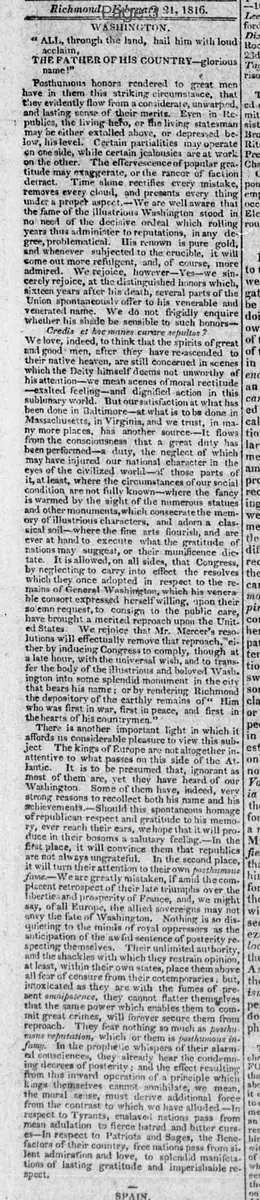
Posthumous honors rendered to great men have in them this striking circumstance, that they evidently flow from a considerate, unwarped, and lasting sense of their merits. Even in Republics, the living hero, or the living statesman may be either exalted above, or depressed below, his level. Certain partialities may operate on one side, while certain jealousies are at work on the other. The effervescence of popular gratitude may exaggerate, or the rancor of faction detract. Time alone rectifies every mistake, removes every cloud, and presents every thing under a proper aspect. We are well aware that the fame of the illustrious Washington stood in no need of the decisive ordeal which rolling years thus administer to reputations, in any degree, problematical. His renown is pure gold, and whenever subjected to the crucible, it will come out more refulgent, and, of course, more admired. We rejoice, however—Yes—we sincerely rejoice, at the distinguished honors which, sixteen years after his death, several parts of the Union spontaneously offer to his venerable and venerated name. We do not frigidly enquire whether his shade be sensible to such honors—
Credis et hoc manes curare sepultos?
We love, indeed, to think that the spirits of great and good men, after they have re-ascended to their native heaven, are still concerned in scenes which the Deity himself deems not unworthy of his attention—we mean scenes of moral rectitude—exalted feeling—and dignified action in this sublunary world. But our satisfaction at what has been done in Baltimore—at what is to be done in Massachusetts, in Virginia, and we trust, in many more places, has another source—It flows from the consciousness that a great duty has been performed—a duty, the neglect of which may have injured our national character in the eyes of the civilized world—of those parts of it, at least, where the circumstances of our social condition are not fully known—where the fancy is warmed by the sight of the numerous statues and other monuments, which consecrate the memory of illustrious characters, and adorn a classical soil—where the fine arts flourish, and are ever at hand to execute what the gratitude of nations may suggest, or their munificence dictate. It is allowed, on all sides, that Congress, by neglecting to carry into effect the resolves which they once adopted in respect to the remains of General Washington, which his venerable consort expressed herself willing, upon their solemn request, to consign to the public care, have brought a merited reproach upon the United States. We rejoice that Mr. Mercer's resolutions will effectually remove that reproach, either by inducing Congress to comply, though at a late hour, with the universal wish, and to transfer the body of the illustrious and beloved Washington into some splendid monument in the city that bears his name; or by rendering Richmond the depository of the earthly remains of "Him who was first in war, first in peace, and first in the hearts of his countrymen."
There is another important light in which it affords us considerable pleasure to view this subject. The kings of Europe are not altogether inattentive to what passes on this side of the Atlantic. It is to be presumed that, ignorant as most of them are, yet they have heard of our Washington. Some of them have, indeed, very strong reasons to recollect both his name and his achievements. Should this spontaneous homage of republican respect and gratitude to his memory, ever reach their ears, we hope that it will produce in their bosoms a salutary feeling.—In the first place, it will convince them that republics are not always ungrateful. In the second place, it will turn their attention to their own posthumous fame.—We are greatly mistaken, if amid the complacent retrospect of their late triumphs over the liberties and prosperity of France, and, we might say, of all Europe, the allied sovereigns may not envy the fate of Washington. Nothing is so disquieting to the minds of royal oppressors as the anticipation of the awful sentence of posterity respecting themselves. Their unlimited authority, and the shackles with which they restrain opinion, at least, within their own states, place them above all fear of censure from their contemporaries, but, intoxicated as they are with the fumes of present omnipotence, they cannot flatter themselves that the same power which enables them to commit great crimes, will forever secure them from reproach. They fear nothing so much as posthumous reputation, which for them is posthumous infamy. In the prophetic whispers of their alarmed consciences, they already hear the condemning decrees of posterity; and the effect resulting from this inward operation of a principle which Kings themselves cannot annihilate, we mean, the moral sense, must derive additional force from the contrast to which we have alluded—In respect to Tyrants, enslaved nations pass from mean adulation to fierce hatred and bitter curses—In respect to Patriots and Sages, the Benefactors of their country, free nations pass from silent admiration and love, to splendid manifestations of lasting gratitude and imperishable respect.
"ALL, through the land, hail him with loud acclaim, THE FATHER OF HIS COUNTRY—glorious name!"
Posthumous honors rendered to great men have in them this striking circumstance, that they evidently flow from a considerate, unwarped, and lasting sense of their merits. Even in Republics, the living hero, or the living statesman may be either exalted above, or depressed below, his level. Certain partialities may operate on one side, while certain jealousies are at work on the other. The effervescence of popular gratitude may exaggerate, or the rancor of faction detract. Time alone rectifies every mistake, removes every cloud, and presents every thing under a proper aspect. We are well aware that the fame of the illustrious Washington stood in no need of the decisive ordeal which rolling years thus administer to reputations, in any degree, problematical. His renown is pure gold, and whenever subjected to the crucible, it will come out more refulgent, and, of course, more admired. We rejoice, however—Yes—we sincerely rejoice, at the distinguished honors which, sixteen years after his death, several parts of the Union spontaneously offer to his venerable and venerated name. We do not frigidly enquire whether his shade be sensible to such honors—
Credis et hoc manes curare sepultos?
We love, indeed, to think that the spirits of great and good men, after they have re-ascended to their native heaven, are still concerned in scenes which the Deity himself deems not unworthy of his attention—we mean scenes of moral rectitude—exalted feeling—and dignified action in this sublunary world. But our satisfaction at what has been done in Baltimore—at what is to be done in Massachusetts, in Virginia, and we trust, in many more places, has another source—It flows from the consciousness that a great duty has been performed—a duty, the neglect of which may have injured our national character in the eyes of the civilized world—of those parts of it, at least, where the circumstances of our social condition are not fully known—where the fancy is warmed by the sight of the numerous statues and other monuments, which consecrate the memory of illustrious characters, and adorn a classical soil—where the fine arts flourish, and are ever at hand to execute what the gratitude of nations may suggest, or their munificence dictate. It is allowed, on all sides, that Congress, by neglecting to carry into effect the resolves which they once adopted in respect to the remains of General Washington, which his venerable consort expressed herself willing, upon their solemn request, to consign to the public care, have brought a merited reproach upon the United States. We rejoice that Mr. Mercer's resolutions will effectually remove that reproach, either by inducing Congress to comply, though at a late hour, with the universal wish, and to transfer the body of the illustrious and beloved Washington into some splendid monument in the city that bears his name; or by rendering Richmond the depository of the earthly remains of "Him who was first in war, first in peace, and first in the hearts of his countrymen."
There is another important light in which it affords us considerable pleasure to view this subject. The kings of Europe are not altogether inattentive to what passes on this side of the Atlantic. It is to be presumed that, ignorant as most of them are, yet they have heard of our Washington. Some of them have, indeed, very strong reasons to recollect both his name and his achievements. Should this spontaneous homage of republican respect and gratitude to his memory, ever reach their ears, we hope that it will produce in their bosoms a salutary feeling.—In the first place, it will convince them that republics are not always ungrateful. In the second place, it will turn their attention to their own posthumous fame.—We are greatly mistaken, if amid the complacent retrospect of their late triumphs over the liberties and prosperity of France, and, we might say, of all Europe, the allied sovereigns may not envy the fate of Washington. Nothing is so disquieting to the minds of royal oppressors as the anticipation of the awful sentence of posterity respecting themselves. Their unlimited authority, and the shackles with which they restrain opinion, at least, within their own states, place them above all fear of censure from their contemporaries, but, intoxicated as they are with the fumes of present omnipotence, they cannot flatter themselves that the same power which enables them to commit great crimes, will forever secure them from reproach. They fear nothing so much as posthumous reputation, which for them is posthumous infamy. In the prophetic whispers of their alarmed consciences, they already hear the condemning decrees of posterity; and the effect resulting from this inward operation of a principle which Kings themselves cannot annihilate, we mean, the moral sense, must derive additional force from the contrast to which we have alluded—In respect to Tyrants, enslaved nations pass from mean adulation to fierce hatred and bitter curses—In respect to Patriots and Sages, the Benefactors of their country, free nations pass from silent admiration and love, to splendid manifestations of lasting gratitude and imperishable respect.
What sub-type of article is it?
Moral Or Religious
Foreign Affairs
What keywords are associated?
George Washington
Posthumous Honors
National Character
Congress Neglect
Republican Gratitude
European Monarchs
Moral Sense
What entities or persons were involved?
George Washington
Congress
Mr. Mercer
Kings Of Europe
Allied Sovereigns
Editorial Details
Primary Topic
Posthumous Honors To George Washington
Stance / Tone
Supportive Of National Gratitude And Critical Of Monarchies
Key Figures
George Washington
Congress
Mr. Mercer
Kings Of Europe
Allied Sovereigns
Key Arguments
Posthumous Honors Reflect True Merit Unaffected By Time Or Faction.
Washington's Fame Is Enduring And Unassailable.
State Honors Fulfill A National Duty Neglected By Congress.
Congress's Failure To Entomb Washington's Remains Damaged U.S. Reputation.
Mr. Mercer's Resolutions Will Remedy This By Proper Interment In Washington Or Richmond.
Republican Gratitude Contrasts With Monarchical Infamy, Potentially Influencing European Rulers.
Tyrants Fear Posterity's Judgment Unlike Revered Patriots.