Thank you for visiting SNEWPapers!
Sign up free
The Times News
Hendersonville, Henderson County, North Carolina
What is this article about?
Newspaper obituary for John D. Rockefeller, detailing his death in Ormond Beach, Florida, daily life there, business career building Standard Oil into a monopoly, ruthless tactics, antitrust battles, retirement, and vast philanthropy amid religious faith. Born 1839 in New York.
Clipping
OCR Quality
Full Text
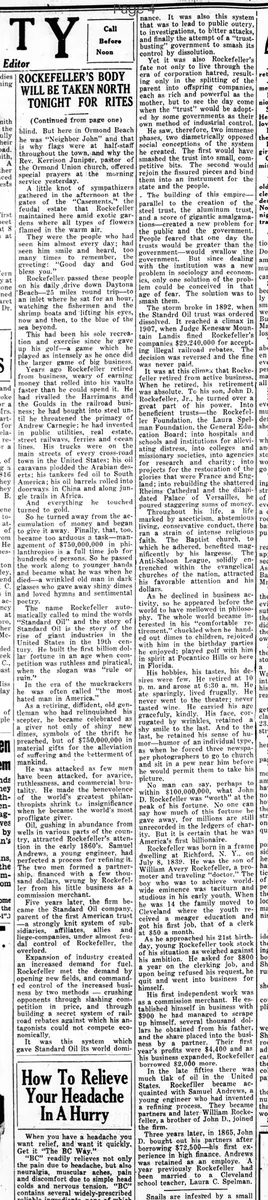
WILL BE TAKEN NORTH
TONIGHT FOR RITES
(Continued from page one)
blind. But here in Ormond Beach he was "Neighbor John" and that is why flags were at half-staff throughout the town, and why the Rev. Kerrison Juniper, pastor of the Ormond Union church, offered special prayers at the morning service yesterday.
A little knot of sympathizers gathered in the afternoon at the gates of the "Casements," the feudal estate that Rockefeller maintained here amid exotic gardens where all types of flowers flamed in the warm air.
They were the people who had seen him almost every day: had seen him smile and heard, too many times to remember, the greeting: "Good day and God bless you."
Rockefeller passed these people on his daily drive down Daytona Beach 25 miles round trip—to an inlet where he sat for an hour, watching the fishermen and the shrimp boats and lifting his eyes, now and then, to the blue of the sea beyond.
This had been his sole recreation and exercise since he gave up his golf—a game which he played as intensely as he once did the larger game of big business.
Years ago Rockefeller retired from business, weary of earning money that rolled into his vaults faster than he could spend it. He had rivalled the Harrimans and the Goulds in the railroad business; he had bought into steel until he threatened the primacy of Andrew Carnegie; he had invested in public utilities, real estate, street railways, ferries and ocean lines. His trucks were on the main streets of every cross-road town in the United States; his oil caravans plodded the Arabian deserts; his tankers fed oil to South America; his oil barrels rolled into doorways in China and along jungle trails in Africa.
And everything he touched turned to gold.
So he turned away from the accumulation of money and began to give it away. Finally, that, too, became too arduous a task—management of $750,000,000 in philanthropies is a full time job for hundreds of persons. So he passed the work along to younger hands and became what he was when he died—a wrinkled old man in dark glasses who gave away shiny dimes and loved hymns and sentimental poetry.
The name Rockefeller automatically called to mind the words "Standard Oil" and the story of Standard Oil is the story of the rise of giant industries in the United States in the 19th century. He built the first billion dollar fortune in an age when competition was ruthless and piratical, when the slogan was "rule or ruin."
In the era of the muckrakers he was often called "the most hated man in America."
As a retiring, diffident, old gentleman who had relinquished his scepter, he became celebrated as a giver not only of shiny new dimes, symbols of the thrift he preached, but of $750,000,000 in material gifts for the alleviation of suffering and the betterment of mankind.
He was attacked as few men have been attacked, for avarice, ruthlessness, and commercial brutality. He made the benevolence of the world's greatest philanthropists shrink to insignificance when he became the world's most profligate giver.
Oil, gushing in abundance from wells in various parts of the country, attracted Rockefeller's attention in the early 1860's. Samuel Andrews, a young engineer, had perfected a process for refining it. The two men formed a partnership, financed with a few thousand dollars, wrung by Rockefeller from his little business as a commission merchant.
Five years later, the firm became the Standard Oil company, parent of the first American trust—a strongly knit system of subsidiaries, affiliates, allies and liege-companies, under almost feudal control of Rockefeller, the overlord.
Expansion of industry created an increased demand for fuel. Rockefeller met the demand by opening new fields, and commanded control of the increased business by two methods - crushing opponents through slashing competition in price, and through building a secret system of railroad rebates against which his antagonists could not compete economically.
It was this system which gave Standard Oil its world dominance. It was also this system that was to lead to public outcry, to investigations, to bitter attacks, and finally the attempt of a "trust busting" government to smash its control by dissolution.
Yet it was also Rockefeller's fate not only to live through the era of corporation hatred, resulting only in the splitting of the parent into offspring companies, each as rich and powerful as the mother, but to see the day come when the "trust" would be adopted by some governments as their own method of industrial control.
He saw, therefore, two immense phases, two diametrically opposed social conceptions of the system he created. The first would have smashed the trust into small, competitive bits. The second would rejoin the fissured pieces and bind them into an instrument for the state and the people.
The building of this empire—parallel to the creation of the steel trust, the aluminum trust, and a score of gigantic amalgamations—created a new problem for the public and the government.
People feared that one day the trusts would be greater than the government—would swallow the government. But since dealing with the institution was a new problem in sociology and economics, only one solution of the problem could be conceived in that age of fear. The solution was to smash them.
The storm broke in 1892, when the Standard Oil trust was ordered dissolved. It reached a climax in 1907, when Judge Kenesaw Mountain Landis fined Rockefeller's companies $29,240,000 for accepting illegal railroad rebates. The decision was reversed and the fine was never paid.
It was at this climax that Rockefeller retired from active business. When he retired, his retirement was absolute. To his son, John D. Rockefeller, Jr., he turned over a great part of his power. Into beneficient trusts—the Rockefeller Foundation, the Laura Spelman Foundation, the General Education Board; into hospitals and schools and institutions for alleviating distress, into colleges and missionary societies, into agencies for research and charity; into projects for the restoration of the glories that were France and England; into rebuilding the shattered Rheims Cathedral and the dilapidated Palace of Versailles, he poured staggering sums of money.
Throughout his life, a life marked by asceticism, abstemious living, conservative conduct, there ran a strain of intense religious faith. The Baptist church, to which he adhered, benefited magnificently by his largesse. The Anti-Saloon League, solidly entrenched within the evangelical churches of the nation, attracted his favorable attention and his dollars.
As he declined in business activity, so he appeared before the world to have mellowed in philosophy. The whole world became interested in his "comfortable retirement," chuckled when he handed out dimes to children, rejoiced with him in the birthday parties he enjoyed; played golf with him in spirit at Pocantico Hills or here in Florida.
His hobbies, his tastes, his desires were few. He retired at 10 p. m. and arose at 6:30 a. m. He ate sparingly, lived frugally. He never went to the theater; never tasted wine. He carried his age gracefully, kindly. His face, corrugated by wrinkles, retained a shy smile to the last. And to the last, he retained his sense of humor—humor of an individual type as when he forced three newspaper photographers to go to church and sit in a pew near him before he would permit them to take his picture.
No man can say, perhaps to within $100,000,000, what John D. Rockefeller was "worth" at the peak of his fortune. No one can say how much of this fortune he gave away, for millions are still unrecorded in the ledgers of charity. But it is certain that he was America's first billionaire.
Rockefeller was born in a frame dwelling at Richford, N. Y., on July 8, 1839. He was the son of William Avery Rockefeller, a promoter and traveling "doctor." The boy who was to achieve world-wide eminence was taciturn and studious in his early youth. When he was 14 the family moved to Cleveland where the youth received a meager education and got his first job, that of a clerk at $50 a month.
As he approached his 21st birthday, young Rockefeller took stock of his situation as weighed against his ambition. He asked for $800 a year on the clerking job, and upon being refused his request, he quit and went into business for himself.
His first independent work was as a commission merchant. He established himself in business with $900 he had managed to scrape up himself, several thousand dollars he obtained from his father, and the share placed into the business by a partner. Their first year's profits were $4,400 and as his business expanded, Rockefeller borrowed $2,000 more.
In the late fifties there was much talk of oil in the United States. Rockefeller became acquainted with Samuel Andrews, a young engineer who had invented a refining process. They became partners and later William Rockefeller, a brother of John D., joined the firm.
Three years later, in 1865, John D. bought out his partners after borrowing $72,500—his first experience in high finance. Andrews was retained as an employe. A year previously Rockefeller had been married to a Cleveland school teacher, Laura C. Spelman.
What sub-type of article is it?
What themes does it cover?
What keywords are associated?
What entities or persons were involved?
Where did it happen?
Story Details
Key Persons
Location
Ormond Beach, Florida
Event Date
July 8, 1839
Story Details
John D. Rockefeller dies in Ormond Beach; biography recounts his early life in Richford, N.Y., and Cleveland, partnership with Samuel Andrews to form Standard Oil in 1865, ruthless expansion to build a billion-dollar empire, retirement from business, and philanthropy distributing $750,000,000, including to foundations and churches.