Thank you for visiting SNEWPapers!
Sign up free
Poem
August 14, 1800
The Kentucky Gazette
Lexington, Fayette County, Kentucky
What is this article about?
The poem 'Delusive Shade of future joys' by Acasto critiques the human tendency to defer happiness, virtue, and reform to 'to-morrow,' using vignettes of an innocent child, miser, sailor, prodigal, student, and the poet himself, warning that death or consequences come unexpectedly.
Clipping
OCR Quality
98%
Excellent
Full Text
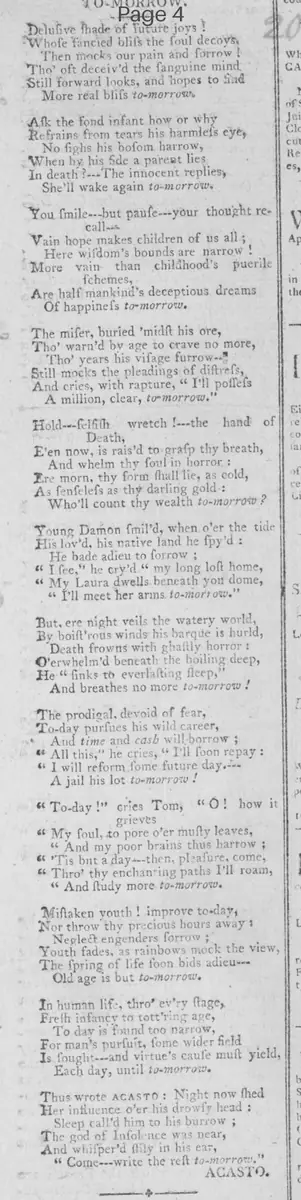
Delusive Shade of future joys!
Whose fancied bliss the soul decoys,
Then mocks our pain and sorrow!
Tho' oft deceiv'd, the sanguine mind
Still forward looks, and hopes to find
More real bliss to-morrow.
Ask the fond infant, how or why
Refrains from tears his harmless eye,
No sighs his bosom harrow,
When by his side a parent lies
In death?—The innocent replies,
She'll wake again to-morrow.
You smile—but pause—your thought recall—
Vain hope makes children of us all;
Here wisdom's bounds are narrow!
More vain than childhood's puerile schemes,
Are half mankind's deceptious dreams
Of happiness to-morrow.
The miser, buried 'midst his ore,
Tho' warn'd by age to crave no more,
Tho' years his visage furrow—
Still mocks the pleadings of distress,
And cries, with rapture, "I'll possess
A million, clear, to-morrow."
Hold—selfish wretch!—the hand of
Death,
E'en now, is rais'd to grasp thy breath,
And whelm thy soul in horror:
Ere morn, thy form shall lie, as cold,
As senseless as thy darling gold:
Who'll count thy wealth to-morrow?
Young Damon smil'd, when o'er the tide
His lov'd, his native land he spied:
He bade adieu to sorrow;
"I see," he cry'd, "my long lost home,
"My Laura dwells beneath yon dome,
"I'll meet her arms to-morrow."
But, ere night veils the watery world,
By boist'rous winds his bark is hurl'd,
Death frowns with ghastly horror:
O'erwhelm'd beneath the boiling deep,
He sinks to everlasting sleep,
And breathes no more to-morrow!
The prodigal, devoid of fear,
To-day pursues his wild career,
And time and cash will borrow;
"All this," he cries, "I'll soon repay:
I will reform some future day.—
A jail his lot to-morrow!
"To-day!" cries Tom, "O! how it
grieves
"My soul, to pore o'er musty leaves,
"And my poor brains thus harrow;
""Tis but a day—then, pleasure, come,
"Thro' thy enchanting paths I'll roam,
"And study more to-morrow."
Mistaken youth! improve to-day,
Nor throw thy precious hours away!
Neglect engenders sorrow;
Youth fades, as rainbows mock the view,
The spring of life soon bids adieu—
Old age is but to-morrow.
In human life, thro' ev'ry stage,
Fresh infancy to tott'ring age,
To-day is found too narrow
For man's pursuit, some wider field
Is sought—and virtue's cause must yield.
Each day, until to-morrow.
Thus wrote Acasto: Night now shed
Her influence o'er his drowsy head:
Sleep call'd him to his burrow;
The god of Indolence was near,
And whisper'd slyly in his ear,
"Come—write the rest to-morrow."
ACASTO.
Whose fancied bliss the soul decoys,
Then mocks our pain and sorrow!
Tho' oft deceiv'd, the sanguine mind
Still forward looks, and hopes to find
More real bliss to-morrow.
Ask the fond infant, how or why
Refrains from tears his harmless eye,
No sighs his bosom harrow,
When by his side a parent lies
In death?—The innocent replies,
She'll wake again to-morrow.
You smile—but pause—your thought recall—
Vain hope makes children of us all;
Here wisdom's bounds are narrow!
More vain than childhood's puerile schemes,
Are half mankind's deceptious dreams
Of happiness to-morrow.
The miser, buried 'midst his ore,
Tho' warn'd by age to crave no more,
Tho' years his visage furrow—
Still mocks the pleadings of distress,
And cries, with rapture, "I'll possess
A million, clear, to-morrow."
Hold—selfish wretch!—the hand of
Death,
E'en now, is rais'd to grasp thy breath,
And whelm thy soul in horror:
Ere morn, thy form shall lie, as cold,
As senseless as thy darling gold:
Who'll count thy wealth to-morrow?
Young Damon smil'd, when o'er the tide
His lov'd, his native land he spied:
He bade adieu to sorrow;
"I see," he cry'd, "my long lost home,
"My Laura dwells beneath yon dome,
"I'll meet her arms to-morrow."
But, ere night veils the watery world,
By boist'rous winds his bark is hurl'd,
Death frowns with ghastly horror:
O'erwhelm'd beneath the boiling deep,
He sinks to everlasting sleep,
And breathes no more to-morrow!
The prodigal, devoid of fear,
To-day pursues his wild career,
And time and cash will borrow;
"All this," he cries, "I'll soon repay:
I will reform some future day.—
A jail his lot to-morrow!
"To-day!" cries Tom, "O! how it
grieves
"My soul, to pore o'er musty leaves,
"And my poor brains thus harrow;
""Tis but a day—then, pleasure, come,
"Thro' thy enchanting paths I'll roam,
"And study more to-morrow."
Mistaken youth! improve to-day,
Nor throw thy precious hours away!
Neglect engenders sorrow;
Youth fades, as rainbows mock the view,
The spring of life soon bids adieu—
Old age is but to-morrow.
In human life, thro' ev'ry stage,
Fresh infancy to tott'ring age,
To-day is found too narrow
For man's pursuit, some wider field
Is sought—and virtue's cause must yield.
Each day, until to-morrow.
Thus wrote Acasto: Night now shed
Her influence o'er his drowsy head:
Sleep call'd him to his burrow;
The god of Indolence was near,
And whisper'd slyly in his ear,
"Come—write the rest to-morrow."
ACASTO.
What sub-type of article is it?
Satire
What themes does it cover?
Moral Virtue
Satire Society
What keywords are associated?
Delusive Hope
Future Joys
Procrastination
Moral Warning
Human Folly
Death Sudden
Virtue Delay
What entities or persons were involved?
Acasto.
Poem Details
Author
Acasto.
Form / Style
Rhymed Stanzas In Iambic Tetrameter
Key Lines
Vain Hope Makes Children Of Us All;
Who'll Count Thy Wealth To Morrow?
And Breathes No More To Morrow!
Old Age Is But To Morrow.
Come—Write The Rest To Morrow.