Thank you for visiting SNEWPapers!
Sign up free
The Virginia Gazette
Richmond, Williamsburg, Richmond County, Virginia
What is this article about?
Trial in Court of King's Bench before Lord Mansfield between Mr. Stuart and his Negro servant on slavery and contract laws. Counsel Wallis argued; opinions from past lords and Bishop of London cited. Case deferred to next Thursday pending Mr. Dunning's attendance.
Clipping
OCR Quality
Full Text
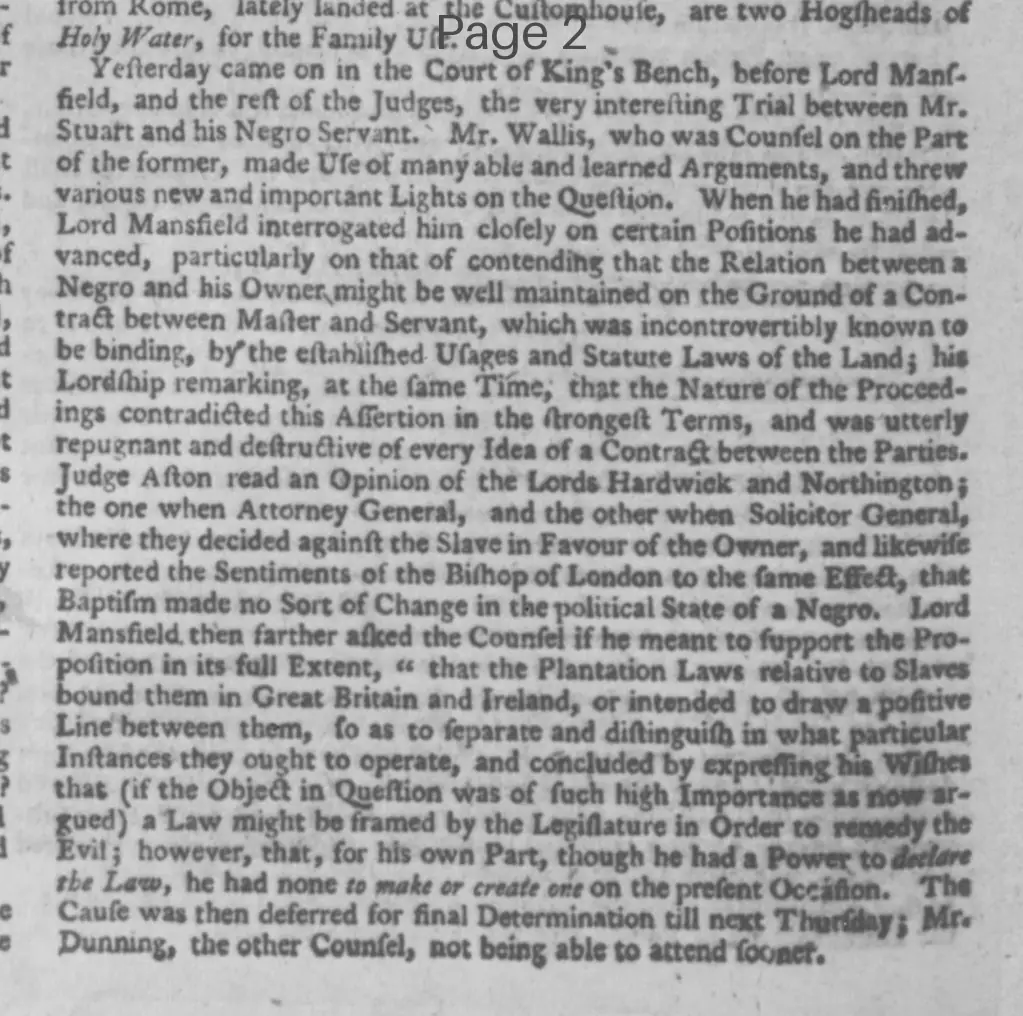
Judge Aston read an Opinion of the Lords Hardwick and Northington; the one when Attorney General, and the other when Solicitor General, where they decided against the Slave in Favour of the Owner, and likewise reported the Sentiments of the Bishop of London to the same Effect, that Baptism made no Sort of Change in the political State of a Negro. Lord Mansfield then farther asked the Counsel if he meant to support the Proposition in its full Extent, "that the Plantation Laws relative to Slaves bound them in Great Britain and Ireland, or intended to draw a positive Line between them, so as to separate and distinguish in what particular Instances they ought to operate," and concluded by expressing his Wishes that (if the Object in Question was of such high Importance as now argued) a Law might be framed by the Legislature in Order to remedy the Evil; however, that, for his own Part, though he had a Power to declare the Law, he had none to make or create one on the present Occasion. The Cause was then deferred for final Determination till next Thursday; Mr. Dunning, the other Counsel, not being able to attend sooner.
What sub-type of article is it?
What keywords are associated?
What entities or persons were involved?
Foreign News Details
Event Date
Yesterday
Key Persons
Outcome
the cause was then deferred for final determination till next thursday
Event Details
Yesterday came on in the Court of King's Bench, before Lord Mansfield, and the rest of the Judges, the very interesting Trial between Mr. Stuart and his Negro Servant. Mr. Wallis, who was Counsel on the Part of the former, made Use of many able and learned Arguments, and threw various new and important Lights on the Question. When he had finished, Lord Mansfield interrogated him closely on certain Positions he had advanced, particularly on that of contending that the Relation between a Negro and his Owner might be well maintained on the Ground of a Contract between Master and Servant, which was incontrovertibly known to be binding, by the established Usages and Statute Laws of the Land; his Lordship remarking, at the same Time, that the Nature of the Proceedings contradicted this Assertion in the strongest Terms, and was utterly repugnant and destructive of every Idea of a Contract between the Parties. Judge Aston read an Opinion of the Lords Hardwick and Northington; the one when Attorney General, and the other when Solicitor General, where they decided against the Slave in Favour of the Owner, and likewise reported the Sentiments of the Bishop of London to the same Effect, that Baptism made no Sort of Change in the political State of a Negro. Lord Mansfield then farther asked the Counsel if he meant to support the Proposition in its full Extent, "that the Plantation Laws relative to Slaves bound them in Great Britain and Ireland, or intended to draw a positive Line between them, so as to separate and distinguish in what particular Instances they ought to operate," and concluded by expressing his Wishes that (if the Object in Question was of such high Importance as now argued) a Law might be framed by the Legislature in Order to remedy the Evil; however, that, for his own Part, though he had a Power to declare the Law, he had none to make or create one on the present Occasion.