Thank you for visiting SNEWPapers!
Sign up free
Literary
February 1, 1771
The Massachusetts Spy
Boston, Suffolk County, Massachusetts
What is this article about?
Geographical and demographic overview of the Russian Empire, highlighting its vast territory exceeding Europe's, underpopulated deserts with fertile soil, and estimated 18.4 million inhabitants based on 1744-1745 census data, suggesting capacity for triple the population.
Clipping
OCR Quality
95%
Excellent
Full Text
BOST
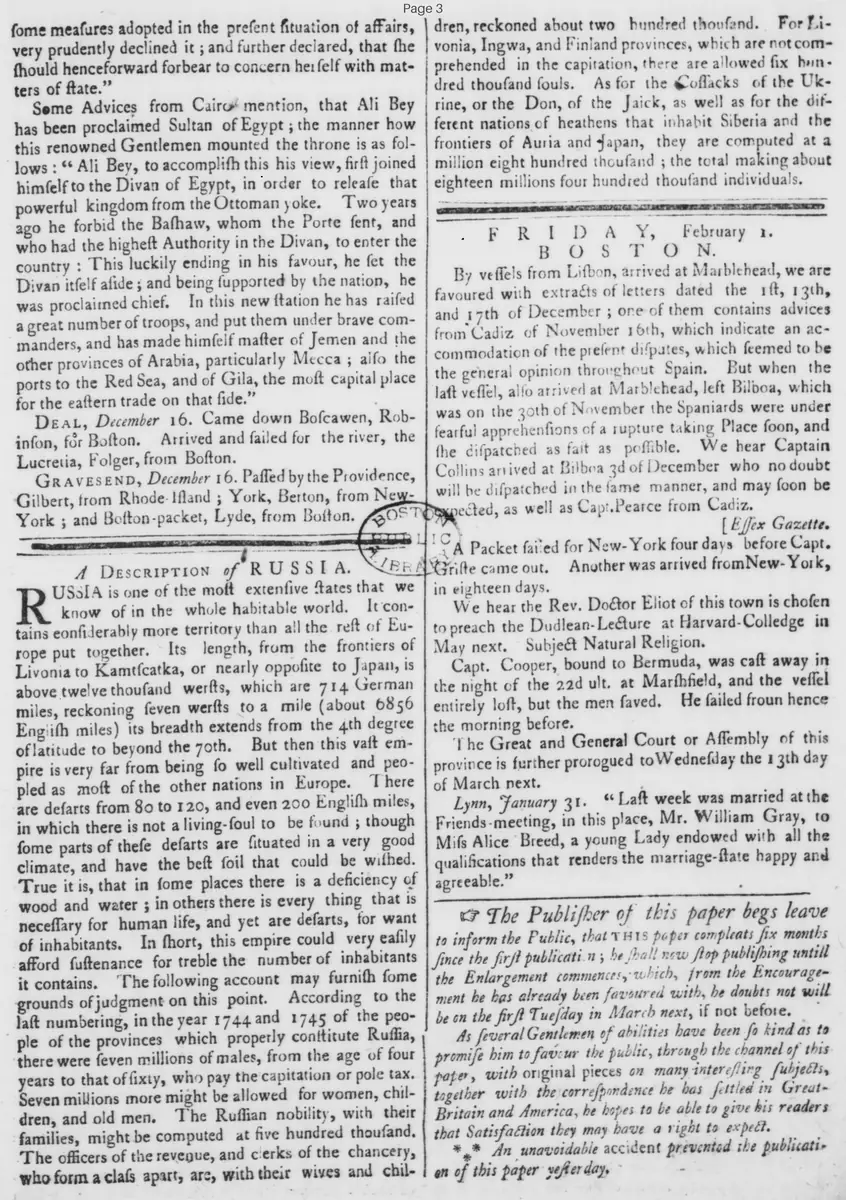
A Description of RUSSIA.
IF RUSSIA is one of the most extensive states that we know of in the whole habitable world. It contains considerably more territory than all the rest of Europe put together.
Its length, from the frontiers of Livonia to Kamchatka, or nearly opposite to Japan, is above twelve thousand wersts, which are 714 German miles, reckoning even wersts to a mile (about 6856 English miles) its breadth extends from the 4th degree of latitude to beyond the 70th.
But then this vast empire is very far from being so well cultivated and peopled as most of the other nations in Europe. There are deserts from 80 to 120, and even 200 English miles, in which there is not a living soul to be found; though some parts of these deserts are situated in a very good climate, and have the best soil that could be wished.
True it is, that in some places there is a deficiency of wood and water; in others there is every thing that is necessary for human life, and yet are deserts, for want of inhabitants.
In short, this empire could very easily afford sustenance for treble the number of inhabitants it contains.
The following account may furnish some grounds of judgment on this point. According to the last numbering, in the year 1744 and 1745 of the people of the provinces which properly constitute Russia, there were eleven millions of males, from the age of four years to that of sixty, who pay the capitation or pole tax. Seven millions more might be allowed for women, children, and old men.
The Russian nobility, with their families, might be computed at five hundred thousand. The officers of the revenue, and clerks of the chancery, who form a class apart, are, with their wives and children, reckoned about two hundred thousand.
For Livonia, Ingria, and Finland provinces, which are not comprehended in the capitation, there are allowed six hundred thousand souls. As for the Cossacks of the Ukraine, or the Don, of the Jaick, as well as for the different nations of heathens that inhabit Siberia and the frontiers of Asia and Japan, they are computed at a million eight hundred thousand; the total making about eighteen millions four hundred thousand individuals.
A Description of RUSSIA.
IF RUSSIA is one of the most extensive states that we know of in the whole habitable world. It contains considerably more territory than all the rest of Europe put together.
Its length, from the frontiers of Livonia to Kamchatka, or nearly opposite to Japan, is above twelve thousand wersts, which are 714 German miles, reckoning even wersts to a mile (about 6856 English miles) its breadth extends from the 4th degree of latitude to beyond the 70th.
But then this vast empire is very far from being so well cultivated and peopled as most of the other nations in Europe. There are deserts from 80 to 120, and even 200 English miles, in which there is not a living soul to be found; though some parts of these deserts are situated in a very good climate, and have the best soil that could be wished.
True it is, that in some places there is a deficiency of wood and water; in others there is every thing that is necessary for human life, and yet are deserts, for want of inhabitants.
In short, this empire could very easily afford sustenance for treble the number of inhabitants it contains.
The following account may furnish some grounds of judgment on this point. According to the last numbering, in the year 1744 and 1745 of the people of the provinces which properly constitute Russia, there were eleven millions of males, from the age of four years to that of sixty, who pay the capitation or pole tax. Seven millions more might be allowed for women, children, and old men.
The Russian nobility, with their families, might be computed at five hundred thousand. The officers of the revenue, and clerks of the chancery, who form a class apart, are, with their wives and children, reckoned about two hundred thousand.
For Livonia, Ingria, and Finland provinces, which are not comprehended in the capitation, there are allowed six hundred thousand souls. As for the Cossacks of the Ukraine, or the Don, of the Jaick, as well as for the different nations of heathens that inhabit Siberia and the frontiers of Asia and Japan, they are computed at a million eight hundred thousand; the total making about eighteen millions four hundred thousand individuals.
What sub-type of article is it?
Essay
What themes does it cover?
Political
Agriculture Rural
What keywords are associated?
Russia
Empire
Geography
Population
Deserts
Cultivation
Capitation Tax
Literary Details
Title
A Description Of Russia.
Form / Style
Prose Description Of Geography And Population
Key Lines
If Russia Is One Of The Most Extensive States That We Know Of In The Whole Habitable World. It Contains Considerably More Territory Than All The Rest Of Europe Put Together.
Its Length, From The Frontiers Of Livonia To Kamchatka, Or Nearly Opposite To Japan, Is Above Twelve Thousand Wersts, Which Are 714 German Miles, Reckoning Even Wersts To A Mile (About 6856 English Miles) Its Breadth Extends From The 4th Degree Of Latitude To Beyond The 70th.
According To The Last Numbering, In The Year 1744 And 1745 Of The People Of The Provinces Which Properly Constitute Russia, There Were Eleven Millions Of Males, From The Age Of Four Years To That Of Sixty, Who Pay The Capitation Or Pole Tax.