Thank you for visiting SNEWPapers!
Sign up free
Tombstone Epitaph
Tombstone, Cochise County, Arizona
What is this article about?
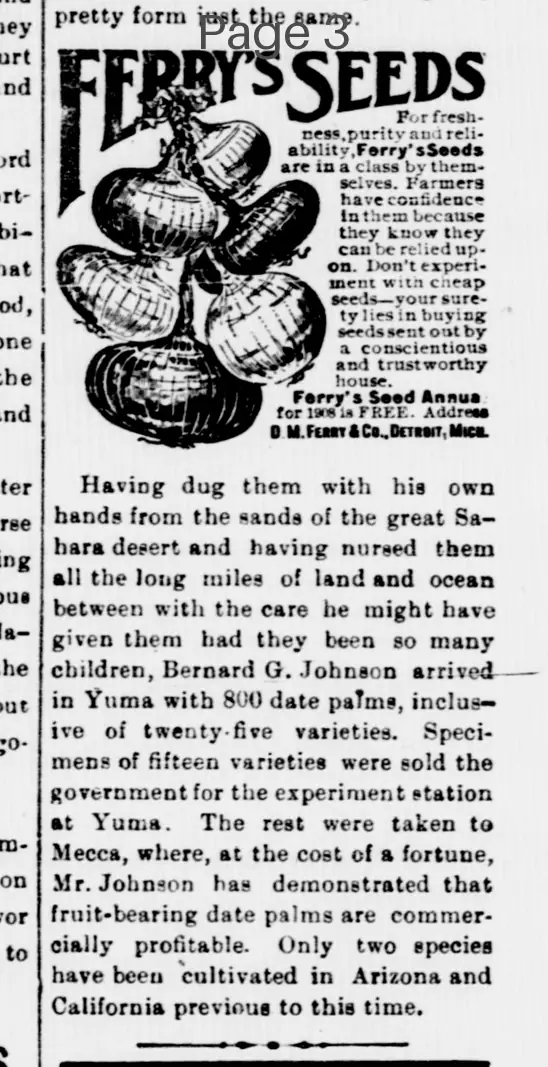
Bernard G. Johnson imported 800 date palms of 25 varieties from the Sahara Desert to Yuma, Arizona, selling specimens to the government and planting the rest in Mecca to prove their commercial profitability in the region.
Merged-components note: Merging image with following story on date palms as sequential reading order and spatially adjacent, likely illustration
Clipping
OCR Quality
Full Text
Specimens of fifteen varieties were sold the government for the experiment station at Yuma.
The rest were taken to Mecca, where, at the cost of a fortune, Mr. Johnson has demonstrated that fruit-bearing date palms are commercially profitable.
Only two species have been cultivated in Arizona and California previous to this time.
What sub-type of article is it?
What themes does it cover?
What keywords are associated?
What entities or persons were involved?
Where did it happen?
Story Details
Key Persons
Location
Sahara Desert, Yuma, Mecca, Arizona, California
Story Details
Bernard G. Johnson personally excavated and transported 800 date palms from the Sahara to Yuma, sold fifteen varieties to the government experiment station, and planted the remainder in Mecca, investing a fortune to demonstrate their commercial fruit-bearing potential in Arizona and California, where only two species had been cultivated before.