Thank you for visiting SNEWPapers!
Sign up free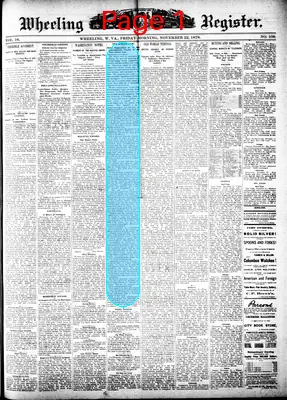
Editorial
November 22, 1878
Wheeling Register
Wheeling, Ohio County, West Virginia
What is this article about?
Correspondence urges West Virginia Legislature to amend free school law: shift to state-wide tax, consolidate county boards, retain superintendents, abolish teachers' institutes, uniform teacher pay for better efficiency and support.
Clipping

OCR Quality
95%
Excellent
Full Text
THE SCHOOL LAW
Some Suggestions as to Amendments Needed in Free School Law.
Correspondence of the Register.
The subject next in importance to codifying the laws and amending the judiciary system for the Legislature to consider, will be a revision of the school law. There is no subject in which all classes feel a deeper interest than the system of common schools, and there is none of more vital importance to the State. The prosperity and welfare of the State are totally dependent on the virtue and intelligence of its population, and there can be no more certain means to secure these than by a thorough and efficient free school system.
The free school system of this State was inaugurated under peculiar disadvantages. In the first place there was strong public prejudice against it. Outside of the city of Wheeling (where a good system had been in operation for many years) a majority of the people looked upon the system with jealousy. They regarded it as a yankee innovation, and with their old Virginia prejudices they were not favorably inclined to receive it. The "pauper system" which had existed in Virginia for so many years was regarded as sufficient to provide for the indigent children of the State, and as the new system involved a heavy increase of taxation at the start, it is easy to imagine how difficult it was to educate the people up to the point to become enthusiastically in favor of it.
In the second place the sparsity of our population makes it difficult to work satisfactorily, and this fact was a great barrier to its efficiency.
And in the next place the Constitution of 1863, in which the first free school system was incorporated, was adopted in the midst of a great political revolution, when civil rights were not watched with the same vigilance nor canvassed with the same calm deliberation as in times of peace. Consequently the system was not as perfect as it might have been. In addition to all these facts, the school system in its infancy fell into the hands, in many instances, of those who were not capable of nursing it.
But many of these difficulties have been overcome, and others are gradually yielding, and now all we need is to make the details answer the wants of the masses. This is the work for the Legislature to do.
The first question of importance is as to the manner of levying the tax for the support of the public schools. In the Constitutional Convention of 1872 there were two conflicting opinions. One was that the law should be exclusively a State tax; the other was that it should be a local tax. A compromise of these opinions was effected, and under the present Constitution a part of the tax is raised by the State and a part by the communities in which the schools are located. The proportion is fixed by the legislature.
The argument in favor of a local tax was a selfish one, and was based upon the fact that wealthier counties would be compelled to pay into the general fund more than they would get back. The argument in favor of a State tax was based upon the ground that the system was a State institution and should be supported by a State revenue, and that in harmony with the principle incorporated in the Constitution that "taxation should be equal and uniform," every dollar in the State should bear its equal proportion of the burden. The latter is the correct one, and we can never secure a thoroughly efficient system until it is adopted.
The next question for consideration will be a reduction of the number of officers connected with the system. The old English maxim was that "too many cooks spoil the broth," and the idea prevails that the school system is injured by having too many officers connected with it. This reduction may be accomplished by having but one board of education in each county, instead of one for each district. This board may be composed of one member from each magisterial district and let the county superintendent be president ex officio. Let the county board perform all the duties now assigned to the district boards. One trustee for each school district can perform all the duties that three do under the present law.
I think that it would be impolitic to abolish the office of County Superintendent. No system can be made efficient without a head to it, and the more centralized the power the more efficient will it be. Instead of abolishing the office of County Superintendent I would impose more duties upon the incumbent of the office and increase his responsibility.
But there is one feature of the present system that ought to be abolished, and that is what is known as Teachers' Institutes. They are too expensive and yield no corresponding benefit.
There ought to be some plan adopted to make the salaries of teachers uniform, and also fix the salaries for the higher grades sufficiently high to stimulate teachers in their work.
With a few other amendments of minor importance our school law can be made perfect, and the system rendered so popular that its success will be secured beyond all political change or revolution.
CITIZEN.
Some Suggestions as to Amendments Needed in Free School Law.
Correspondence of the Register.
The subject next in importance to codifying the laws and amending the judiciary system for the Legislature to consider, will be a revision of the school law. There is no subject in which all classes feel a deeper interest than the system of common schools, and there is none of more vital importance to the State. The prosperity and welfare of the State are totally dependent on the virtue and intelligence of its population, and there can be no more certain means to secure these than by a thorough and efficient free school system.
The free school system of this State was inaugurated under peculiar disadvantages. In the first place there was strong public prejudice against it. Outside of the city of Wheeling (where a good system had been in operation for many years) a majority of the people looked upon the system with jealousy. They regarded it as a yankee innovation, and with their old Virginia prejudices they were not favorably inclined to receive it. The "pauper system" which had existed in Virginia for so many years was regarded as sufficient to provide for the indigent children of the State, and as the new system involved a heavy increase of taxation at the start, it is easy to imagine how difficult it was to educate the people up to the point to become enthusiastically in favor of it.
In the second place the sparsity of our population makes it difficult to work satisfactorily, and this fact was a great barrier to its efficiency.
And in the next place the Constitution of 1863, in which the first free school system was incorporated, was adopted in the midst of a great political revolution, when civil rights were not watched with the same vigilance nor canvassed with the same calm deliberation as in times of peace. Consequently the system was not as perfect as it might have been. In addition to all these facts, the school system in its infancy fell into the hands, in many instances, of those who were not capable of nursing it.
But many of these difficulties have been overcome, and others are gradually yielding, and now all we need is to make the details answer the wants of the masses. This is the work for the Legislature to do.
The first question of importance is as to the manner of levying the tax for the support of the public schools. In the Constitutional Convention of 1872 there were two conflicting opinions. One was that the law should be exclusively a State tax; the other was that it should be a local tax. A compromise of these opinions was effected, and under the present Constitution a part of the tax is raised by the State and a part by the communities in which the schools are located. The proportion is fixed by the legislature.
The argument in favor of a local tax was a selfish one, and was based upon the fact that wealthier counties would be compelled to pay into the general fund more than they would get back. The argument in favor of a State tax was based upon the ground that the system was a State institution and should be supported by a State revenue, and that in harmony with the principle incorporated in the Constitution that "taxation should be equal and uniform," every dollar in the State should bear its equal proportion of the burden. The latter is the correct one, and we can never secure a thoroughly efficient system until it is adopted.
The next question for consideration will be a reduction of the number of officers connected with the system. The old English maxim was that "too many cooks spoil the broth," and the idea prevails that the school system is injured by having too many officers connected with it. This reduction may be accomplished by having but one board of education in each county, instead of one for each district. This board may be composed of one member from each magisterial district and let the county superintendent be president ex officio. Let the county board perform all the duties now assigned to the district boards. One trustee for each school district can perform all the duties that three do under the present law.
I think that it would be impolitic to abolish the office of County Superintendent. No system can be made efficient without a head to it, and the more centralized the power the more efficient will it be. Instead of abolishing the office of County Superintendent I would impose more duties upon the incumbent of the office and increase his responsibility.
But there is one feature of the present system that ought to be abolished, and that is what is known as Teachers' Institutes. They are too expensive and yield no corresponding benefit.
There ought to be some plan adopted to make the salaries of teachers uniform, and also fix the salaries for the higher grades sufficiently high to stimulate teachers in their work.
With a few other amendments of minor importance our school law can be made perfect, and the system rendered so popular that its success will be secured beyond all political change or revolution.
CITIZEN.
What sub-type of article is it?
Education
What keywords are associated?
School Law
Free Schools
Education Reform
State Tax
County Boards
Teacher Salaries
Administrative Efficiency
What entities or persons were involved?
Legislature
Constitutional Convention Of 1872
County Superintendent
Teachers' Institutes
Editorial Details
Primary Topic
Amendments To The Free School Law
Stance / Tone
Advocating Revisions For Efficiency And Popularity
Key Figures
Legislature
Constitutional Convention Of 1872
County Superintendent
Teachers' Institutes
Key Arguments
Revise School Law To Address Historical Disadvantages And Improve Efficiency
Adopt Exclusive State Tax For Schools To Ensure Equality And Uniformity
Reduce Number Of School Officers By Consolidating Boards At County Level
Retain And Empower County Superintendent For Centralized Control
Abolish Expensive Teachers' Institutes
Establish Uniform And Higher Salaries For Teachers
Make Minor Amendments To Perfect The System