Thank you for visiting SNEWPapers!
Sign up free
Daily Press
Newport News, Virginia
What is this article about?
Russia selects Paris for peace talks with Japan, mediated by President Roosevelt, with M. Nelidoff as plenipotentiary. Japan agrees to appoint negotiators. Expectations of armistice; positive reactions in Washington, London, and Paris. Only two Russian ministers favored continuing the war.
Clipping
OCR Quality
Full Text
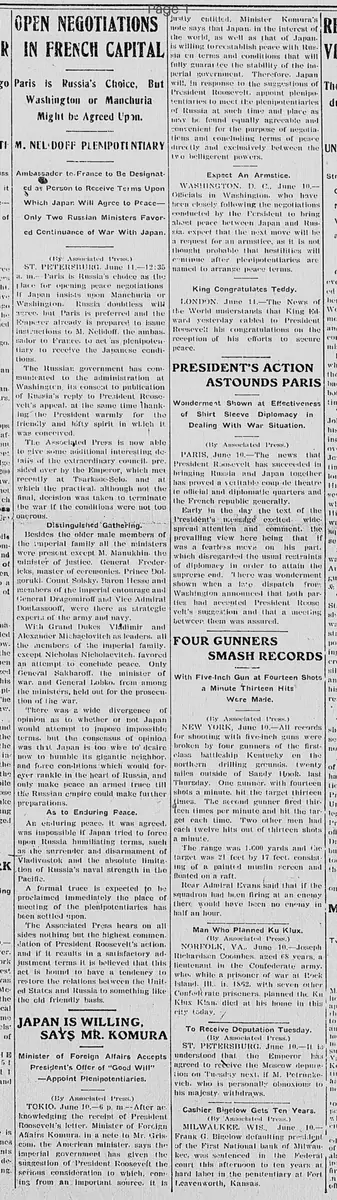
IN FRENCH CAPITAL
Paris is Russia's Choice,
But Washington or Manchuria Might be Agreed Upon.
M. NELIDOFF PLEMIPOTENTIARY
Ambassador to France to Be Designated as Person to Receive Terms Upon Which Japan Will Agree to Peace--
Only Two Russian Ministers Favored Continuance of War With Japan.
(By Associated Press.)
ST. PETERSBURG, June 11—12:35 a. m.--Paris is Russia's choice as the place for opening peace negotiations If Japan insists upon Manchuria or Washington, Russia doubtless will agree, but Paris is preferred and the Emperor already is prepared to issue instructions to M. Nelidoff, the ambassador to France, to act as plenipotentiary to receive the Japanese conditions.
The Russian government has communicated to the administration at Washington, its consent to publication of Russia's reply to President Roosevelt's appeal, at the same time thanking the President warmly for the friendly and lofty spirit in which it was conceived.
The Associated Press is now able to give some additional interesting details of the extraordinary council, presided over by the Emperor, which met recently at Tsarskoe-Selo, and at which the practical, although not the final, decision was taken to terminate the war if the conditions were not too onerous.
Distinguished Gathering.
Besides the older male members of the imperial family all the ministers were present except M. Manukhin, the minister of justice. General Fredericks, master of ceremonies, Prince Dolgoruki, Count Solsky, Baron Hesse and members of the imperial entourage and General Dragomiroff and Vice Admiral Dubassoff, were there as strategic experts of the army and navy.
With Grand Dukes Vladimir and Alexander Michailovitch as leaders, all the members of the imperial family, except Nicholas Nicolaievitch, favored an attempt to conclude peace. Only General Kuropatkin, the minister of war, and General Lobko, from among the ministers, held out for the prosecution of the war.
There was a wide divergence of opinion as to whether or not Japan would attempt to impose impossible terms, but the consensus of opinion was that Japan is too wise to desire now to humble its gigantic neighbor, and force conditions which would forever rankle in the heart of Russia, and only make peace an armed truce till the Russian empire could make further preparations.
As to Enduring Peace.
An enduring peace, it was agreed was impossible if Japan tried to force upon Russia humiliating terms, such as the surrender and disarmament of Vladivostok and the absolute limitation of Russia's naval strength in the Pacific.
A formal truce is expected to be proclaimed immediately the place of meeting of the plenipotentiaries has been settled upon.
The Associated Press hears on all sides nothing but the highest commendation of President Roosevelt's action, and if it results in a satisfactory adjustment terms it is believed that this act is bound to have a tendency to restore the relations between the United States and Russia to something like the old friendly basis.
JAPAN IS WILLING,
SAYS MR. KOMURA
Minister of Foreign Affairs Accepts President's Offer of "Good Will" .-Appoint Plenipotentiaries.
(By Associated Press.)
TOKYO, June 10.-6 p. m.--After acknowledging the receipt of President Roosevelt's letter, Minister of Foreign Affairs Komura, in a note to Mr. Griscom, the American minister, says the imperial government has given the suggestion of President Roosevelt the serious consideration to which, coming from an important source, it is justly entitled. Minister Komura's note says that Japan, in the interest of the world, as well as that of Japan, is willing to reestablish peace with Russia on terms and conditions that will fully guarantee the stability of the imperial government. Therefore, Japan will, in response to the suggestions of President Roosevelt, appoint plenipotentiaries to meet the plenipotentiaries of Russia at such time and place as may be found equally agreeable and convenient for the purpose of negotiations and concluding terms of peace directly and exclusively between the two belligerent powers.
Expect An Armistice.
WASHINGTON, D. C., June 10.--Officials in Washington, who have been closely following the negotiations conducted by the President to bring about peace between Japan and Russia, expect that the next move will be a request for an armistice, as it is not thought probable that hostilities will continue after plenipotentiaries are named to arrange peace terms.
King Congratulates Teddy.
London, June 11.--The News of the World understands that King Edward yesterday cabled to President Roosevelt his congratulations on the reception of his efforts to secure peace.
PRESIDENT'S ACTION
ASTOUNDS PARIS
Wonderment Shown at Effectiveness of Shirt Sleeve Diplomacy in Dealing With War Situation.
(By Associated Press.)
PARIS, June 10.--The news that President Roosevelt has succeeded in bringing Russia and Japan together has proved a veritable coup de theatre to official and diplomatic quarters and the French republic generally.
Early in the day the text of the President's message excited widespread attention and comment, the prevailing view here being that it was a fearless move on his part, which disregarded the usual restraints of diplomacy in order to attain the supreme end, and there was wonderment shown when a late dispatch from Washington announced that both parties had accepted President Roosevelt's suggestion and that a meeting between them was assured.
What sub-type of article is it?
What keywords are associated?
What entities or persons were involved?
Where did it happen?
Foreign News Details
Primary Location
Paris
Event Date
June 10 11
Key Persons
Outcome
russia and japan agree to appoint plenipotentiaries for peace negotiations; expectation of formal truce upon settling meeting place; consensus against humiliating terms for enduring peace.
Event Details
Russia prefers Paris for peace talks with Japan, mediated by President Roosevelt, and prepares to appoint Ambassador Nelidoff as plenipotentiary. Imperial council at Tsarskoe-Selo favors ending the war if terms not onerous, with most family and ministers supporting peace except Kuropatkin and Lobko. Japan accepts mediation and will appoint negotiators. Washington expects armistice; King Edward congratulates Roosevelt; Paris astounded by success.