Thank you for visiting SNEWPapers!
Sign up free
Story
October 14, 1800
Gazette Of The United States, & Daily Advertiser
Philadelphia, Philadelphia County, Pennsylvania
What is this article about?
Biographical sketch of General Charles C. Pinckney, detailing his South Carolina ancestry, Oxford education, Revolutionary War service, Federal Convention role, French embassy, military commands, and virtues of integrity and patriotism.
Clipping
OCR Quality
98%
Excellent
Full Text
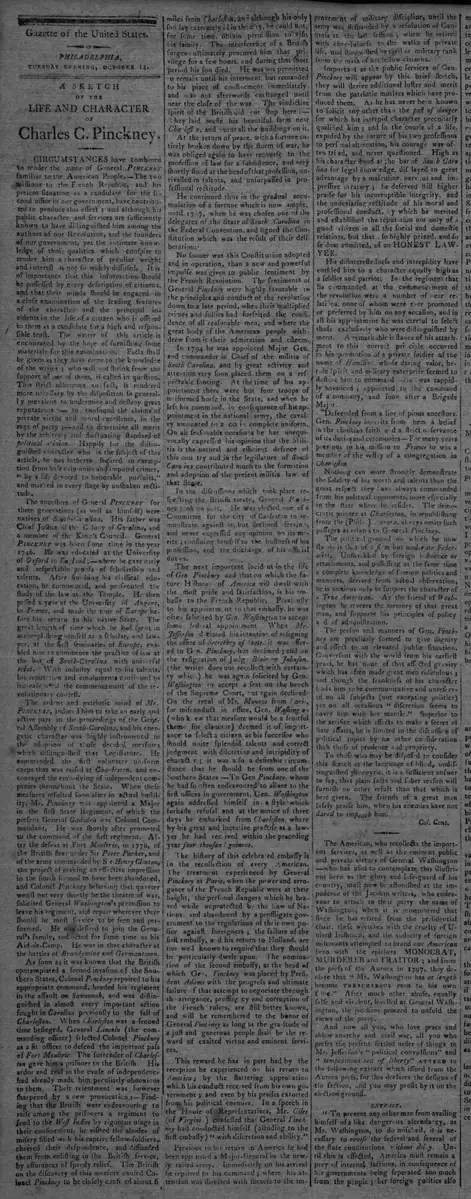
SKETCH
OF
LIFE AND CHARACTER
Charles C. Pinckney.
CIRCUMSTANCES have combined to render the name of General Pinckney familiar to the American People. The two missions to the French Republic, and his present situation as a candidate for the second office in our government, have contributed to produce this effect; and although his public character and services are sufficiently known to have distinguished him among the authors of our Revolution, and the founders of our government, yet the intimate knowledge of those qualities which conspire to render him a character of peculiar weight and interest is not so widely diffused. It is of importance that this information should be possessed by every description of citizens, and that their minds should be engaged in a close examination of the leading features of the character and the principal incidents in the life of a citizen who is offered to them as a candidate for a high and responsible trust. The writer of this article is encouraged by the hope of furnishing some materials for this examination. Facts shall be given as they have come to the knowledge of the writer; who will not shrink from the support of one of them, if called in question. This strict adherence to fact, is rendered more necessary by the disposition so generally prevalent to undermine and destroy great reputations; to confound the claims of private virtue and moral excellence, in the rage of party; and to determine all merit by the arbitrary and fluctuating standard of political opinion. Happily for the distinguished character who is the subject of this article, he has hitherto secured an exemption from base calumnies and imputed crimes, "by a life devoted to honorable pursuits," and marked in every stage by unshaken rectitude.
The ancestors of General Pinckney for three generations (as well as himself) were natives of South-Carolina. His father was Chief Justice of the Colony of Carolina, and a member of the King's Council. General Pinckney was born some time in the year 1746. He was educated at the University of Oxford in England; where he gave early and respectable proofs of scholarship and talents. After finishing his classical education, he commenced, and prosecuted the study of the law at the Temple. He then passed a year at the University of Angers, in France, and made the tour of Europe before his return to his native State. The great length of time which he had spent in accomplishing himself as a scholar, and lawyer, at the great seminaries of Europe, enabled him to commence the practice of law at the bar of South-Carolina with universal eclat. With industry equal to his talents, his reputation and emoluments continued to increase until the commencement of the revolutionary contest.
The ardent and patriotic mind of Mr. Pinckney, induced him to take an early and active part in the proceedings of the General Assembly of South-Carolina, and his energetic character was highly instrumental in the adoption of those decided measures which distinguished that Legislature. He commanded the first volunteer uniform corps that was raised at Charleston, and encouraged the embodying of independent companies throughout the State. When these measures resulted soon after in actual hostility, Mr. Pinckney was appointed a Major in the first State Regiment, of which the present General Gadsden was Colonel Commandant. He was shortly after promoted to the command of the first regiment. After the defeat at Fort Moultrie, in 1776, of the British fleet under Sir Peter Parker, and of the army commanded by Sir Henry Clinton, the project of making an effective impression in the South seemed to have been abandoned, and Colonel Pinckney believing that quarters would not very shortly be the theatre of war, solicited General Washington's permission to leave his regiment, and repair wherever there should be most service to be seen and performed. He was desired to join the General's family, and acted for some time as his Aid-de-Camp. He was in that character at the battles of Brandywine and Germantown. As soon as it was known that the British contemplated a second invasion of the Southern States, Colonel Pinckney repaired to his appropriate command, headed his regiment in the assault on Savannah, and was distinguished in almost every important action fought in Carolina previously to the fall of Charleston. When Charleston was a second time besieged, General Lincoln (the commanding officer) selected Colonel Pinckney as a fit officer to defend the important pass of Fort Moultrie. The surrender of Charleston gave him a prisoner to the British. His ardor and zeal in the cause of independence had already made him peculiarly obnoxious to them. Their resentment was however sharpened by a new provocation; Finding that the British were endeavouring to raise among the prisoners a regiment to send to the West Indies by rigorous usage in their confinement, he visited the abodes of misery filled with his captive fellow-soldiers, cheered their despondence, and dissuaded them from enlisting in the British service, by assurances of speedy relief. The British on the discovery of this measure caused Colonel Pinckney to be closely confined about 6 miles from Charleston, and although his only son lay extremely ill in the city, he could not, for some time, obtain permission to visit his family. The interference of a British surgeon ultimately procured him that privilege for a few hours, and during that short period his son died. He was not permitted to remain until his interment, but remanded to his place of confinement immediately, and was not afterwards exchanged until near the close of the war. The vindictive spirit of the British did not stop here: they laid waste his beautiful farm near Charleston, and burnt all the buildings on it. At the return of peace, with a fortune entirely broken down by the storm of war, he was obliged again to have recourse to the profession of law for a subsistence, and very shortly stood at the head of that profession, unrivalled in talents, and unsurpassed in professional rectitude.
He continued this until 1787, when he was chosen one of the delegates of the State of South Carolina in the Federal Convention, and signed the Constitution which was the result of their deliberations.
No sooner was this Constitution adopted and in operation, than a new and powerful impulse was given to public sentiment by the French Revolution. The sentiments of General Pinckney were highly favorable to the principles and conduct of the revolution down to a late period, when their multiplied crimes and follies had forfeited the confidence of all reasonable men, and when the great body of the American people withdrew from it their admiration and esteem. In 1794 he was appointed Major General and commander in Chief of the militia of South Carolina, and by great activity and attention very soon placed them on a respectable footing. At the time of his appointment there were but four troops of uniformed horse in the State, and when he left his command, in consequence of his appointment in the national army, the cavalry amounted to 200 in complete uniform. On all seasonable occasions he has unequivocally expressed his opinion that the Militia is the natural and efficient defence of this country and in the legislature of South Carolina contributed much to the formation and adoption of the present militia law of that State.
In the discussions which took place respecting the British treaty, General Pinckney took no part. He was elected one of a Committee for the city of Charleston to remonstrate against it, but declined serving, and never expressed any opinion on its merits; confining himself to the business of his profession, and the discharge of his official duties.
The next important incident in the life of Gen. Pinckney and that on which the future Historian of America will dwell with the most pride and satisfaction, is his embassy to the French Republic. Previously to his appointment to that embassy, he was often solicited by Gen. Washington to accept some federal appointment When Mr. Jefferson declared his intention of resigning the office of Secretary of State, it was offered to Gen. Pinckney, but declined: and on the resignation of Judge Blair or Johnson, (the writer does not recollect which) he was again solicited by Gen. Washington to accept a seat on the bench of the Supreme Court, but again declined On the recall of Mr. Monroe from Paris, for misconduct in office, Gen. Washington (who knew that measure would be a fruitful theme for clamour) deemed it of importance to select a citizen as his successor who should unite splendid talents and correct judgment with discretion and intrepidity of character; it was also a desirable circumstance that he should be from one of the Southern States --To Gen Pinckney, whom he had so often endeavoured to allure to the first offices in government, Gen. Washington again addressed himself in a style which forbade refusal and at the notice of three days he embarked from Charleston, where by his great and lucrative practice as a lawyer he had received within the preceding year four thousand guineas.
The history of this celebrated embassy is in the recollection of every American. The treatment experienced by General Pinckney at Paris, when the power and arrogance of the French Republic were at their height, the personal dangers which he braved while unprotected by the Law of Nations, and abandoned by a profligate government to the regulations of their own police against foreigners; the failure of the first embassy, and his return to Holland, are too well known to require that they should be particularly dwelt upon. The nomination of the second embassy, at the head of which Gen. Pinckney was placed by President Adams with the progress and ultimate failure that attempt to negotiate through the arrogance, profligacy and corruption of the French rulers, are still better known, and will be remembered to the honor of General Pinckney as long as the gratitude of a just and generous people shall be the reward of exalted virtue and eminent services.
This reward he has in part had by the reception he experienced on his return to America; by the flattering approbation which his conduct received from his own government; and even by his praises extorted from his political enemies. In a speech in the House of Representatives, Mr. Giles (of Virginia) confessed that General Pinckney had conducted himself (alluding to the first embassy) "with discretion and ability."
Previous to his return to America he had been appointed a Major-General in the newly raised army. Immediately on his arrival he repaired to his command; where his attention was directed with success to the improvement of military discipline, until the army was disbanded by a resolution of Congress at the last session when he retired with cheerfulness to the walks of private life, undistinguished by civil or military rank from the mass of his fellow-citizens.
Important as the public services of Gen. Pinckney will appear by this brief sketch, they will derive additional lustre and merit from the patriotic motives which have produced them. As he has never been known to solicit any other than the post of danger for which his intrepid character peculiarly qualified him: and in the course of a life, exposed by the nature of his two professions to personal altercation, his courage was often tried, and never questioned. High as his character stood at the bar of South Carolina for legal knowledge, displayed to great advantage by a masculine, nervous and impressive oratory; he deserved still higher praise for his incorruptible integrity, and the undeviating rectitude of his moral and professional conduct, by which he merited and established the reputation not only of a good citizen in all the social and domestic relations, but that, so highly prized, and so seldom admitted, of an HONEST LAWYER.
His disinterestedness and intrepidity have entitled him to a character equally high as a soldier and a patriot. In the regiment that he commanded at the commencement of the revolution were a number of near relations, none of whom were ever promoted or preferred by him on any occasion, and in all his appointments he was careful to elect those exclusively who were distinguished by merit. A remarkable instance of his attachment to this correct principle occurred in his promotion of a private soldier of the name of Hamilton, whose daring valor, heroic spirit and military enterprise seemed to destine him to command --he was rapidly advanced; appointed to the command of a company, and soon after a Brigade Major.
Descended from a line of pious ancestors, Gen. Pinckney inherits from them a belief in the Christian faith and a strict observance of its duties and ceremonies -- For many years previous to his mission to France he was a member of the vestry of a congregation in Charleston
Nothing can more strongly demonstrate the solidity of his worth and talents than the great respect they have always commanded from his political opponents, more especially in the state where he resides. The democratic printer at Charleston, in republishing from the (Phila.) Aurora, always omits such passages as relates to General Pinckney.
The political ground on which he now stands is that of a firm but moderate Federalist. Unshackled by foreign influence or attachments, and possessing at the same time a complete knowledge of foreign politics and manners, derived from actual observation, he is anxious only to support the character of a True American. As the friend of Washington he reveres the memory of that great man, and supports his principles of policy and of administration.
The person and manners of Gen. Pinckney are peculiarly formed to give dignity and effect to an elevated public situation. Conversant with the world from his earliest years, he has none of that affected gravity which has often made great men ridiculous; and though the frankness of his character leads him to be communicative and unreserved on all subjects (not excepting politics) yet on all occasions "discretion seems to cover him with her mantle." Superior to the artifice which affects to make a secret of state affairs, he is limited in the discussion of political topics by no other consideration than those of prudence and propriety.
To those who may be disposed to consider this sketch as the language of blind, undistinguished panegyric, it is a sufficient answer to say, that plain facts and sober reason will furnish no other result than that which is here given. The friends of a great man safely praise him, when his enemies have not dared to impeach him.
Col. Cent.
OF
LIFE AND CHARACTER
Charles C. Pinckney.
CIRCUMSTANCES have combined to render the name of General Pinckney familiar to the American People. The two missions to the French Republic, and his present situation as a candidate for the second office in our government, have contributed to produce this effect; and although his public character and services are sufficiently known to have distinguished him among the authors of our Revolution, and the founders of our government, yet the intimate knowledge of those qualities which conspire to render him a character of peculiar weight and interest is not so widely diffused. It is of importance that this information should be possessed by every description of citizens, and that their minds should be engaged in a close examination of the leading features of the character and the principal incidents in the life of a citizen who is offered to them as a candidate for a high and responsible trust. The writer of this article is encouraged by the hope of furnishing some materials for this examination. Facts shall be given as they have come to the knowledge of the writer; who will not shrink from the support of one of them, if called in question. This strict adherence to fact, is rendered more necessary by the disposition so generally prevalent to undermine and destroy great reputations; to confound the claims of private virtue and moral excellence, in the rage of party; and to determine all merit by the arbitrary and fluctuating standard of political opinion. Happily for the distinguished character who is the subject of this article, he has hitherto secured an exemption from base calumnies and imputed crimes, "by a life devoted to honorable pursuits," and marked in every stage by unshaken rectitude.
The ancestors of General Pinckney for three generations (as well as himself) were natives of South-Carolina. His father was Chief Justice of the Colony of Carolina, and a member of the King's Council. General Pinckney was born some time in the year 1746. He was educated at the University of Oxford in England; where he gave early and respectable proofs of scholarship and talents. After finishing his classical education, he commenced, and prosecuted the study of the law at the Temple. He then passed a year at the University of Angers, in France, and made the tour of Europe before his return to his native State. The great length of time which he had spent in accomplishing himself as a scholar, and lawyer, at the great seminaries of Europe, enabled him to commence the practice of law at the bar of South-Carolina with universal eclat. With industry equal to his talents, his reputation and emoluments continued to increase until the commencement of the revolutionary contest.
The ardent and patriotic mind of Mr. Pinckney, induced him to take an early and active part in the proceedings of the General Assembly of South-Carolina, and his energetic character was highly instrumental in the adoption of those decided measures which distinguished that Legislature. He commanded the first volunteer uniform corps that was raised at Charleston, and encouraged the embodying of independent companies throughout the State. When these measures resulted soon after in actual hostility, Mr. Pinckney was appointed a Major in the first State Regiment, of which the present General Gadsden was Colonel Commandant. He was shortly after promoted to the command of the first regiment. After the defeat at Fort Moultrie, in 1776, of the British fleet under Sir Peter Parker, and of the army commanded by Sir Henry Clinton, the project of making an effective impression in the South seemed to have been abandoned, and Colonel Pinckney believing that quarters would not very shortly be the theatre of war, solicited General Washington's permission to leave his regiment, and repair wherever there should be most service to be seen and performed. He was desired to join the General's family, and acted for some time as his Aid-de-Camp. He was in that character at the battles of Brandywine and Germantown. As soon as it was known that the British contemplated a second invasion of the Southern States, Colonel Pinckney repaired to his appropriate command, headed his regiment in the assault on Savannah, and was distinguished in almost every important action fought in Carolina previously to the fall of Charleston. When Charleston was a second time besieged, General Lincoln (the commanding officer) selected Colonel Pinckney as a fit officer to defend the important pass of Fort Moultrie. The surrender of Charleston gave him a prisoner to the British. His ardor and zeal in the cause of independence had already made him peculiarly obnoxious to them. Their resentment was however sharpened by a new provocation; Finding that the British were endeavouring to raise among the prisoners a regiment to send to the West Indies by rigorous usage in their confinement, he visited the abodes of misery filled with his captive fellow-soldiers, cheered their despondence, and dissuaded them from enlisting in the British service, by assurances of speedy relief. The British on the discovery of this measure caused Colonel Pinckney to be closely confined about 6 miles from Charleston, and although his only son lay extremely ill in the city, he could not, for some time, obtain permission to visit his family. The interference of a British surgeon ultimately procured him that privilege for a few hours, and during that short period his son died. He was not permitted to remain until his interment, but remanded to his place of confinement immediately, and was not afterwards exchanged until near the close of the war. The vindictive spirit of the British did not stop here: they laid waste his beautiful farm near Charleston, and burnt all the buildings on it. At the return of peace, with a fortune entirely broken down by the storm of war, he was obliged again to have recourse to the profession of law for a subsistence, and very shortly stood at the head of that profession, unrivalled in talents, and unsurpassed in professional rectitude.
He continued this until 1787, when he was chosen one of the delegates of the State of South Carolina in the Federal Convention, and signed the Constitution which was the result of their deliberations.
No sooner was this Constitution adopted and in operation, than a new and powerful impulse was given to public sentiment by the French Revolution. The sentiments of General Pinckney were highly favorable to the principles and conduct of the revolution down to a late period, when their multiplied crimes and follies had forfeited the confidence of all reasonable men, and when the great body of the American people withdrew from it their admiration and esteem. In 1794 he was appointed Major General and commander in Chief of the militia of South Carolina, and by great activity and attention very soon placed them on a respectable footing. At the time of his appointment there were but four troops of uniformed horse in the State, and when he left his command, in consequence of his appointment in the national army, the cavalry amounted to 200 in complete uniform. On all seasonable occasions he has unequivocally expressed his opinion that the Militia is the natural and efficient defence of this country and in the legislature of South Carolina contributed much to the formation and adoption of the present militia law of that State.
In the discussions which took place respecting the British treaty, General Pinckney took no part. He was elected one of a Committee for the city of Charleston to remonstrate against it, but declined serving, and never expressed any opinion on its merits; confining himself to the business of his profession, and the discharge of his official duties.
The next important incident in the life of Gen. Pinckney and that on which the future Historian of America will dwell with the most pride and satisfaction, is his embassy to the French Republic. Previously to his appointment to that embassy, he was often solicited by Gen. Washington to accept some federal appointment When Mr. Jefferson declared his intention of resigning the office of Secretary of State, it was offered to Gen. Pinckney, but declined: and on the resignation of Judge Blair or Johnson, (the writer does not recollect which) he was again solicited by Gen. Washington to accept a seat on the bench of the Supreme Court, but again declined On the recall of Mr. Monroe from Paris, for misconduct in office, Gen. Washington (who knew that measure would be a fruitful theme for clamour) deemed it of importance to select a citizen as his successor who should unite splendid talents and correct judgment with discretion and intrepidity of character; it was also a desirable circumstance that he should be from one of the Southern States --To Gen Pinckney, whom he had so often endeavoured to allure to the first offices in government, Gen. Washington again addressed himself in a style which forbade refusal and at the notice of three days he embarked from Charleston, where by his great and lucrative practice as a lawyer he had received within the preceding year four thousand guineas.
The history of this celebrated embassy is in the recollection of every American. The treatment experienced by General Pinckney at Paris, when the power and arrogance of the French Republic were at their height, the personal dangers which he braved while unprotected by the Law of Nations, and abandoned by a profligate government to the regulations of their own police against foreigners; the failure of the first embassy, and his return to Holland, are too well known to require that they should be particularly dwelt upon. The nomination of the second embassy, at the head of which Gen. Pinckney was placed by President Adams with the progress and ultimate failure that attempt to negotiate through the arrogance, profligacy and corruption of the French rulers, are still better known, and will be remembered to the honor of General Pinckney as long as the gratitude of a just and generous people shall be the reward of exalted virtue and eminent services.
This reward he has in part had by the reception he experienced on his return to America; by the flattering approbation which his conduct received from his own government; and even by his praises extorted from his political enemies. In a speech in the House of Representatives, Mr. Giles (of Virginia) confessed that General Pinckney had conducted himself (alluding to the first embassy) "with discretion and ability."
Previous to his return to America he had been appointed a Major-General in the newly raised army. Immediately on his arrival he repaired to his command; where his attention was directed with success to the improvement of military discipline, until the army was disbanded by a resolution of Congress at the last session when he retired with cheerfulness to the walks of private life, undistinguished by civil or military rank from the mass of his fellow-citizens.
Important as the public services of Gen. Pinckney will appear by this brief sketch, they will derive additional lustre and merit from the patriotic motives which have produced them. As he has never been known to solicit any other than the post of danger for which his intrepid character peculiarly qualified him: and in the course of a life, exposed by the nature of his two professions to personal altercation, his courage was often tried, and never questioned. High as his character stood at the bar of South Carolina for legal knowledge, displayed to great advantage by a masculine, nervous and impressive oratory; he deserved still higher praise for his incorruptible integrity, and the undeviating rectitude of his moral and professional conduct, by which he merited and established the reputation not only of a good citizen in all the social and domestic relations, but that, so highly prized, and so seldom admitted, of an HONEST LAWYER.
His disinterestedness and intrepidity have entitled him to a character equally high as a soldier and a patriot. In the regiment that he commanded at the commencement of the revolution were a number of near relations, none of whom were ever promoted or preferred by him on any occasion, and in all his appointments he was careful to elect those exclusively who were distinguished by merit. A remarkable instance of his attachment to this correct principle occurred in his promotion of a private soldier of the name of Hamilton, whose daring valor, heroic spirit and military enterprise seemed to destine him to command --he was rapidly advanced; appointed to the command of a company, and soon after a Brigade Major.
Descended from a line of pious ancestors, Gen. Pinckney inherits from them a belief in the Christian faith and a strict observance of its duties and ceremonies -- For many years previous to his mission to France he was a member of the vestry of a congregation in Charleston
Nothing can more strongly demonstrate the solidity of his worth and talents than the great respect they have always commanded from his political opponents, more especially in the state where he resides. The democratic printer at Charleston, in republishing from the (Phila.) Aurora, always omits such passages as relates to General Pinckney.
The political ground on which he now stands is that of a firm but moderate Federalist. Unshackled by foreign influence or attachments, and possessing at the same time a complete knowledge of foreign politics and manners, derived from actual observation, he is anxious only to support the character of a True American. As the friend of Washington he reveres the memory of that great man, and supports his principles of policy and of administration.
The person and manners of Gen. Pinckney are peculiarly formed to give dignity and effect to an elevated public situation. Conversant with the world from his earliest years, he has none of that affected gravity which has often made great men ridiculous; and though the frankness of his character leads him to be communicative and unreserved on all subjects (not excepting politics) yet on all occasions "discretion seems to cover him with her mantle." Superior to the artifice which affects to make a secret of state affairs, he is limited in the discussion of political topics by no other consideration than those of prudence and propriety.
To those who may be disposed to consider this sketch as the language of blind, undistinguished panegyric, it is a sufficient answer to say, that plain facts and sober reason will furnish no other result than that which is here given. The friends of a great man safely praise him, when his enemies have not dared to impeach him.
Col. Cent.
What sub-type of article is it?
Biography
Historical Event
Personal Triumph
What themes does it cover?
Bravery Heroism
Moral Virtue
Triumph
What keywords are associated?
Charles Pinckney
American Revolution
Federal Convention
French Embassy
South Carolina Militia
Legal Career
Patriotism
What entities or persons were involved?
Charles C. Pinckney
George Washington
Thomas Jefferson
Where did it happen?
South Carolina, Charleston
Story Details
Key Persons
Charles C. Pinckney
George Washington
Thomas Jefferson
Location
South Carolina, Charleston
Event Date
1746 1800
Story Details
Charles C. Pinckney, born 1746 in South Carolina, educated in Europe, became a prominent lawyer, served in Revolutionary War, signed U.S. Constitution, led militias, and conducted embassies to France, demonstrating integrity and patriotism despite personal losses.