Thank you for visiting SNEWPapers!
Sign up free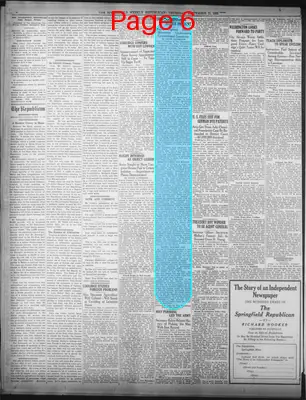
Story
September 11, 1924
Springfield Weekly Republican
Springfield, Hampden County, Massachusetts
What is this article about?
President Coolidge, in a Baltimore speech honoring Lafayette, criticizes La Follette's push to let Congress overrule Supreme Court decisions, warning it threatens liberty and minority rights, drawing on historical examples like Roosevelt's past proposals.
Clipping

OCR Quality
98%
Excellent
Full Text
COOLIDGE DENOUNCES ATTACK ON COURT
Warns Against Radical Movement Undermining Constitutional Guaranties
By DAVID LAWRENCE
Special Dispatch to The Republican
Baltimore, Md.. Sept. 6-President Coolidge made a speech here today in memory of Lafayette, but aimed at La Follette. Mr Coolidge painted a picture of the hero of the American Revolution as a moderate and not a radical, as a man who flung aside temptations to rule and even rejected a French crown. Out of the philosophy of Lafayette the President drew the moral that American institutions ought to be maintained and that efforts to transfer to Congress the right to override decisions of the supreme court of the United States as advocated by La Follette and his group, would only result in tyranny and the oppression of the minority by the majority.
Urged by his counsellors to hit hard at the La Follette movement, the President devoted considerable space in his address to radicalism as it has been evolved in America and constantly sought to prove by the example of Lafayette that La Follette government would in effect be mob government.
"A deliberate and determined effort," said Mr Coolidge, "is being made to break down the guarantees of our fundamental law. It has for its purpose the confiscation of property and the destruction of liberty."
Congress and the Supreme Court
The President did not of course go into details as to the La Follette program, but aimed his shafts at the planks in the third party platform which would change the constitution of the United States. He was particularly caustic in his remarks about the proposal to give Congress the power to overrule the supreme court.
"But the Legislature," he declared. "is not judicial. Along with what are admitted to be the merits of the question, also what is supposed to be the popular demand and the greatest partisan advantage weigh very heavily in making legislative decisions. It is well known that when the House of Representatives sits as a judicial body to determine contested elections. it has a tendency to decide in a partisan way."
Mr Coolidge's main argument was that courts existed to protect the minority and that to give complete power to a majority left the individual who was oppressed only with the tedious alternative of persuading enough people to agree with him so as to make a majority.
Before La Follette Was Roosevelt
The idea of limiting in some way the power of the supreme court of the United States did not originate altogether with La Follette in the present campaign. Theodore Roosevelt, campaigning in 1912, made a memorable speech at Columbus, O. just before the Ohio primaries advocating the recall of judicial decisions. He had some sharp things to say about the judges themselves. He believed that while the fathers of America framed a constitution with careful checks and balances, they did not make it impossible for an executive to appoint "reactionary" judges.
In the last few years, the criticism of the supreme court which has provoked the radicals to demand a change has emanated largely from the close decisions in the supreme court in which one man virtually overruled Congress by declaring a certain law unconstitutional. Some of the four-to-three decisions led to the suggestion that whenever the supreme court is so closely divided, Congress ought to have a further voice in maintaining the validity of a law it has passed.
While none of the radicals has ever charged the supreme court with being partisan politically, the cry has gone up that men of a certain conservative viewpoint have been appointed to the bench under the Republican administration and that if only one kind of judge were continuously appointed, the judiciary would represent a class viewpoint. Conversely, when Louis D. Brandeis. who was known to hold more or less radical views, was appointed by President Wilson. the Conservatives raised a howl and endeavored to prevent confirmation by the Senate.
Stability Important Asset
So the La Follette argument is that unless some means is devised to prevent extreme conservatives from being chosen for the judiciary and some plan adopted to keep one or two judges from overriding the wishes of Congress, a fundamental change in the constitution should be made.
Mr Coolidge expressed the viewpoint today that stability of government "is a very important asset," and argued against hasty change.
"I doubt," he said, "if there has been any change that has ever really been desired by the people which they have not been able to secure."
This, after all. is the issue of the campaign. Do the people want a change? Mr Coolidge's speech touched not only on the maintenance of the status quo in domestic affairs but defended his foreign policy as helpful to Europe "without sacrificing American Independence." He hopes America will "set the example to the world. both in domestic and foreign relations of magnanimity" and in that course he believes is the greatest honor which we can bestow upon the memory of Lafayette.
[Copyright, 1924, by The Republican Publishing company.
Warns Against Radical Movement Undermining Constitutional Guaranties
By DAVID LAWRENCE
Special Dispatch to The Republican
Baltimore, Md.. Sept. 6-President Coolidge made a speech here today in memory of Lafayette, but aimed at La Follette. Mr Coolidge painted a picture of the hero of the American Revolution as a moderate and not a radical, as a man who flung aside temptations to rule and even rejected a French crown. Out of the philosophy of Lafayette the President drew the moral that American institutions ought to be maintained and that efforts to transfer to Congress the right to override decisions of the supreme court of the United States as advocated by La Follette and his group, would only result in tyranny and the oppression of the minority by the majority.
Urged by his counsellors to hit hard at the La Follette movement, the President devoted considerable space in his address to radicalism as it has been evolved in America and constantly sought to prove by the example of Lafayette that La Follette government would in effect be mob government.
"A deliberate and determined effort," said Mr Coolidge, "is being made to break down the guarantees of our fundamental law. It has for its purpose the confiscation of property and the destruction of liberty."
Congress and the Supreme Court
The President did not of course go into details as to the La Follette program, but aimed his shafts at the planks in the third party platform which would change the constitution of the United States. He was particularly caustic in his remarks about the proposal to give Congress the power to overrule the supreme court.
"But the Legislature," he declared. "is not judicial. Along with what are admitted to be the merits of the question, also what is supposed to be the popular demand and the greatest partisan advantage weigh very heavily in making legislative decisions. It is well known that when the House of Representatives sits as a judicial body to determine contested elections. it has a tendency to decide in a partisan way."
Mr Coolidge's main argument was that courts existed to protect the minority and that to give complete power to a majority left the individual who was oppressed only with the tedious alternative of persuading enough people to agree with him so as to make a majority.
Before La Follette Was Roosevelt
The idea of limiting in some way the power of the supreme court of the United States did not originate altogether with La Follette in the present campaign. Theodore Roosevelt, campaigning in 1912, made a memorable speech at Columbus, O. just before the Ohio primaries advocating the recall of judicial decisions. He had some sharp things to say about the judges themselves. He believed that while the fathers of America framed a constitution with careful checks and balances, they did not make it impossible for an executive to appoint "reactionary" judges.
In the last few years, the criticism of the supreme court which has provoked the radicals to demand a change has emanated largely from the close decisions in the supreme court in which one man virtually overruled Congress by declaring a certain law unconstitutional. Some of the four-to-three decisions led to the suggestion that whenever the supreme court is so closely divided, Congress ought to have a further voice in maintaining the validity of a law it has passed.
While none of the radicals has ever charged the supreme court with being partisan politically, the cry has gone up that men of a certain conservative viewpoint have been appointed to the bench under the Republican administration and that if only one kind of judge were continuously appointed, the judiciary would represent a class viewpoint. Conversely, when Louis D. Brandeis. who was known to hold more or less radical views, was appointed by President Wilson. the Conservatives raised a howl and endeavored to prevent confirmation by the Senate.
Stability Important Asset
So the La Follette argument is that unless some means is devised to prevent extreme conservatives from being chosen for the judiciary and some plan adopted to keep one or two judges from overriding the wishes of Congress, a fundamental change in the constitution should be made.
Mr Coolidge expressed the viewpoint today that stability of government "is a very important asset," and argued against hasty change.
"I doubt," he said, "if there has been any change that has ever really been desired by the people which they have not been able to secure."
This, after all. is the issue of the campaign. Do the people want a change? Mr Coolidge's speech touched not only on the maintenance of the status quo in domestic affairs but defended his foreign policy as helpful to Europe "without sacrificing American Independence." He hopes America will "set the example to the world. both in domestic and foreign relations of magnanimity" and in that course he believes is the greatest honor which we can bestow upon the memory of Lafayette.
[Copyright, 1924, by The Republican Publishing company.
What sub-type of article is it?
Historical Event
Biography
What themes does it cover?
Justice
Moral Virtue
What keywords are associated?
Coolidge Speech
La Follette Criticism
Supreme Court
Constitutional Guarantees
Lafayette Memorial
What entities or persons were involved?
President Coolidge
La Follette
Lafayette
Theodore Roosevelt
Louis D. Brandeis
President Wilson
Where did it happen?
Baltimore, Md.
Story Details
Key Persons
President Coolidge
La Follette
Lafayette
Theodore Roosevelt
Louis D. Brandeis
President Wilson
Location
Baltimore, Md.
Event Date
Sept. 6, 1924
Story Details
President Coolidge delivers a speech in Baltimore commemorating Lafayette, using his example to denounce La Follette's radical proposals to allow Congress to override Supreme Court decisions, arguing it would lead to tyranny and undermine constitutional guarantees protecting minorities.