Thank you for visiting SNEWPapers!
Sign up free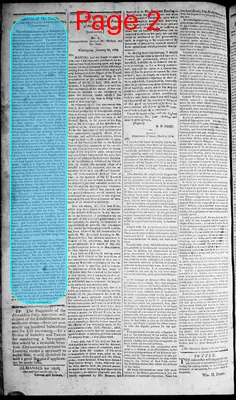
Literary
April 1, 1808
Alexandria Daily Advertiser
Alexandria, Virginia
What is this article about?
Mr. Custis addresses the U.S. people on the Arlington improved American long woolled sheep, derived from Mount Vernon stock including Persian imports. He highlights their superior wool, form, feeding efficiency, and profitability, urging agricultural improvement for national benefit.
Clipping
OCR Quality
98%
Excellent
Full Text
Address of Mr. Custis.
TO THE PEOPLE OF THE UNITED STATES.
[Continued.]
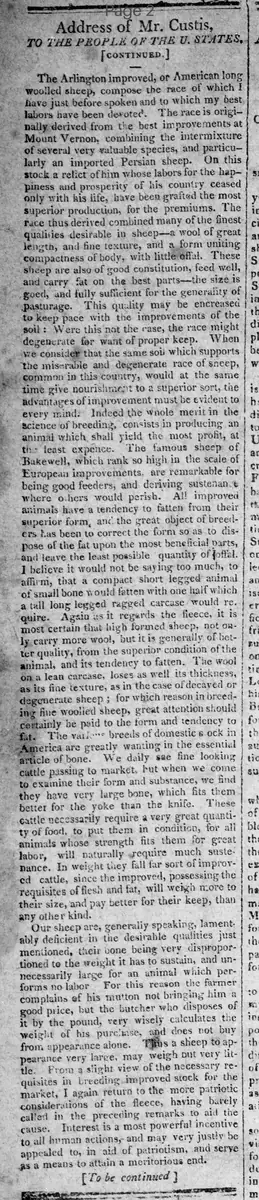
The Arlington improved, or American long woolled sheep, compose the race of which I have just before spoken and to which my best labors have been devoted. The race is originally derived from the best improvements at Mount Vernon, combining the intermixture of several very valuable species, and particularly an imported Persian sheep. On this stock a relict of him whose labors for the happiness and prosperity of his country ceased only with his life, have been grafted the most superior production, for the premiums. The race thus derived combined many of the finest qualities desirable in sheep--a wool of great length, and fine texture, and a form uniting compactness of body, with little offal. These sheep are also of good constitution, feed well, and carry fat on the best parts--the size is good, and fully sufficient for the generality of pasturage. This quality may be increased to keep pace with the improvements of the soil: Were this not the case, the race might degenerate for want of proper keep. When we consider that the same soil which supports the miserable and degenerate race of sheep, common in this country, would at the same time give nourishment to a superior sort, the advantages of improvement must be evident to every mind. Indeed the whole merit in the science of breeding, consists in producing an animal which shall yield the most profit, at the least expense. The famous sheep of Bakewell, which rank so high in the scale of European improvements, are remarkable for being good feeders, and deriving sustenance where others would perish. All improved animals have a tendency to fatten from their superior form, and the great object of breeders has been to correct the form so as to dispose of the fat upon the most beneficial parts, and leave the least possible quantity of offal. I believe it would not be saying too much, to affirm, that a compact short legged animal of small bone would fatten with one half which a tall long legged ragged carcase would require. Again as it regards the fleece, it is most certain that high formed sheep, not only carry more wool, but it is generally of better quality, from the superior condition of the animal, and its tendency to fatten. The wool on a lean carcase, loses as well its thickness, as its fine texture, as in the case of decayed or degenerate sheep; for which reason in breeding fine woolled sheep, great attention should certainly be paid to the form and tendency to fat. The various breeds of domestic stock in America are greatly wanting in the essential article of bone. We daily see fine looking cattle passing to market, but when we come to examine their form and substance, we find they have very large bone, which fits them better for the yoke than the knife. These cattle necessarily require a very great quantity of food, to put them in condition, for all animals whose strength fits them for great labor, will naturally require much sustenance. In weight they fall far short of improved cattle, since the improved, possessing the requisites of flesh and fat, will weigh more to their size, and pay better for their keep, than any other kind. Our sheep are, generally speaking, lamentably deficient in the desirable qualities just mentioned, their bone being very disproportioned to the weight it has to sustain, and unnecessarily large for an animal which performs no labor. For this reason the farmer complains of his mutton not bringing him a good price, but the butcher who disposes of it by the pound, very wisely calculates the weight of his purchase, and does not buy from appearance alone. Thus a sheep to appearance very large, may weigh out very little. From a slight view of the necessary requisites in breeding improved stock for the market, I again return to the more patriotic considerations of the fleece, having barely called in the preceding remarks to aid the cause. Interest is a most powerful incentive to all human actions,-- and may very justly be appealed to, in aid of patriotism, and serve as a means to attain a meritorious end.
[To be continued]
TO THE PEOPLE OF THE UNITED STATES.
[Continued.]
The Arlington improved, or American long woolled sheep, compose the race of which I have just before spoken and to which my best labors have been devoted. The race is originally derived from the best improvements at Mount Vernon, combining the intermixture of several very valuable species, and particularly an imported Persian sheep. On this stock a relict of him whose labors for the happiness and prosperity of his country ceased only with his life, have been grafted the most superior production, for the premiums. The race thus derived combined many of the finest qualities desirable in sheep--a wool of great length, and fine texture, and a form uniting compactness of body, with little offal. These sheep are also of good constitution, feed well, and carry fat on the best parts--the size is good, and fully sufficient for the generality of pasturage. This quality may be increased to keep pace with the improvements of the soil: Were this not the case, the race might degenerate for want of proper keep. When we consider that the same soil which supports the miserable and degenerate race of sheep, common in this country, would at the same time give nourishment to a superior sort, the advantages of improvement must be evident to every mind. Indeed the whole merit in the science of breeding, consists in producing an animal which shall yield the most profit, at the least expense. The famous sheep of Bakewell, which rank so high in the scale of European improvements, are remarkable for being good feeders, and deriving sustenance where others would perish. All improved animals have a tendency to fatten from their superior form, and the great object of breeders has been to correct the form so as to dispose of the fat upon the most beneficial parts, and leave the least possible quantity of offal. I believe it would not be saying too much, to affirm, that a compact short legged animal of small bone would fatten with one half which a tall long legged ragged carcase would require. Again as it regards the fleece, it is most certain that high formed sheep, not only carry more wool, but it is generally of better quality, from the superior condition of the animal, and its tendency to fatten. The wool on a lean carcase, loses as well its thickness, as its fine texture, as in the case of decayed or degenerate sheep; for which reason in breeding fine woolled sheep, great attention should certainly be paid to the form and tendency to fat. The various breeds of domestic stock in America are greatly wanting in the essential article of bone. We daily see fine looking cattle passing to market, but when we come to examine their form and substance, we find they have very large bone, which fits them better for the yoke than the knife. These cattle necessarily require a very great quantity of food, to put them in condition, for all animals whose strength fits them for great labor, will naturally require much sustenance. In weight they fall far short of improved cattle, since the improved, possessing the requisites of flesh and fat, will weigh more to their size, and pay better for their keep, than any other kind. Our sheep are, generally speaking, lamentably deficient in the desirable qualities just mentioned, their bone being very disproportioned to the weight it has to sustain, and unnecessarily large for an animal which performs no labor. For this reason the farmer complains of his mutton not bringing him a good price, but the butcher who disposes of it by the pound, very wisely calculates the weight of his purchase, and does not buy from appearance alone. Thus a sheep to appearance very large, may weigh out very little. From a slight view of the necessary requisites in breeding improved stock for the market, I again return to the more patriotic considerations of the fleece, having barely called in the preceding remarks to aid the cause. Interest is a most powerful incentive to all human actions,-- and may very justly be appealed to, in aid of patriotism, and serve as a means to attain a meritorious end.
[To be continued]
What sub-type of article is it?
Essay
What themes does it cover?
Agriculture Rural
Commerce Trade
Patriotism
What keywords are associated?
Sheep Breeding
Agricultural Improvement
Mount Vernon
Wool Quality
American Livestock
Profit In Farming
Patriotism In Agriculture
What entities or persons were involved?
Mr. Custis
Literary Details
Title
Address Of Mr. Custis. To The People Of The United States.
Author
Mr. Custis
Subject
On The Arlington Improved American Long Woolled Sheep
Form / Style
Prose Essay On Sheep Breeding And Agricultural Improvement
Key Lines
The Race Is Originally Derived From The Best Improvements At Mount Vernon, Combining The Intermixture Of Several Very Valuable Species, And Particularly An Imported Persian Sheep.
Indeed The Whole Merit In The Science Of Breeding, Consists In Producing An Animal Which Shall Yield The Most Profit, At The Least Expense.
I Again Return To The More Patriotic Considerations Of The Fleece, Having Barely Called In The Preceding Remarks To Aid The Cause.